

The Scent of Italian Elegance
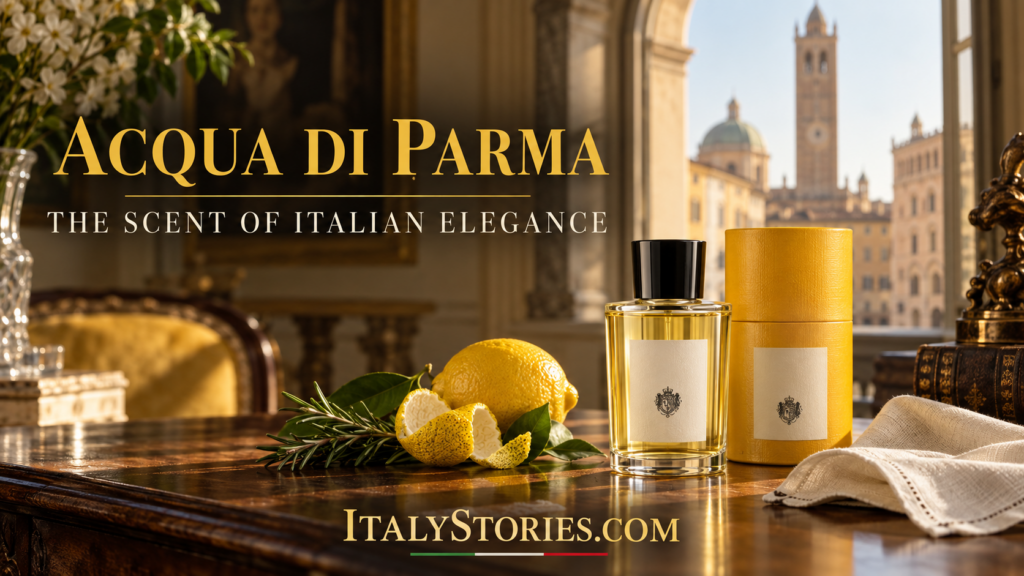
Some luxury brands announce themselves with extravagance. Acqua di Parma has always preferred another language: sunlight, simplicity, impeccable proportions and the unmistakable freshness of citrus. Its story began in Parma in 1916, when Baron Carlo Magnani created a personal fragrance that was strikingly different from the heavy perfumes fashionable in Europe at the time. That fragrance was Colonia, a luminous composition destined to become one of the most enduring symbols of Italian elegance.
More than a century later, the transparent Art Deco bottle, black cap and vivid yellow presentation box remain instantly recognizable. Yet Acqua di Parma is more than a famous fragrance house. It represents a particular Italian understanding of luxury—one founded on balance, craftsmanship and the ability to transform an ordinary daily ritual into a moment of beauty.
A Modern Fragrance Born in Parma
At the beginning of the twentieth century, Parma was already a city of refinement. Its historic streets, elegant theatres, musical traditions and aristocratic residences had produced a culture in which beauty was never considered superficial. Architecture, food, music and craftsmanship were all expressions of the same search for harmony.
It was in this atmosphere that Baron Carlo Magnani imagined a fragrance for himself and a small circle of friends. Rather than following the dominant fashion for dark, intense and highly concentrated perfumes, he wanted something fresher and more spontaneous—a scent that would feel clean, energetic and modern.
Colonia opened with the brilliance of lemon, sweet orange and Calabrian bergamot. Lavender, rosemary, verbena and rose gave the fragrance an aromatic heart, while vetiver, sandalwood and patchouli provided warmth and structure. The result was light but not simple, refreshing but never ordinary.
Its character was immediately Italian. The fragrance suggested the golden light falling across the walls of Parma, the scent of citrus peel, freshly pressed linen and herbs warmed by the Mediterranean sun. It was elegant without being formal and luxurious without appearing ostentatious.
That quiet originality would become the foundation of the entire Acqua di Parma identity.
The Fragrance of Italian Tailoring
Colonia’s early success was closely connected to the world of Italian tailoring. In an age when clothing was made to measure and personal presentation was governed by subtle codes, fragrance formed part of a gentleman’s wardrobe.
Tailors reportedly used the cologne to perfume handkerchiefs and freshly prepared garments. A discreet trace of citrus and aromatic herbs complemented the clean lines of a tailored suit without overwhelming it. Colonia became the invisible finishing touch—something noticed only when the wearer passed close by.
This association reveals an essential aspect of Italian style. True elegance is often found in details that are not immediately visible: the hand-finished seam inside a jacket, the perfect weight of a fabric, the polish on a pair of shoes or the fragrance left behind in a room.
Acqua di Parma belonged naturally to this universe. It did not attempt to dominate the wearer. Instead, it completed an image of confidence, restraint and good taste.
Although cologne was traditionally marketed toward men, Colonia’s balance and freshness allowed it to transcend rigid distinctions. Its citrus opening and aromatic heart gave it a universal character. Long before unisex fragrances became a modern category, Colonia was already appreciated by anyone attracted to its clean and luminous personality.
From Italy to the International Stage
During the 1930s, Acqua di Parma entered its first golden age. As Italian fashion, cinema and design gained international visibility, Colonia became associated with a sophisticated European lifestyle.
Its reputation expanded through personal recommendation rather than aggressive publicity. Members of aristocratic society, international travellers and performers discovered the fragrance in Italy and carried it abroad. Between the 1930s and the post-war years, it became a discreet favorite among prominent figures from the worlds of cinema and culture.
Hollywood’s relationship with Italy grew especially strong during the 1950s and 1960s. American actors and directors arrived in Rome, where Cinecittà studios offered grand sets, experienced technicians and an atmosphere that seemed both ancient and modern. Rome became known as “Hollywood on the Tiber,” while Italian tailoring, sports cars, hotels and restaurants helped define a new ideal of international glamour.
Acqua di Parma fitted perfectly into this world. Colonia was polished but relaxed, cosmopolitan yet unmistakably Italian. It belonged beside a tailored dinner jacket, a linen shirt, a convertible crossing Rome at night or an afternoon spent on the Amalfi Coast.
It was the olfactory expression of the dolce vita: not excess for its own sake, but the pleasure of living beautifully.
An Iconic Bottle and the Power of Yellow
The visual identity of Acqua di Parma is almost as important as the fragrance itself. The transparent bottle, influenced by Art Deco design, communicates clarity and order. Its clean geometric form allows the golden liquid to become part of the composition, while the black cap introduces a note of formal contrast.
Nothing is unnecessarily decorative. Like a well-designed Italian object, the bottle achieves distinction through proportion, material and restraint.
Then there is the yellow.
Acqua di Parma’s vibrant yellow packaging has become one of the most recognizable signatures in luxury perfumery. Warm, optimistic and full of energy, it evokes sunlight on the ochre and golden façades of Italian cities. It also reflects the citrus ingredients at the heart of Colonia.
The famous cylindrical hatbox turns opening a fragrance into a ceremony. Its shape recalls the elegance of early twentieth-century travel, when personal possessions were carried in carefully constructed cases and even practical objects were expected to possess beauty.
Over time, this combination of transparent glass, black details and intense yellow became a complete visual language. It allowed Acqua di Parma to be recognized from across a room without relying on oversized logos or theatrical decoration.
The packaging communicates precisely what the fragrance expresses: radiance disciplined by elegance.
Decline and an Italian Renaissance
Like many historic houses, Acqua di Parma experienced periods of changing fortune. Consumer habits evolved, international perfume companies grew more powerful and the market increasingly favored large advertising campaigns and constantly changing launches.
By the late twentieth century, Colonia retained its prestige but had become less visible. It risked surviving merely as a beautiful memory from another era.
The decisive transformation came in 1993, when Italian entrepreneurs Luca Cordero di Montezemolo, Diego Della Valle and Paolo Borgomanero joined forces to revive the brand. Their objective was not to turn Acqua di Parma into a nostalgic reproduction of its past. They recognized that its history, craftsmanship and understated identity could speak powerfully to contemporary consumers.
The revival preserved Colonia as the heart of the house while placing it within a broader idea of Italian living. Acqua di Parma gradually expanded into personal-care products, shaving accessories, home fragrances, candles, travel objects and handcrafted leather goods.
This was a thoughtful evolution. Rather than treating perfume as an isolated product, the company presented fragrance as part of a complete environment—a way of dressing, travelling, welcoming guests and caring for one’s surroundings.
In 2001, Acqua di Parma became part of the LVMH group. The new ownership provided the international structure required to expand the house while maintaining its Italian character. Today, the brand continues to present itself as an expression of Italian craftsmanship and contemporary artistry, with its creations produced in Italy.
Colonia: A Composition Built Around Light
The enduring appeal of Colonia lies in the way its ingredients create movement.
Lemon, sweet orange and Calabrian bergamot provide the first impression. Their brightness is immediate, but the effect is more refined than the simple smell of fresh fruit. Bergamot contributes a floral, slightly bitter elegance, while lemon introduces clarity and orange adds softness.
As the opening develops, lavender, rose, verbena and rosemary emerge. Lavender creates a bridge between cleanliness and tradition. Rosemary brings an aromatic Mediterranean quality, recalling herbs growing in dry coastal landscapes. Rose contributes delicacy, while verbena reinforces the green citrus character.
Vetiver, sandalwood and patchouli form the base. These notes prevent the fragrance from becoming fleeting or excessively sharp. Vetiver gives dryness and structure, sandalwood provides warmth, and patchouli adds depth.
The composition follows the architecture of a classic eau de cologne, yet its proportions make it distinctive. Colonia does not rely on drama. Its strength comes from balance, much like a Renaissance façade or a perfectly cut suit.
The fragrance also changes according to context. In summer, its citrus notes can feel cooling and energetic. In colder weather, its aromatic and woody elements become more apparent. Worn formally, it suggests polished restraint; worn casually, it feels natural and effortless.
This versatility helps explain why a fragrance created in 1916 can still feel relevant.
A Wider Italian Landscape of Fragrance
While Colonia remains the central icon, Acqua di Parma has gradually created a much wider olfactory portrait of Italy.
The Blu Mediterraneo collection explores landscapes and ingredients associated with some of the country’s most evocative destinations. Orange recalls Capri, bergamot represents Calabria, myrtle evokes Panarea and fig suggests the Amalfi Coast. Rather than reproducing these places literally, the fragrances translate their atmosphere into scent: sea air, sun-warmed vegetation, citrus groves, shaded terraces and coastal gardens.
Other compositions examine flowers, woods, spices and precious materials through what the house describes as a sun-filled Italian perspective. The common element is luminosity. Even richer fragrances are constructed around clarity and contrast.
Home fragrances and candles extend this sensory world into domestic spaces. Leather accessories and decorative objects introduce the skills of Italian artisans, emphasizing careful material selection and hand-finished details.
This expansion demonstrates that Acqua di Parma is no longer simply the name of a cologne. It has become a vision of Italian life expressed through fragrance, color, objects and rituals.
Craftsmanship as a Form of Luxury
In contemporary culture, luxury is often confused with price, rarity or visible status. Acqua di Parma proposes a more traditional definition.
Luxury can be the pleasure of touching good paper, opening a beautifully constructed box or using an object whose proportions have been carefully considered. It can exist in the precise movement required to fold packaging, finish a leather surface or engrave a glass bottle.
These details are not always obvious in photographs. They reveal themselves gradually through use. That is precisely why they matter.
Italian craftsmanship has historically flourished in this territory between practicality and beauty. An object must fulfil its function, but it should also enrich the experience of the person who owns it. Acqua di Parma applies that principle to fragrance: the scent is the central creation, yet every element surrounding it contributes to the ritual.
The result is a form of luxury that feels human rather than intimidating.
Why Acqua di Parma Still Matters
Acqua di Parma has survived because it has never depended entirely on fashion. Trends in perfumery change constantly: sweet compositions replace austere ones, powerful fragrances give way to minimalism, and forgotten ingredients return under new names.
Colonia remains recognizable because it is based on an enduring emotional idea—the desire to feel refreshed, composed and ready for the day.
Its history also offers a lesson in successful Italian branding. The house possesses a clear place of origin, a distinctive founding product, memorable visual codes and an identity strong enough to evolve without becoming unrecognizable.
Most importantly, it communicates Italy without reducing the country to a collection of clichés. Its Italy is found in proportion, light, craftsmanship and ease. It is the Italy of a linen handkerchief, an ochre palace, a citrus grove and an elegant room illuminated by the morning sun.
More than a century after Baron Carlo Magnani created Colonia for his personal use, the fragrance continues to express the same attitude: modernity without noise, confidence without arrogance and beauty without excess.
That may be the true secret of Acqua di Parma. It does not simply offer the scent of Italy. It captures the Italian art of making refinement appear completely natural.
Follow ItalyStories.com to discover more remarkable stories about the people, places, traditions and creations that have made Italy an enduring source of beauty and inspiration.