

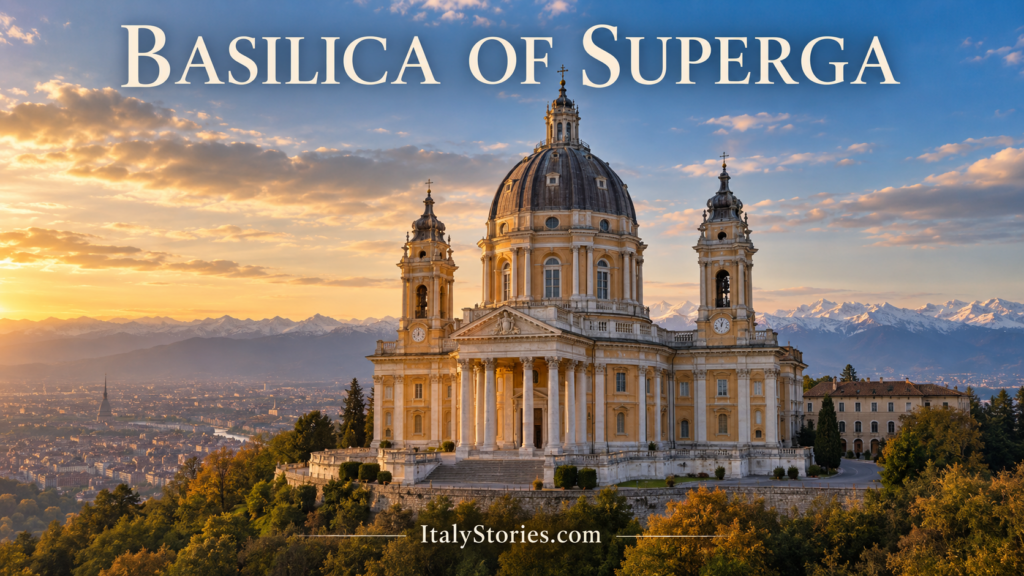
High above Turin, where the city gives way to wooded hills and the horizon opens towards the Alps, the Basilica of Superga seems to belong simultaneously to the sky and to history. Its great dome rises more than six hundred metres above sea level, visible from streets, squares and distant roads. On a clear day, the view from the hill embraces Turin and the long Alpine arc beyond it. Yet people do not climb to Superga for the panorama alone. They come for a royal promise, for one of the masterpieces of Italian Baroque architecture, for the tombs of the House of Savoy and for the memory of a football team whose name became a legend.
Few Italian monuments carry so many different emotions within the same walls. The Basilica of Superga is majestic but not cold, theatrical but never frivolous. It celebrates victory and dynastic power, yet it is also associated with one of the most painful moments in modern Italian history. Superga can be admired as architecture, visited as a church, explored as a royal mausoleum and approached in silence as a place of remembrance. Every one of these identities is genuine, and together they make the basilica one of the most powerful places in Piedmont.
The Promise Made Above a Besieged Turin
The story begins in 1706, during the War of the Spanish Succession. Turin was under siege by French forces, and the future of the Savoy state appeared uncertain. According to tradition, Duke Victor Amadeus II of Savoy and Prince Eugene of Savoy climbed the hill of Superga to observe the enemy positions and study the battlefield below. Inside a small existing chapel, Victor Amadeus made a vow to the Virgin Mary: if Turin were saved, he would build a great church in her honour on that hill.
The decisive battle took place on September 7, 1706, and ended with the defeat of the besieging army. The city was liberated, and the victory became a turning point for the House of Savoy. Victor Amadeus did not forget his promise. The project was entrusted to Filippo Juvarra, the brilliant Sicilian architect who would transform the image of Turin and become one of the greatest figures of European Baroque architecture.
Construction began in 1717. The location created enormous practical difficulties: the summit had to be prepared, materials had to be carried up the hill and an architectural complex of exceptional size had to be raised in a place exposed to wind and winter weather. Fourteen years later, in 1731, the sanctuary was inaugurated. Dedicated to the Nativity of the Virgin Mary, it was both the fulfilment of a religious vow and a declaration of the new royal status acquired by the Savoy dynasty after the Treaty of Utrecht.
Filippo Juvarra’s Theatre of Stone and Light
Juvarra understood that a building placed on Superga could not be designed as an ordinary church. It had to command the landscape. The basilica therefore combines a monumental classical portico, a soaring central dome and two symmetrical bell towers. From a distance, its silhouette is unmistakable. As visitors approach, the composition changes: the dome appears to rise behind the portico while the towers frame the façade, giving the entire complex an almost theatrical rhythm.
The architecture is grand, but Juvarra avoided turning it into a heavy mass. Columns, curved surfaces, openings and changes in height allow light to move continuously across the building. The dome draws the eye upwards, while the pale tones of the façade react beautifully to the changing sky. At sunrise and sunset, Superga can seem warm and golden; in winter mist, it becomes solemn and remote. Its position makes the weather part of the architecture.
Inside, the central plan creates an impression of harmony and vertical movement. The decorative richness belongs to the late Baroque, but the proportions remain controlled. Marble, sculptural details, chapels and altars contribute to a space conceived not only for worship but also for representation. This was a royal sanctuary, intended to speak about faith and authority at the same time.
The panorama explains why the hill was strategically important in 1706 and why Juvarra’s architecture works so powerfully here. Turin stretches below in an ordered pattern of avenues and rooftops, crossed by the Po and surrounded by a landscape that changes with every season. Beyond the city, the Alps form a vast natural wall. On the clearest days, the relationship between architecture, city and mountains is unforgettable.
The Royal Tombs of the House of Savoy
Beneath the basilica lies the Royal Crypt, one of the most important dynastic burial places in Italy. It contains the tombs and monuments of numerous members of the House of Savoy, the dynasty that ruled Piedmont and later played a central role in the unification of Italy. The crypt turns Superga from a commemorative church into a royal mausoleum.
The atmosphere below is very different from the light-filled spaces above. Monumental tombs, allegorical sculptures and carefully arranged chapels create a place of silence and ceremony. Dukes, princes, queens and kings are gathered within an artistic programme that presents death through the language of rank, memory and continuity. The Savoy family did not choose Superga simply as a cemetery. The crypt was a way of placing the dynasty within a sacred and historical narrative.
Not every ruler of united Italy is buried here. Victor Emmanuel II, the first king of Italy, and Umberto I rest in the Pantheon in Rome. Superga nevertheless remains deeply connected with the long history of the Savoy family before and after Italian unification. Walking through the crypt means moving through generations of a dynasty that shaped Turin’s palaces, avenues, institutions and political destiny.
The Hill Reached by a Historic Railway
Part of the charm of visiting Superga lies in the journey. The hill can be reached by road, but the most evocative approach is the historic Sassi–Superga line. Beginning in the Turin district of Sassi, the railway climbs through greenery towards the summit. The slow ascent allows the city to recede gradually, replacing traffic and buildings with trees, glimpses of the landscape and the growing expectation of the basilica above.
The line is not merely a means of transport. It belongs to the story of Turin and to the old European tradition of mountain railways built to connect cities with panoramic hills, sanctuaries and places of leisure. Arriving at Superga in this way gives the visit a natural rhythm: first the climb, then the sudden opening of the view, and finally the encounter with Juvarra’s façade.
The surrounding hill is also a place for walking and observing the Turin landscape from a different perspective. Superga stands within a green area that feels surprisingly distant from the city below, even though the centre of Turin is only a few kilometres away. This contrast is one of the reasons the site remains so memorable. It is close enough to belong to the city, yet high enough to seem removed from ordinary life.
The Day Superga Became Sacred to Italian Football
On May 4, 1949, Superga acquired another meaning, one that no architect or king could have imagined. A Fiat G.212 aircraft was bringing the Torino football team home from Lisbon, where the players had taken part in a friendly match. Turin was covered by cloud and rain, and visibility around the hill was extremely poor. The aircraft struck the rear retaining wall of the basilica. All thirty-one people on board were killed.
Among them were the players of the Grande Torino, one of the strongest and most admired teams in the history of Italian football. Led on the field by captain Valentino Mazzola, Torino had dominated the national championship during the 1940s and provided many players to the Italian national team. The disaster took the lives of footballers, coaches, club officials, journalists and crew members. It did not simply destroy a team. It interrupted a sporting era and left an entire country in mourning.
The wall at the back of the basilica became a memorial. Scarves, flowers, flags and handwritten messages are still left there by supporters. Every May 4, people climb to Superga to remember the victims. Torino fans lead the commemoration, but the respect extends far beyond club rivalry. The Grande Torino became part of Italy’s collective memory: a team remembered not only for its victories, but for the unity, confidence and hope it represented in a country emerging from war.
It would be easy to describe the tragedy with excessive drama, but Superga itself asks for restraint. The memorial is powerful precisely because it is simple. The names are there, the wall is there, and the silence of the hill does the rest. Visitors who know little about football often understand immediately that this is not an ordinary sporting monument. It is a place where private grief became national memory.
A Monument with Two Silences
The Basilica of Superga contains two very different silences. One lies beneath the church, among the royal tombs of a dynasty that helped create modern Italy. The other stands outside, beside the wall where the story of the Grande Torino ended. One silence belongs to centuries of ceremonial history; the other remains painfully close, renewed every year by flowers and voices.
Between them rises Juvarra’s dome, still dominating Turin as it has for nearly three centuries. Superga is therefore much more than a beautiful viewpoint or a masterpiece to be photographed. It is a place where the ambitions of kings, the genius of an architect, religious devotion, the identity of a city and the love for a football team meet on the same hill.
Perhaps that is why the descent towards Turin feels different from the climb. After seeing the city from above, entering the Royal Crypt and standing before the memorial, the visitor carries away more than an image. Superga reminds us that monuments do not preserve only stone. They preserve promises, victories, losses and the people whom a community refuses to forget.
Follow ItalyStories.com to discover more Italian cities, places, characters and traditions hidden beyond the usual postcards.