

The discreet northern capital that helped invent modern Italy
Turin is one of Italy’s most underrated revelations. Perhaps this is because it does not advertise itself with the same insistence as some other cities. It is elegant, but in a measured way. It is historic, but rarely theatrical about it. It is beautiful, but often with the calm confidence of a place that knows exactly what it is and feels no need to perform for passing applause. Set between the Po River and the distant Alpine arc, Turin has long possessed a character of discipline, reserve and intellectual depth. It is a city of arcades and geometry, of chocolate and industry, of royal palaces and workers’ neighborhoods, of cinema, cars, political thought and quiet grandeur. It helped shape the modern Italian state, and yet many first-time visitors arrive with no clear idea of just how much the city has done. Turin, one suspects, is not offended by this. It has always preferred substance to noise.
The origins of Turin reach back to ancient settlement by the Taurini, a Celtic-Ligurian people whose name still echoes in the city’s identity. The Romans later established Augusta Taurinorum, probably in the late first century BC, creating a military colony laid out with the familiar Roman grid. Remarkably, that ancient rational order still influences the city center today. Turin’s straight streets and urban clarity are not an accident of modern planning; they descend from Rome. After the imperial era, the city passed through the usual sequence of upheavals and powers that marked northern Italy, but it remained a strategically valuable place at the western gateway of the peninsula.
The truly decisive turn came with the House of Savoy. In 1563 Duke Emmanuel Philibert moved the ducal capital from Chambéry to Turin, and the city began its transformation into one of Europe’s notable court capitals. Over the following centuries, the Savoy rulers reshaped Turin with extraordinary coherence. Architects such as Guarino Guarini, Filippo Juvarra and later Benedetto Alfieri gave the city its Baroque and monumental profile. Piazzas opened with measured elegance, churches rose with daring domes, palaces multiplied and a sense of ordered magnificence took hold. Piazza Castello became the symbolic heart of power, surrounded by the Palazzo Reale, Palazzo Madama and later the institutions that would shape the city’s political role. Turin is one of the very few Italian cities whose monumental identity feels almost orchestrated, as if it had been composed rather than merely accumulated.
That courtly identity also involved war and sacrifice. Turin’s history includes sieges, most famously the siege of 1706 during the War of the Spanish Succession, when the city resisted French forces. The figure of Pietro Micca, the soldier who sacrificed himself in the tunnels beneath the citadel to help repel the enemy advance, entered local legend and national memory. Not far from the city, the Basilica of Superga stands high above the plain, both as a Baroque masterpiece and as a site of layered memory. It was commissioned by Victor Amadeus II after the victory over the French, and centuries later it became tragically associated with the 1949 air disaster that killed the Grande Torino football team, a wound still deeply felt in the city. Turin remembers in a sober way, but it remembers intensely.
In the nineteenth century Turin stepped into an even larger role. It became the first capital of the Kingdom of Italy in 1861, after unification, and remained so until 1865. This was a relatively brief period, but a profoundly important one. Turin was the city from which the new Italian state first tried to organize itself. Cavour, one of the architects of unification, was inseparable from Turin’s political culture, and the city’s administrative seriousness suited the task of building institutions. If Rome later became the symbolic and historical capital of the nation, Turin retains the distinction of having been the first. It helped invent modern Italy before politely stepping aside.
The city’s architecture still tells this story with great eloquence. The Royal Palace and the Savoy residences speak of dynasty and ceremony. Palazzo Madama embodies centuries of transformation, from Roman gate to medieval fortress to Baroque residence. The Palazzo Carignano, with its undulating brick façade, is one of the great masterpieces of Italian Baroque and the birthplace of King Victor Emmanuel II. The Cathedral of Saint John the Baptist houses the Holy Shroud, one of Christianity’s most discussed and venerated relics. Faithful believers regard it with devotion, while scholars and scientists continue to debate aspects of its history and dating. Turin, characteristically, contains both reverence and inquiry without requiring them to shout at one another.
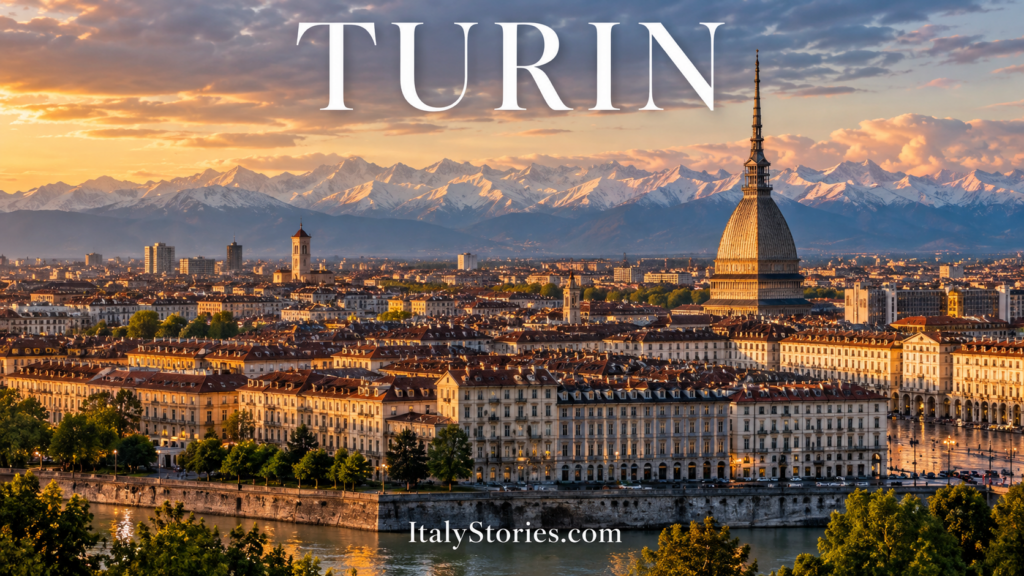
Then there is the Mole Antonelliana, perhaps the city’s most iconic symbol. Originally conceived in the nineteenth century as a synagogue, it became through changing circumstances and bold engineering a uniquely Turin landmark, with its soaring spire dominating the skyline. Today it houses the National Museum of Cinema, an ideal home in a city that was one of the birthplaces of Italian cinema. This is another side of Turin often overlooked: it is not merely industrial or administrative, but deeply cultural. The Egyptian Museum is one of the most important collections of Egyptian antiquities outside Egypt. The city’s museums, libraries and cultural institutions reveal an intellectual ambition equal to its architectural one.
Of course, Turin cannot be understood without industry. In 1899 FIAT was founded here, and the city became the heart of Italy’s automotive revolution. Factories, engineers, assembly lines and working-class neighborhoods reshaped Turin in the twentieth century. The Lingotto factory, once one of the symbols of industrial modernity with its rooftop test track, remains among the most extraordinary pieces of industrial architecture in Europe. Turin drew migrants from across Italy, especially from the south, turning it into a city of internal migration, labor politics and social change. The elegant capital of Savoy also became the city of workers, unions, postwar growth and the contradictions of modern industrial life. This dual identity is essential to Turin. It is aristocratic and proletarian, ceremonial and practical, polished and deeply real.
Its neighborhoods reflect this diversity. The Quadrilatero Romano, near the ancient core, offers history, nightlife and urban intimacy. San Salvario, once known for other reasons, has become one of the city’s liveliest and most multicultural districts, full of restaurants, bars and contemporary energy. Crocetta suggests bourgeois elegance, while areas linked to former industry reveal different chapters of the city’s social story. Along the Po and in Borgo Po, Turin softens into greener and more residential moods. The long arcaded streets make walking possible in almost all weather, another sign that Turin was designed by people who preferred civilization to improvisation.
Turin’s food is one of its most persuasive arguments. This is a city where chocolate achieved philosophical seriousness. Gianduiotto, bicerin and the long tradition of café culture give Turin a sweet and caffeinated dignity few places can match. Historic cafés such as Caffè Al Bicerin or the grand central establishments once hosted politicians, writers, officers and conspirators, all fortified by coffee, chocolate and opinion. Savory cuisine is equally rich. Agnolotti, vitello tonnato, bollito misto, finanziera and the broader Piedmontese tradition of refined yet substantial cooking speak of a region where agriculture, court culture and bourgeois taste collaborated effectively. Turin is also linked to vermouth, born here in the eighteenth century and now one of the city’s elegant liquid signatures. An aperitivo in Turin is not merely a pre-dinner habit. It is a local art form conducted with appropriate seriousness.
There are also curiosities that add another layer to the city’s reputation. Turin is often associated, in popular lore, with both white and black magic, as part of esoteric triangles that connect it to other European cities. These stories belong to urban mythology rather than documented civic history, but they persist because Turin’s atmosphere seems capable of hosting them. Its wide avenues, mists, river views and stately architecture create a setting in which rational order and mysterious suggestion can coexist surprisingly well. It is a city where enlightenment and secrecy have always seemed on speaking terms.
Tourism in Turin has grown significantly, especially since the 2006 Winter Olympics, which helped bring renewed international attention to the city. Yet Turin remains less overwhelmed than many Italian destinations, and this can be one of its great pleasures. Visitors can explore major museums, royal residences, churches and markets with a feeling of space still available to thought. The city’s relationship with tourism is therefore healthier than in many places: it welcomes interest without appearing conquered by it. At the same time, Turin continues to evolve as a center for innovation, higher education, aerospace, design and culture, proving that its future is not built on nostalgia alone.
What makes Turin different from other Italian cities is its unusual combination of reserve and richness. Rome proclaims, Venice seduces, Florence harmonizes, Naples erupts, Milan accelerates. Turin reflects. It offers grandeur without chaos, elegance without vanity and history without excessive dramatization. It is perhaps the most quietly sophisticated of Italy’s major cities. The longer one stays, the more it gives.
Anyone visiting Turin should walk under the arcades, cross Piazza Castello, look up at the Mole, enter the Egyptian Museum, consider the Royal Palace, pause in front of Palazzo Carignano, and climb or drive up to Superga for the views over city and Alps. They should spend time in a historic café, taste bicerin, and allow the city’s rhythm to work its effect. Turin is not best consumed quickly. It is a city of measured appreciation.
Today Turin remains a major Italian city, influential in culture, education, manufacturing, innovation and national memory. It bears the marks of its royal past and its industrial twentieth century, while continuing to reinvent itself for new generations. It is a place of broad avenues and intimate cafés, rigorous façades and warm kitchens, serious history and understated charm. In an age that often confuses loudness with importance, Turin offers an elegant correction.
If you have visited Turin, tell us what stayed with you most: the view from Superga, the arcades at dusk, the Mole Antonelliana, a cup of bicerin, the grandeur of Piazza Castello, or the quiet feeling that the city had much more to say than it initially revealed. And if you enjoy discovering Italy through stories told from an Italian point of view, follow Made in Italy Stories. We tell you about Italy, as Italians.
[…] stato un tempo in cui, a Torino, bastava guardare l’orologio senza averne uno al polso. Quando le porte di Mirafiori si aprivano, […]
[…] above Turin, where the city gives way to wooded hills and the horizon opens towards the Alps, the Basilica of […]