

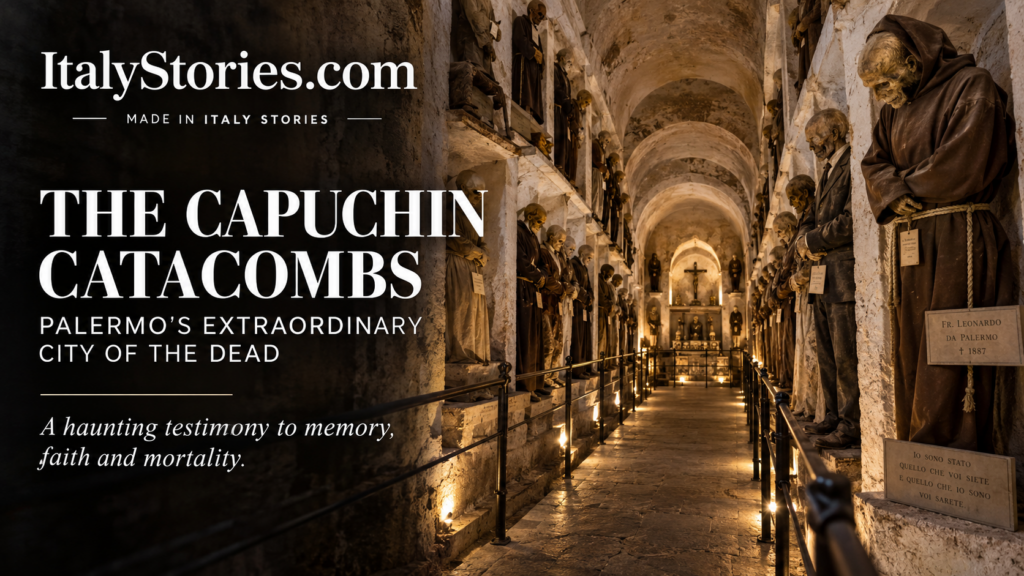
Palermo is a city that rarely hides its contradictions. Gold mosaics shine above crowded streets, Norman towers rise beside Baroque churches, elegant palaces stand only a few steps from noisy markets, and beauty often appears where visitors least expect it. Yet beneath the Capuchin convent, away from the sunlight and the restless sounds of the Sicilian capital, there is another Palermo: silent, motionless and unsettlingly human. This is the world of the Capuchin Catacombs, one of Italy’s most extraordinary historical places and perhaps the closest thing Europe possesses to an entire city inhabited by the dead.
The first sensation on entering is not simply fear. It is disorientation. The underground corridors are lined with men, women, priests, monks and children who died centuries ago but still wear the clothes chosen for them by their families. Some stand against the walls; others lie in coffins or rest inside glass cases. Their jackets, dresses, uniforms, religious habits and embroidered garments have faded, but they still communicate social position, profession, age and personal identity. These people were not reduced to anonymous bones. They remained members of Palermo society even after death, arranged according to the same distinctions that had shaped their lives.
The catacombs are not ancient Roman ruins, despite what their name sometimes leads visitors to imagine. Their story began at the end of the sixteenth century, when the cemetery used by the Capuchin friars had become too small. The monks needed more space, so they excavated new underground chambers beneath their convent. The environmental conditions inside those chambers produced an unexpected result: some bodies decomposed much more slowly than usual. The dry air, the porous walls and the particular circulation of air encouraged natural dehydration.
In 1599, the body of Brother Silvestro da Gubbio was placed in the new cemetery. He is traditionally considered the earliest mummy still preserved in the catacombs. His survival marked the beginning of a practice that would transform a simple monastic burial place into one of the most remarkable collections of human remains in the world. At first, the privilege belonged only to the Capuchin friars. Gradually, however, wealthy citizens, benefactors, members of the clergy and representatives of Palermo’s most influential families began asking to be buried there.
News of the naturally preserved bodies spread through the city. What had begun as a practical solution to a shortage of space acquired a deeper social and religious meaning. To be placed in the Capuchin Catacombs became a sign of prestige, but it was also seen as a way of remaining close to the living. Death did not necessarily mean disappearance. Families could visit their relatives, pray in front of them and continue to recognise them as part of the household. By the eighteenth century, requests had become so numerous that the friars expanded the underground cemetery, creating new galleries and sections.
In 1783, burial in the catacombs was formally opened to a broader group of people who requested it and could meet the necessary conditions. The result was an astonishing portrait of Palermo between the seventeenth and nineteenth centuries. The corridors developed into a carefully organised social map. There were areas for monks and priests, men and women, children, unmarried women and professionals. Judges, doctors, soldiers, merchants, artists and members of the aristocracy were placed in sections reflecting the roles they had occupied in life.
Today, the catacombs preserve around two thousand skeletons and mummified bodies. Walking through their galleries is like entering a historical archive in which the documents have faces. The clothing reveals changes in fashion, wealth and social ambition. Military uniforms recall political conflicts and foreign powers. Clerical vestments reflect the central position of the Church. Women appear in silk gowns, bonnets and carefully decorated dresses, while men wear coats, waistcoats and formal suits. Children are dressed with particular tenderness, sometimes in their finest clothes, as though prepared for a ceremony that never ended.
The method used to preserve many of these bodies was relatively simple, although it required time, experience and suitable environmental conditions. The deceased were placed in special rooms, often on racks positioned above ceramic pipes, where the bodies slowly lost moisture. This natural drying process could take many months. Once dehydration was complete, the remains might be washed with vinegar, dressed and placed in the galleries. In some cases, the bodies were treated with chemical substances or subjected to more complex embalming procedures. During periods of epidemic, different methods were sometimes adopted to reduce the risk associated with handling the dead.
Not every person in the catacombs was preserved in the same way, and not every body survived equally well. Some retain recognisable facial features, hair, moustaches or fragments of skin. Others have become skeletal figures held together by their clothing. Time has treated them differently, just as life once did. This variety makes the experience more powerful because the catacombs do not resemble a theatrical display created all at once. They are the result of several centuries of changing customs, techniques and attitudes towards death.
The families often decided how their relatives should appear. A person could be dressed in formal clothes, a professional uniform or garments carrying a religious meaning. Some requested in their wills that their clothes be changed periodically. Relatives contributed to the maintenance of the body and its position in the catacombs. As long as payments and donations continued, the deceased remained prominently displayed. If a family stopped contributing, the body might be moved to a less prestigious location. Even underground, therefore, Palermo’s social hierarchy did not entirely disappear.
To modern eyes, this arrangement may appear disturbing, but it belonged to a culture in which death was much more visible than it is today. Families commonly mourned at home, religious processions passed through city streets, and churches frequently contained tombs, relics and reminders of mortality. The boundary between everyday life and the world of the dead was less rigid. The Capuchin Catacombs expressed the Christian belief that the body was temporary while the soul continued its journey, yet they also revealed a profoundly human desire to resist separation.
Parents wanted to see their children again. Husbands and wives wanted to preserve familiar faces. Important citizens wished to retain their public identities. Religious men hoped their bodies would remind visitors to pray and reflect on the brevity of earthly life. Vanity, grief, faith and affection met in the same corridors. It would be too simple to describe the catacombs merely as macabre. They are also a monument to the difficulty human beings have always faced in accepting that someone loved can vanish completely.
Among all the people resting beneath the convent, one child has become the most famous. Rosalia Lombardo died in Palermo in 1920, shortly before her second birthday. According to the traditional account, her grieving father asked the embalmer Alfredo Salafia to preserve her body. Salafia was already known for his exceptional technical ability, but the result achieved with Rosalia was extraordinary. More than a century later, she still appears to be asleep.
Rosalia lies inside a small glass-covered coffin in the Chapel of Santa Rosalia. A bow rests in her light-coloured hair, her face appears peaceful, and her eyelashes remain visible. Her preservation is so remarkable that she became known as the “Sleeping Beauty of Palermo.” Unlike many of the older mummies, whose survival depended largely on natural dehydration, Rosalia was preserved through a carefully prepared chemical formula.
Research into Salafia’s handwritten notes revealed that his solution included formalin, glycerine, alcohol, salicylic acid and zinc salts. Each substance performed a different function: limiting bacterial activity, preventing excessive drying, controlling fungal growth and giving the tissues a degree of rigidity. The body was not emptied of its internal organs, as people sometimes imagine. Modern examinations have shown that they remained remarkably intact.
For years, visitors reported that Rosalia appeared to open and close her eyes. The story encouraged rumours that something mysterious was occurring inside the coffin. The explanation is less supernatural but still fascinating. Her eyelids were never entirely closed, and changes in light entering the room can reveal more or less of the eyes beneath them, creating the impression of movement. It is a powerful optical effect, strengthened by the emotion of standing before a child whose face seems untouched by time.
Rosalia was among the final people admitted to the cemetery and became the symbol of its closing chapter. The catacombs had officially ceased to function as an active burial place decades earlier, although a small number of later interments were permitted. By the early twentieth century, attitudes towards public health, burial and the display of human remains had changed profoundly. The underground city stopped growing, leaving its silent population suspended between history and memory.
Yet the catacombs are not merely a collection of curiosities from a distant age. They are an invaluable source of information about the people of Sicily. Clothing, teeth, bones, soft tissues and traces of disease can help researchers understand diet, health, working conditions and medical practices. Scientific projects have used X-rays, CT scans and other non-destructive techniques to study the remains while treating them with dignity. The bodies can reveal evidence of illness, physical development and the living conditions experienced by different social groups.
This scientific work also raises difficult ethical questions. These are not objects manufactured for a museum; they are human beings who once had names, relationships and personal histories. Many were displayed according to the wishes of their families, but they could never have imagined modern tourism, photography or worldwide media exposure. The catacombs therefore ask visitors for something more demanding than curiosity: respect.
Photography inside is prohibited, and that rule has a meaning beyond the protection of the remains. It discourages the transformation of the dead into souvenirs or backgrounds for amusing pictures. The experience is intended to be observed quietly. The iron barriers separating visitors from the bodies are a modern necessity, but they also create a clear moral boundary. One may look, study and remember, but not treat these people as decorations in a horror attraction.
The Capuchin Catacombs belong completely to Palermo because they contain the city’s history in an unusually direct form. Above ground, Palermo tells its story through architecture: Arab courtyards, Norman churches, Spanish façades, aristocratic palaces and crowded working-class districts. Below ground, the same story is told through bodies and clothes. The city’s professions, traditions, religious beliefs and divisions of class are all present. The catacombs are a society preserved after its final breath.
They also reveal something important about Sicily’s relationship with memory. On an island repeatedly transformed by invasion, migration, earthquakes, epidemics and political upheaval, the past is never entirely gone. It survives in buildings, family names, recipes, rituals, languages and stories. In the Capuchin corridors, that persistence becomes physical. The past does not simply leave a trace; it stands in front of us.
Visitors may enter expecting a frightening experience, but many leave with a different emotion. The initial shock gradually gives way to attention. Details begin to emerge: a pair of shoes, a carefully tied ribbon, the remains of a fashionable jacket, a priest’s vestments, a child’s small hands. These objects restore a fragment of individuality to people separated from us by centuries. They remind us that those silent figures once walked through Palermo’s streets, heard its church bells, bargained in its markets, celebrated marriages, worried about money, raised children and looked at the same Sicilian sky.
The catacombs do not promise immortality. In fact, they demonstrate the opposite. Clothes collapse, colours disappear and even carefully preserved bodies continue to change. Nothing completely defeats time. But memory can delay oblivion, and storytelling can return identity to those who might otherwise become anonymous remains.
That is why the Capuchin Catacombs are far more than one of Italy’s strangest places. They are a historical document, a religious space, a scientific archive and a deeply emotional portrait of a city. They show how Palermo’s people confronted loss, expressed status, protected family bonds and imagined the relationship between body and soul.
In the final corridor, silence seems heavier than it did at the entrance. The dead no longer appear like a crowd of frightening strangers. They resemble inhabitants of another Palermo, waiting patiently beneath the modern city. Above them, traffic moves, markets open, families gather around tables and life continues with all its noise and disorder. Below, centuries remain still.
The Capuchin Catacombs leave visitors with an uncomfortable but necessary thought: every person becomes part of history, even when history forgets the person’s name. These men, women and children have endured not because they conquered countries or built empires, but because someone once refused to let them disappear. Their extraordinary city of the dead is ultimately a story about the living—their love, their fear, their faith and their eternal need to remember.
Follow ItalyStories.com to discover more extraordinary places, forgotten traditions, remarkable people and hidden stories from every corner of Italy.