

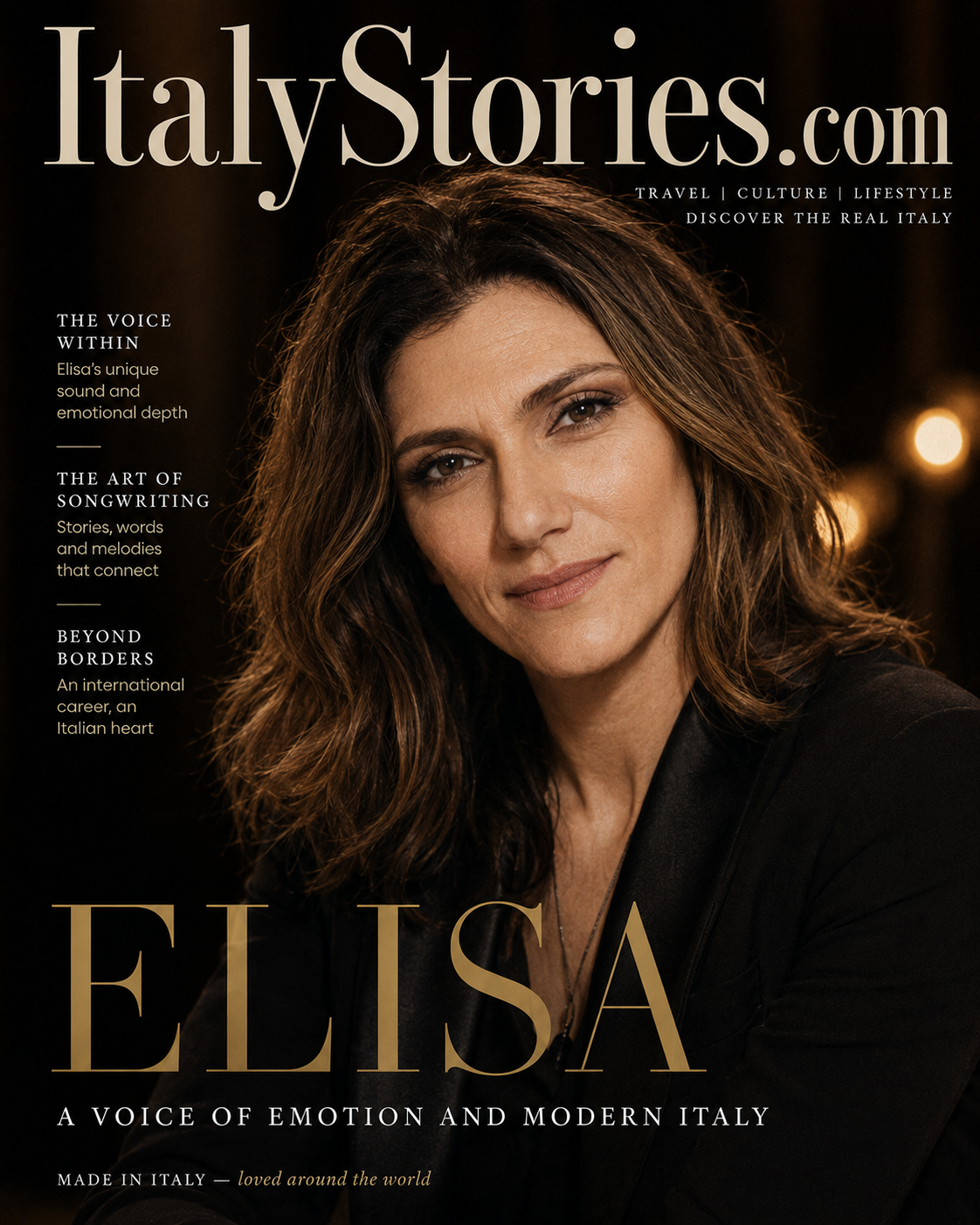
The Night a Private Voice Filled San Siro
On June 18, 2025, Elisa walked onto the stage at Milan’s San Siro Stadium for the first stadium concert of her career. More than fifty thousand people had come to hear a singer whose public image had never depended on spectacle for its own sake. For nearly three decades, her greatest strength had been intimacy: a voice capable of sounding as though it were singing to one person even when the room contained thousands.
San Siro changed the scale, but not the principle. The set moved through more than twenty-five years of music, from the English-language songs of her beginnings to the Italian songs that had become part of the country’s shared memory. Friends and collaborators joined her: Ligabue, Giorgia, Jovanotti, Cesare Cremonini, Giuliano Sangiorgi, Dardust and others. The concert was also conceived as a statement about sustainability, with reduced-impact production choices and environmental projects connected to the event.
There was something almost symbolic about the timing. Elisa had never followed the usual path of the Italian pop star. She had begun by singing almost entirely in English, developed a sound shaped as much by international alternative rock and soul as by Italian songwriting, won Sanremo with her first major Italian-language song, worked with Ennio Morricone and Quentin Tarantino, written for other artists, moved from electronic experimentation to acoustic minimalism and back again, and built a career in which commercial success rarely required artistic simplification.
The stadium was therefore not simply a bigger stage. It was the visible result of a long argument she had been making through music: that an Italian artist could be local and international at once; that vulnerability could be powerful; that experimentation and mass communication did not have to be enemies; and that a singer could keep changing without losing the emotional signature that made the public trust her.
To understand how Elisa reached that night in Milan, one has to go back to a landscape far from the giant stadium: northeastern Italy, near borders, winds, ports and languages, where a girl named Elisa Toffoli began writing songs before she had any idea how far they would travel.
A Border Childhood: Trieste, Monfalcone and the Desire to Create
Elisa Toffoli was born in Trieste on December 19, 1977, and grew up in the Friuli-Venezia Giulia area, especially around Monfalcone. Geography matters in her story. This is one of Italy’s great border regions, a place where cultures, languages and histories meet rather than line up neatly. Trieste looks toward Central Europe and the Adriatic at the same time. Monfalcone carries the industrial and maritime character of the Gulf. Nearby are Slovenia, the Karst, the Isonzo and landscapes that can feel both Italian and larger than a single national frame.
That environment seems, in retrospect, almost made for an artist who would resist categories. Elisa developed interests in music, dance, drawing and other forms of expression when she was young. She began writing early, and her instinct was not to wait for permission. Songs became a private space in which she could test emotions and identities before the music industry had any opinion about them.
English entered this private creative world very naturally. For an Italian teenager in the late 1980s and early 1990s, English-language music represented more than export culture. It represented sonic freedom. Artists such as Aretha Franklin, Ella Fitzgerald, Jim Morrison, Björk, Tori Amos, Alanis Morissette, Dolores O’Riordan and especially the kind of emotionally exposed alternative songwriting that emerged in that period offered models that did not sound like the traditional Italian festival system.
Elisa’s attraction to English would later puzzle some Italian listeners, but it was not a marketing trick. She has often described English as a language that gave her a certain emotional distance and musical flexibility. Its sounds fitted the music she was hearing and writing. At first, singing in English was part of the way she discovered herself.
This is important because the most famous transformation in her career – the move into Italian with ‘Luce (Tramonti a nord est)’ – was not the moment she finally became authentic. She was authentic before that. The change was more interesting: it was the moment she learned that another language, her own, could reveal a different kind of truth.
Before any of that could happen, however, someone in the professional world had to recognize the unusual combination already forming: a young Italian singer-songwriter with an international ear, a powerful but flexible voice, and a desire to make records that did not sound like the obvious product of the Italian mainstream.
Caterina Caselli, Sugar and the Door to California
The person who helped open that door was Caterina Caselli. By the 1990s, Caselli had already lived one of the most fascinating second acts in Italian music. After becoming a major singer in the 1960s, she developed into an important record executive and talent scout through Sugar Music. Her career gave her an unusual capacity to recognize not only a voice, but the potential shape of an artist.
Elisa came to Sugar as a teenager. The company did not try to force her immediately into the standard Italian formula. Instead, she was given time to develop. That decision was fundamental. A less patient system might have taken the obvious route: Italian lyrics, conventional pop arrangements, a quick festival appearance. Elisa’s early career moved in the opposite direction.
She worked with producer Corrado Rustici, the Italian guitarist and producer whose international experience made him especially suited to her. Rustici had worked across rock, soul and pop worlds and understood the importance of preserving the raw identity of a singer rather than polishing it into anonymity. Elisa traveled to the United States and worked on the material that would become her debut album.
The California experience placed her in a professional context where singing in English was not an exotic gesture. It was simply the language of the studio. For a very young artist from northeastern Italy, this mattered psychologically as much as musically. She could test her songs against international production standards without first having to translate herself into what the Italian market expected.
The partnership with Sugar and Rustici established one of the most important patterns in Elisa’s career: collaboration without surrender. She has repeatedly worked with strong producers, composers and artists, but the best collaborations do not erase her. They sharpen some part of her identity. From Rustici to Glen Ballard, from Zucchero to Ligabue, from Ennio Morricone to contemporary songwriters, the pattern remains surprisingly consistent.
By 1997, the preparation was complete. Elisa was ready to release an album that looked almost nothing like the conventional debut of an Italian female singer.
Pipes & Flowers: The Debut That Did Not Sound Italian – and Somehow Did
Pipes & Flowers arrived in 1997. It was sung in English and carried traces of rock, soul, acoustic songwriting and alternative pop. Songs such as ‘Labyrinth’, ‘Sleeping in Your Hand’ and ‘A Feast for Me’ introduced a voice that could whisper, rise, crack open and suddenly become enormous without losing emotional focus.
The album was a critical and commercial success in Italy. That success mattered because it challenged an assumption: that an Italian artist needed to sound conventionally Italian in order to build a domestic audience. Elisa’s listeners were willing to follow her into English because the music felt emotionally legible. The words might not have been instantly understood by everyone, but the voice made their emotional direction clear.
Her singing already contained the contradictions that would define her mature work. It could be technically powerful but never merely demonstrative. She could attack a phrase with rock intensity and then retreat into something almost fragile. She was capable of impressive range, yet the most memorable moments were often not the highest notes but the small changes in pressure, breath and color that made a line feel lived rather than displayed.
Pipes & Flowers also revealed her as a songwriter rather than simply an interpreter. That distinction would become increasingly important as her career developed. She was not waiting for the perfect material to be delivered from outside. She was building her own emotional vocabulary.
The album’s success brought awards and attention, but perhaps its greatest achievement was simpler: it created trust. Listeners accepted that Elisa might not take the predictable route. This trust gave her room for the next record, where she pushed further into electronic sounds and darker textures rather than repeating the debut formula.
For many singers, the first success creates a trap. The market asks for the same thing again, slightly larger. Elisa’s second album suggested that repetition was never going to be the organizing principle of her career.
Asile’s World: Electronic Restlessness and a Refusal to Repeat
Released in 2000, Asile’s World was more electronic, more layered and at times more experimental than its predecessor. The title itself played with Elisa’s name in reverse – ‘Asile’ – turning identity into a small linguistic game. That gesture suited the album’s mood: inward-looking, strange, modern, interested in transformation.
The record embraced electronic production, programming and a more synthetic sound world. For listeners who had discovered Elisa through the organic textures of Pipes & Flowers, it could feel like a sharp turn. But the change was consistent with her artistic instinct. She has always treated production as part of meaning, not merely decoration.
The turn also reflected a wider moment in international music. Around the end of the 1990s and beginning of the 2000s, electronic textures had moved deeply into alternative pop. Björk, trip-hop, experimental R&B and sophisticated studio programming were reshaping what a singer-songwriter record could sound like. Elisa absorbed these possibilities without abandoning melody.
Asile’s World did not replace the singer of the debut; it expanded her. The record demonstrated that she could inhabit a programmed environment without losing the human irregularities of her voice. It also proved that Sugar’s early trust in her had been justified. She was not developing as a product with a defined shelf. She was developing as an artist with a moving center.
Then came the event that changed her relationship with the Italian public forever: Sanremo 2001.
Sanremo 2001: When “Luce” Changed the Language of Elisa
Elisa arrived at the 2001 Sanremo Music Festival with an unusual position. She was already successful, already respected, and already known for singing in English. She did not need the Festival to invent her career. That made the decision to participate more interesting.
The song was ‘Luce (Tramonti a nord est)’. It had originated in English as ‘Come Speak to Me’, but the Italian version became something deeper than translation. Elisa worked on the Italian adaptation with Zucchero, another artist who understood how to make Italian language live inside internationally influenced music.
The result was extraordinary. ‘Luce’ sounded contemporary, personal and unmistakably tied to Elisa’s landscape. Even the subtitle, ‘Tramonti a nord est’ – sunsets in the northeast – located the song in a geography that had shaped her. The music did not suddenly turn into traditional Italian canzone. Instead, Italian entered Elisa’s existing musical world and changed its emotional temperature.
She won the Festival. The song also collected major additional recognition, including the critics’ prize and honors for performance and songwriting. Twenty-five years later, Italian music media would still describe ‘Luce’ as one of the most awarded songs in Sanremo history.
What made the victory so important was not merely the trophy. Sanremo revealed another Elisa to the public. In English she had often been atmospheric, private, international. In Italian, the emotional content seemed to move closer to the surface. The consonants, vowels and meanings carried the intimacy differently. She discovered that her native language could be not a limitation but another instrument.
The victory also changed the wider conversation around her. She could no longer be treated simply as the Italian singer who preferred English. She had become central to Italian songwriting itself.
Many artists who win Sanremo spend years trying to recreate the winning formula. Elisa did not. The next phases of her career continued to move between languages, genres and production styles. But ‘Luce’ remained a point of no return: from then on, Italian and English would coexist in her artistic identity rather than compete for it.
Then Comes the Sun: After Victory, a More Human Light
Later in 2001 came Then Comes the Sun, an album that brought together some of the lessons of the previous years. Compared with the electronic density of Asile’s World, the record often felt warmer and more organic. It was still international in language and sound, but its emotional directness had deepened.
Songs such as ‘Heaven Out of Hell’ and ‘Dancing’ became central to Elisa’s catalog. ‘Heaven Out of Hell’, associated with the film Casomai, showed how naturally her voice could inhabit cinema. She did not sing as though she were illustrating a scene; she created an emotional space in which a scene could live.
‘Dancing’ would have an even stranger afterlife. Initially part of the early-2000s period, the song resurfaced years later in North America when it was used in the television program So You Think You Can Dance? A choreography introduced it to a new audience, digital sales grew, and Elisa’s music suddenly found a path into the United States and Canada that had not been planned in the conventional record-industry way.
This delayed success is one of the most revealing episodes of her career. It demonstrates how songs can travel independently of their original release cycle. A piece written in one context can wait for years until another cultural moment gives it a second life.
Then Comes the Sun also confirmed a broader truth about Elisa: her music often sits comfortably beside images. She has repeatedly contributed to cinema, television and visual projects, not because her songs are generic enough to serve as background but because they tend to create atmosphere. Her voice has narrative weight.
The early 2000s therefore found her in a rare position: a Sanremo winner who remained difficult to categorize, an English-language songwriter who had discovered the force of Italian, and a pop artist whose work could move into film without losing its identity.
Lotus: Stripping the Songs Back to Their Bones
In 2003 Elisa made another turn. Lotus was conceived around acoustic arrangements and a more intimate sound. After electronic experimentation and polished studio production, she moved toward wood, strings, room sound, breath and space.
The album included reworkings of earlier songs alongside new material and selected interpretations. This kind of project can easily become a decorative ‘unplugged’ exercise. Lotus felt more substantial because Elisa used acoustic reduction as a form of investigation. What remains of a song when production is removed? How much emotional force belongs to the composition, and how much to the voice itself?
The answers were flattering. Her songs survived simplification because their emotional architecture was strong. In stripped form, the qualities of her singing became even clearer: dynamic control, sensitivity to silence, the ability to move from almost spoken softness into full vocal release, and a phrasing style that often treated breath as part of the lyric.
The natural imagery surrounding Lotus also connected deeply with Elisa’s personal geography and later environmental sensibility. Flowers, water and landscape were not yet the formal activism that would emerge much later, but the emotional connection between nature and creativity was already visible.
The album became one of the most loved projects of her catalog and proved again that reinvention did not require abandoning the past. Elisa could revisit earlier songs and make them sound newly discovered.
Pearl Days and Glen Ballard: Rock on an International Scale
Only a year later, in 2004, Elisa turned again. Pearl Days was recorded with American producer Glen Ballard, known for major international work and particularly associated with records that balanced strong songwriting and rock production. Elisa spent months in Los Angeles working on the album.
Pearl Days was louder, harder and more physically rock-oriented than Lotus. The contrast was almost theatrical: after removing the walls, she rebuilt them with amplifiers. Tracks such as ‘Together’ and ‘The Waves’ showed a singer fully comfortable with a larger band sound.
The collaboration with Ballard also demonstrated Elisa’s professional confidence. By this point she was not a young Italian artist being introduced to international production. She was a mature songwriter able to work as an equal within that environment. The sessions included respected musicians, and the record’s sound reflected a global rock vocabulary without erasing her identity.
Around this period, ‘Una poesia anche per te’ became another important Italian-language song, showing that the two linguistic sides of her career had become increasingly fluid. English remained natural, but Italian was no longer an exception reserved for special occasions.
The 2000s as a whole reveal how difficult it is to summarize Elisa with a single genre. She could make electronic pop, intimate acoustic music and guitar-driven rock within a few years, yet the catalog still sounded coherent because the emotional center remained constant.
Soundtrack, Ligabue and the Art of Singing Someone Else’s Words
In 2006 Elisa marked roughly a decade of work with Soundtrack ’96-’06, a collection that helped define her repertoire for a broader public. Retrospectives can freeze an artist, but this one also introduced important new material.
Among the most significant songs was ‘Gli ostacoli del cuore’, written by Luciano Ligabue. The collaboration was revealing. Ligabue’s writing is deeply connected to Italian language, narrative and rock tradition; Elisa’s interpretation brought a different emotional transparency to it. The song became a major success and opened a creative relationship that would later produce ‘A modo tuo’.
Elisa has a rare skill as an interpreter: she can sing someone else’s song without making it sound borrowed. This is different from simple vocal excellence. She seems to search for the psychological point at which another writer’s words intersect with her own experience. When she finds it, the distinction between author and interpreter becomes less important.
This quality helps explain why so many major Italian artists have trusted her with their material or invited her into collaboration. She does not merely decorate a song with a beautiful voice. She re-enters it from the inside.
The Soundtrack era also consolidated Elisa’s standing as one of the central voices of contemporary Italian music. She had now accumulated enough significant songs that a retrospective felt natural, but her most interesting work was still far from finished.
“Dancing” Crosses the Atlantic
In 2007 and 2008, the old song ‘Dancing’ unexpectedly opened a North American chapter. Its use on So You Think You Can Dance? created strong public interest, and the song reached new listeners through digital platforms. A compilation titled Dancing was subsequently released for the North American market.
For Elisa, the episode was both satisfying and ironic. She had begun her career with an international imagination, singing in English and working in the United States. Yet the American breakthrough did not come through a carefully engineered launch. It came through choreography, television and rediscovery.
This is a reminder that international success is rarely a straight line. A record company can plan distribution, but culture often has its own timing. ‘Dancing’ reached people because dancers found emotional and physical possibilities inside it. The song became a movement before it became a market event.
The American experience also reinforced a point already visible in her career: Elisa’s songs communicate beyond literal language. The body can understand what the lyric means before the mind translates it. That quality is especially powerful in dance and cinema, where music interacts with image, gesture and space.
Heart and Ivy: Adulthood, Motherhood and a Softer Strength
After several years focused partly on retrospectives, live work and international activity, Elisa returned with Heart in 2009. The album reached number one in Italy and felt like the work of an artist entering a new adult phase without becoming musically conservative.
Heart contained collaborations and strong pop-rock writing, but its emotional atmosphere was also influenced by changes in Elisa’s life. Around this period she became a mother. Private life should never be used as an easy explanation for art, but in Elisa’s case themes of vulnerability, protection and responsibility became increasingly visible across later work.
Ivy followed in 2010, offering another intimate, largely acoustic project and revisiting earlier material alongside new songs. The relationship between Heart and Ivy almost echoed the earlier contrast between Pearl Days and Lotus: expansion followed by reduction, electricity followed by air.
This repeated movement suggests something structural in Elisa’s creativity. She seems to need both scales. She enjoys large production, rhythm and power, but repeatedly returns to stripped arrangements to test whether the songs still breathe without machinery.
By now her career had accumulated a second kind of authority. The public no longer expected her to stay in one sound. Change itself had become part of the contract.
Morricone, Tarantino and “Ancora qui”
One of the most extraordinary collaborations in Elisa’s career began with Ennio Morricone. The great composer invited her into a project that eventually produced ‘Ancora qui’, with music by Morricone and lyrics by Elisa.
The assignment carried intimidating weight. Writing words for a Morricone melody means entering a musical space already charged with cinematic memory. Elisa later explained that Morricone encouraged her to draw from a powerful personal memory. She wrote with the memory of a childhood friend who had died young in mind, turning grief into a lyric of return and recognition.
The song took another remarkable turn when Quentin Tarantino chose it for Django Unchained. Suddenly Elisa’s voice was inside the sonic world of one of the most discussed international films of the period. ‘Ancora qui’ was also considered in the Academy Awards eligibility process for original song.
This episode brought together three very different artistic identities: Morricone’s monumental cinematic language, Tarantino’s obsessive relationship with film music, and Elisa’s intimate lyrical instinct. The collaboration worked because none of the three was reduced to the other.
For Elisa, it was also confirmation that her voice belonged naturally in cinema at the highest level. The girl who had begun writing songs in northeastern Italy had become a lyricist trusted by one of Italy’s greatest composers and a vocalist heard in a major Hollywood production.
L’anima vola: Choosing Italian Without Giving Up the World
In 2013 Elisa released L’anima vola, her first studio album sung entirely in Italian. The move was significant precisely because she had spent so many years proving that an Italian artist could build a major career in English. Now she turned fully toward her native language not as retreat, but as expansion.
The title track, ‘L’anima vola’, carried the melodic openness and emotional directness that Italian listeners had come to associate with her best work. The album also included ‘Ancora qui’ and songs involving important collaborators. It became a major commercial success and reached number one in Italy.
The project demonstrated how much Elisa’s relationship with Italian had evolved since Sanremo 2001. ‘Luce’ had been a revelation; by 2013 Italian was a complete creative home. She could write, interpret, whisper and explode in it without sounding as though she were translating an English-language self.
The album also helped bring her to a new generation of listeners who knew less about the English-language beginnings. This generational renewal is crucial in a long career. Artists survive not only by keeping old fans, but by allowing new audiences to enter through a contemporary doorway.
One of the most enduring songs associated with this period would arrive through Luciano Ligabue.
“A modo tuo”: A Song About Letting Go
Ligabue wrote ‘A modo tuo’ with his daughter in mind and wanted Elisa to sing it from the emotional perspective of a mother. The song became one of the most beloved Italian recordings of Elisa’s mature career.
Its subject is simple and enormous: the painful work of raising a child while knowing that love ultimately requires letting that child go. Elisa’s interpretation avoids theatrical excess. The power comes from restraint, from the feeling that the singer is trying to remain composed while the meaning of the words keeps breaking through.
This is a perfect example of her interpretive gift. The song was not written by her, yet she made it feel intimately connected to her voice and life. In performances, the emotional response from audiences often comes before the chorus is fully underway because the situation is universally recognizable.
‘A modo tuo’ also reveals something about Elisa’s maturity as a singer. The young artist of Pipes & Flowers could convey vulnerability through texture and atmosphere. The mature Elisa could convey it through clarity. She no longer needed mystery to protect emotion.
On, Diari aperti and the Freedom to Move Again
After the Italian-language focus of L’anima vola, Elisa returned to English and more electronic-pop energy with On in 2016. The album included ‘No Hero’, one of its most visible songs, and demonstrated that her earlier international vocabulary had never disappeared. She could switch languages without treating either as a costume.
Two years later came Diari aperti, a project centered much more strongly on Italian songwriting. The title – Open Diaries – suggested confession, but the songs were not simple autobiography. Elisa was using personal language to reach outward. ‘Se piovesse il tuo nome’, written with contributions from Calcutta and Dardust, became one of the album’s major successes; ‘Anche fragile’ offered another example of the way Elisa can turn weakness into a form of strength.
By this stage, she was also deeply involved in the wider Italian musical community. She had served as artistic director on Amici, written songs for younger artists, collaborated across generations, and become a reference point rather than simply a contemporary.
This shift in status is subtle. A singer begins by trying to enter a scene. If the career lasts long enough, the scene begins to measure itself partly against the singer. By the late 2010s, Elisa had reached that second position.
Sanremo 2022: Returning Without Repeating 2001
Twenty-one years after winning Sanremo with ‘Luce’, Elisa returned to the Festival in 2022 with ‘O forse sei tu’. The return carried obvious symbolic weight. The easy move would have been to construct a nostalgic sequel to 2001. She did not.
‘O forse sei tu’ was elegant, controlled and emotionally mature. Elisa finished second, behind Mahmood and Blanco, and won the orchestra’s award. The performance reminded viewers that her relationship with the Festival had changed. In 2001 she had arrived as the surprising outsider who conquered the Italian language. In 2022 she arrived as one of the country’s established musical authorities.
The same year she released the ambitious double project Ritorno al futuro / Back to the Future. The bilingual title was almost a summary of her career: Italian and English, memory and experimentation, intimacy and social vision. The project included collaborations and songs that engaged with both personal and collective concerns.
The associated live work also became increasingly connected to environmental responsibility. Elisa began treating the concert not only as a musical event but as a system with ecological consequences. This would become central to the next chapter of her public life.
The Voice: Power, Air, Imperfection and Truth
Elisa’s voice is often described simply as powerful, but that is not enough. Many singers are powerful. What makes her distinctive is the relationship between power and vulnerability.
Her instrument can move from a breathy, almost private tone into a strong belt without sounding as though two different singers are taking turns. There is continuity in the emotional color. Even at full volume, a certain fragility remains audible. Even in quiet passages, one senses the physical capacity behind the softness.
Her English pronunciation, especially in the early years, helped her sound unusually natural for an Italian pop singer working internationally, but language was never the whole story. The deeper element is phrasing. Elisa often delays, stretches or softens a word in ways that create emotional uncertainty. She does not always attack notes with perfect geometric cleanliness; sometimes the slight roughness is the point.
This is why technical descriptions alone do not explain her. Range, breath control and dynamics matter, but listeners recognize Elisa because the voice sounds psychologically present. It seems to be thinking while it sings.
Her influences are broad, from soul and jazz singers to alternative rock and singer-songwriters, yet she never became a direct imitation of any one model. Over time, the voice itself became the genre.
The People Around Elisa
Elisa’s career is deeply personal, but it is also a story of important artistic relationships.
Caterina Caselli recognized her early and created the conditions for development rather than forcing speed. Corrado Rustici helped give the first records an international musical frame. Zucchero played a crucial role in the Italian adaptation of ‘Luce’, helping her enter her native language without losing the song’s original identity.
Glen Ballard brought a large-scale rock production sensibility to Pearl Days. Luciano Ligabue entrusted her with songs that became central to her Italian repertoire, including ‘Gli ostacoli del cuore’ and ‘A modo tuo’. Ennio Morricone gave her a melody that became ‘Ancora qui’, asking her to write from memory rather than abstraction.
Andrea Rigonat, guitarist and later Elisa’s husband, has been an important musical presence across her live and studio world. Their partnership is relevant not because of celebrity curiosity, but because Elisa’s music has always been shaped by close working relationships in which trust matters.
Across later years she has collaborated with Giorgia, Jovanotti, Cesare Cremonini, Giuliano Sangiorgi, Dardust, Francesco De Gregori, Ligabue, Andrea Bocelli and many others. The list is long, but the pattern is more important than the names: Elisa collaborates widely without becoming generic.
She is a musician other musicians trust.
Beyond the Stage: Environmental Commitment and Fondazione Lotus
In the 2020s, Elisa’s public identity expanded beyond music into environmental action. This was not entirely surprising. Nature had long been present in her imagery, from the landscapes of the northeast to the visual world of Lotus. But the concern became more structured and practical.
Her live projects began experimenting with sustainability protocols and reduced-impact production. By the time of the 2025 San Siro concert, environmental responsibility had become part of the event’s architecture rather than a slogan added afterward. Biofuel, public-transport incentives, waste management, monitoring and other measures were integrated into the production.
The concert also introduced Fondazione Lotus, created to support environmental and social projects, and Plantasia, a proposed sound park and regeneration project in Milan. Elisa described a desire to connect beauty with responsibility, arguing that large-scale music could no longer pretend to be separate from the ecological cost of events.
This commitment gave a new meaning to the scale of San Siro. A stadium show is normally a symbol of artistic arrival. Elisa tried to make it also a laboratory: if tens of thousands of people gather for beauty, can that gathering leave something better behind?
By 2026, environmental work through Fondazione Lotus had become an increasingly visible part of her public activity. It is too early to know how large this second legacy will become. But it already reveals something consistent with her music: she is most interested in borders when they can be crossed – between art and responsibility, private emotion and collective life, beauty and action.
San Siro, 2025 and the Twenty-Five-Year Circle of “Luce”
The 2025 San Siro concert brought many of Elisa’s artistic lines together. It celebrated more than twenty-five years of music, included major collaborators, revisited songs from across the catalog, and transformed the biggest stage of her career into an environmental statement.
A live album, San Siro Live 2025, followed, preserving the event and the sense of a catalog that had become part of Italian pop memory. The songs represented several different Elisas: the English-language songwriter, the Sanremo winner, the rock performer, the acoustic interpreter, the cinematic voice, the mother singing ‘A modo tuo’, the artist of ‘O forse sei tu’. None canceled the others.
In 2026, another anniversary created an emotional circle: twenty-five years since ‘Luce (Tramonti a nord est)’ won Sanremo. Elisa marked the period with further arena dates, allowing a song once regarded as a surprising linguistic turn to be heard as one of the central works of her career.
The anniversary matters because ‘Luce’ no longer belongs only to Elisa. It belongs to weddings, radio memories, cover performances, school-age discoveries, old Sanremo clips and family listening. That is what happens when a song moves from success into cultural memory.
Elisa’s career has now lasted long enough for the early work to be rediscovered by people who were not born when it was released. This is one of the clearest signs of artistic endurance.
Why Elisa Still Matters
Elisa matters because she expanded the possible shape of the Italian pop singer.
She showed that an artist from Italy could begin in English without being dismissed as artificial, then move into Italian without betraying the original project. She showed that electronic experimentation, acoustic intimacy, rock production and melodic pop could all belong to one career. She demonstrated that technical vocal ability could serve emotional truth rather than replace it.
She also changed the image of female authorship in Italian mainstream music. Elisa was not simply a voice chosen to interpret songs written by others. From the beginning, she wrote, arranged, produced, played instruments and made decisions about sound. Her career helped normalize the idea of the female pop artist as complete musical author rather than only performer.
Her best songs do not all sound alike, but they share a moral quality: they take emotion seriously. They do not treat tenderness as weakness. They allow uncertainty, longing, grief, love and fear to remain complicated.
And perhaps this is why her voice has aged so well. It was never built around youth alone. Even when she was very young, she sounded as though she were searching for something deeper than fashion. As she matured, the search became the career.
From Trieste and Monfalcone to California studios, from English lyrics to Sanremo, from ‘Dancing’ in North America to Morricone and Tarantino, from intimate acoustic records to a sold-out San Siro, Elisa has spent nearly three decades refusing the false choice between intimacy and scale.
The voice became larger, the audience became larger, the stages became larger. But the essential movement remained the same: someone listening closely to an emotion, finding the right sound for it, and offering it to the world without pretending it was simple.
That is the reason Elisa remains one of the defining voices of modern Italy.
A Final Thank You from ItalyStories.com
Thank you for spending time with this story. ItalyStories.com was created to explore the voices, places, memories and cultural figures that have carried Italy far beyond its borders. If Elisa’s journey has made you curious about another chapter of Italian music and culture, we would be delighted to welcome you to the next story.
[…] decade began with Toto Cutugno winning in 1980 with “Solo noi.” Alice won in 1981 with “Per Elisa,” written with Franco Battiato, a victory that proved sophisticated pop could succeed within the […]