

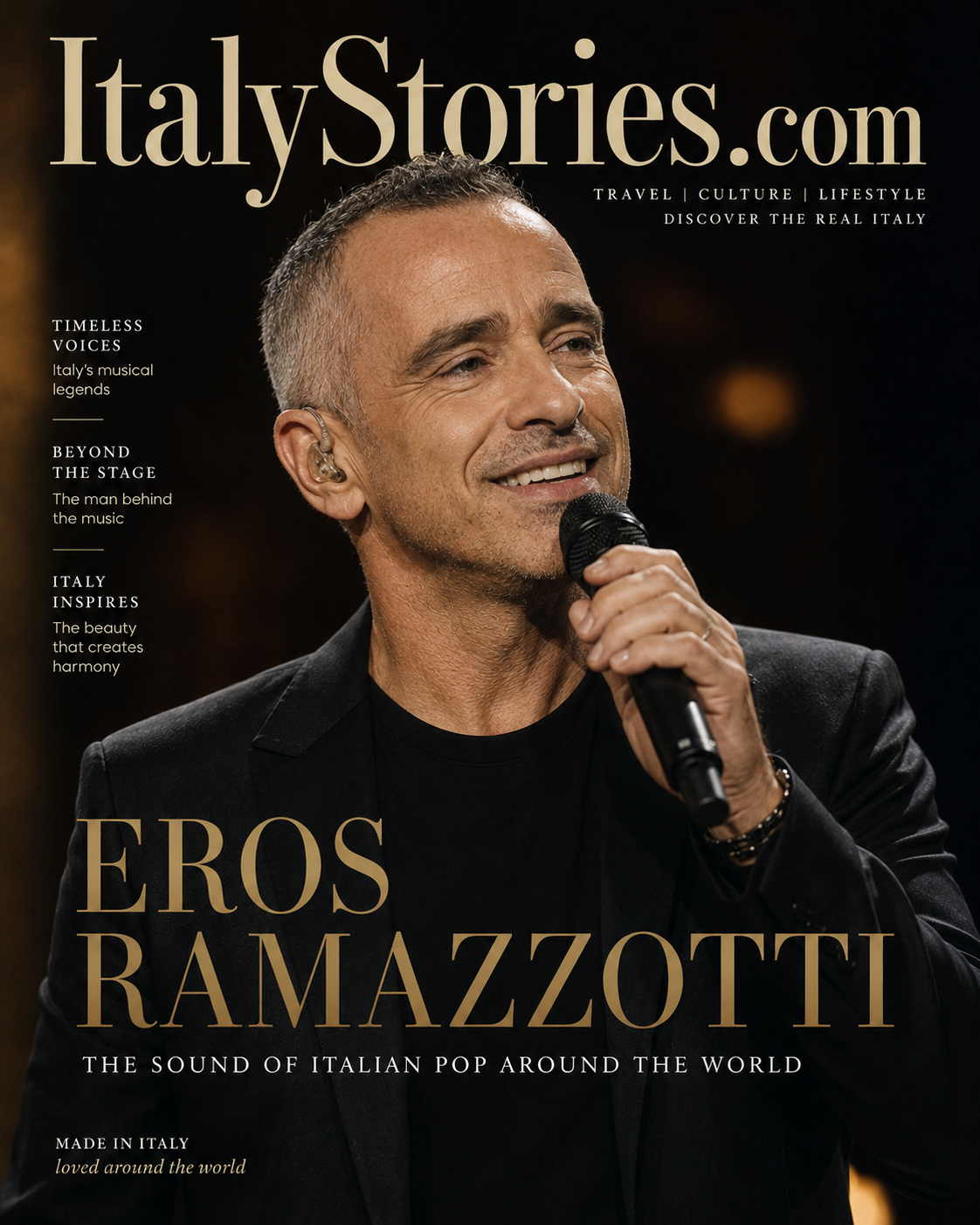
The Night Rome Reached Radio City
In 1990, Eros Ramazzotti walked onto the stage of Radio City Music Hall in New York carrying something that the international record business did not always consider easy to export: Italian pop sung with an unmistakably Italian voice.
He was twenty-six. He had already won the Sanremo Music Festival, filled arenas in Europe and built a powerful following in Spain. But New York was different. The room itself was a symbol of American entertainment, and the invitation had come from Clive Davis, one of the most influential record executives of the era. Ramazzotti’s official biography describes him as the first Italian artist to perform there to a sold-out audience.
The achievement mattered because he had not arrived by hiding where he came from. He was not imitating an American singer, changing his vowels or sanding away the accent that made his voice instantly recognizable. His songs were built on Italian melody, Mediterranean emotional directness and the craft of writers and arrangers who understood that a chorus could be both intimate and enormous.
By then, audiences outside Italy were already singing with him. In Spain, his albums existed in Spanish-language versions. In France and elsewhere in Europe, songs that had begun in Rome and Milan had become radio staples. Latin America was opening to him. The formula would eventually support a career measured in decades, continents and tens of millions of records.
Yet the young man on the Radio City stage had grown up far from the polished mythology of international stardom. He came from Cinecittà, from the Roman outskirts, from a family where music was loved but celebrity was remote. His first serious steps in the industry included rejection, a contest, a small record label and the difficult move from Rome to Milan.
The world would later know the name Eros Ramazzotti as a brand of Italian pop. The story began with a boy who was simply trying to get someone to listen.
Cinecittà: A Childhood at the Edge of the Dream Factory
Eros Walter Luciano Ramazzotti was born in Rome on October 28, 1963, and grew up in the Cinecittà area. The name immediately evokes the great studios that helped create the international image of postwar Italian cinema, but the neighborhood in which he lived was not a movie set. It was working-class Rome, a place of apartment blocks, ordinary families and young people who could see the glamour of the entertainment world without necessarily knowing how to enter it.
His father, Rodolfo Ramazzotti, worked in construction and painting but loved music deeply. He played and wrote songs and encouraged his son’s ambitions. Ramazzotti’s mother, Raffaela Molina, provided the other center of the family. Years later, after her death, Eros would return to that bond in his music, most explicitly in the song “Mamarà.”
The father’s encouragement was especially important because the first institutional verdict on Eros’s musical future was not promising. After middle school he tried to enter the conservatory and was not admitted. He then enrolled in accounting school, but the ordinary academic route did not hold him for long. Music occupied too much space in his imagination.
This could easily be retold as one of those neat stories in which a rejected future star proves everyone wrong. Real life was less tidy. Ramazzotti did not move directly from rejection to triumph. He had to find another route into an industry that, in early-1980s Italy, still depended heavily on festivals, record companies, radio, television and personal networks.
In 1981 he entered the Voci Nuove competition at Castrocaro with a song called “Rock 80.” He reached the final and attracted the attention of people connected with the young DDD label. The result was a recording contract and a move to Milan.
For a Roman teenager, the move was not merely geographical. Milan was the working capital of much of the Italian record business. It meant studios, offices, producers, deadlines and the realization that wanting to sing was different from becoming a professional singer.
His first single, “Ad un amico,” appeared in 1982. It did not turn him into a star. If anything, those early recordings showed an artist still being formed. The people around him began to matter enormously.
Among the collaborators who would help define the first great phase of his career were Piero Cassano, formerly of Matia Bazar, lyricist Adelio Cogliati and arranger Celso Valli. Earlier, figures such as Renato Brioschi and Alberto Salerno had also contributed to the material that led him toward Sanremo. The career that would later look inevitable was being built song by song by a team.
“Terra promessa”: The Door Opens at Sanremo
In 1984, the Sanremo Music Festival introduced a separate competition for younger artists. Ramazzotti arrived with “Terra promessa” and won the Newcomers section.
The song did not sound like the traditional image of an Italian festival ballad. Its melodic writing was unmistakably Italian, but the arrangement carried the pulse of contemporary European pop. More importantly, the subject was generational. It spoke from inside the uncertainty of young people searching for a future rather than from the distance of an adult songwriter observing them.
Ramazzotti himself was only twenty. The slightly nasal, grainy quality of his voice made him immediately identifiable. It was not a classical “beautiful voice” in the conventional Italian sense, and that difference became an advantage. On radio, you knew who was singing within seconds.
Winning Sanremo gave him visibility, but the people around him were already thinking beyond Italy. “Terra promessa” was distributed across Europe, and the record company treated Ramazzotti from the beginning as an artist with international potential.
That decision would prove decisive.
A year later he returned to Sanremo among the established artists with “Una storia importante,” written with Piero Cassano and Adelio Cogliati. He did not win the Festival, but the song became far more important than its competition result. It grew into a major hit, especially in France, and helped make his debut album Cuori agitati the beginning of a European career rather than merely an Italian one.
The title itself – “An Important Story” – almost sounds prophetic in retrospect. What mattered was not only the romance inside the lyric, but the shape of the songwriting. Ramazzotti’s songs increasingly relied on tension between verses that felt conversational and choruses that opened wide. The arrangements made room for keyboards, guitars and large rhythmic sections without losing the melodic line.
In 1986 he returned to Sanremo and won the main competition with “Adesso tu.” The song placed his origins at the center of the story. It was not simply another love song. It carried the perspective of someone from the outskirts who had moved into a different world without forgetting where he had begun.
The accompanying album, Nuovi eroi, confirmed that the first victory had not been an accident. Eros Ramazzotti was now one of the central young voices in Italian pop.
A Team That Learned How to Write for One Voice
Great pop careers are often described as if the singer alone creates the entire universe. Ramazzotti’s success is better understood as the result of a long creative dialogue.
Adelio Cogliati became one of the defining lyricists of his repertoire. Piero Cassano contributed to music and structure during the crucial early years. Celso Valli’s arrangements helped give the recordings their polished scale. Later, Claudio Guidetti and other collaborators would become important to the evolution of the sound.
The achievement of the team was not that every song sounded the same. It was that each song sounded as though it belonged to the same person.
Ramazzotti’s voice required specific writing. It has a narrow, recognizable grain, a forward placement and a slightly rough emotional edge. The best melodies let him begin in a relatively restrained register, climb gradually and then release into a chorus where the particular color of the voice becomes an emotional signature.
This is one reason his songs survived translation into Spanish so well. The identity did not depend only on wordplay. It lived in melody, phrasing and the physical sound of the singer.
From the mid-1980s onward, Ramazzotti’s records appeared in Spanish versions with unusual consistency. This was not a late attempt to exploit Latin markets after Italian success. It was part of the career architecture.
Spain responded early and strongly. Contemporary Spanish press was already reporting large sales and packed concerts by the late 1980s. Over time, the Spanish-language catalog created a second pathway into Latin America, where Italian melodic pop had historical roots but where Ramazzotti managed to belong to the present rather than to nostalgia.
He did not become less Italian in Spanish. That was the trick. The Spanish versions carried the same Roman voice.
From “In certi momenti” to “Musica è”: Becoming Bigger Than a Festival Star
The albums that followed Sanremo widened his range.
In certi momenti, released in 1987, contained “La luce buona delle stelle,” recorded with British actress and singer Patsy Kensit, one of the first visible international duets in a career that would later be full of them. The album also included “Ciao pà,” a song connected to his father, showing how personal relationships were already entering the repertoire without being turned into tabloid confession.
Musica è arrived in 1988. The title track became one of Ramazzotti’s most ambitious songs: broad, theatrical and almost programmatic in its belief that music can hold memories, desire, pain and identity inside one form. Years later he would record a version with Andrea Bocelli, linking Italian pop with one of the world’s best-known classical crossover voices.
In ogni senso, released in 1990, included “Se bastasse una canzone,” one of his most enduring songs. Its premise is simple and almost utopian: what if a song could relieve suffering, change injustice or repair what people cannot repair by themselves? Ramazzotti has always had a sentimental streak, but songs like this show that his sentimentality is not limited to romance. It often reaches toward social hope, even when the solution is deliberately impossible.
By the time In ogni senso was released, his audience was genuinely international. The Radio City Music Hall performance in New York symbolized that change, but the more important reality was the touring circuit underneath it. Ramazzotti was building audiences country by country, often through versions of the same songs in two languages.
In an industry increasingly dominated by English-language pop, he demonstrated that an Italian singer could travel without becoming an imitation of the Anglo-American mainstream.
“Tutte storie” and the Moment the World Became the Market
The 1993 album Tutte storie marked another leap.
Its most famous song, “Cose della vita,” became a global signature. The original video was directed by Spike Lee, an extraordinary choice for an Italian pop singer at the time. Lee was already internationally known through films such as Do the Right Thing and Malcolm X. His involvement signaled that Ramazzotti’s record company no longer saw international prestige as something peripheral to the project.
“Cose della vita” has one of Ramazzotti’s most durable themes: relationships are contradictory because life itself is contradictory. The song is not built around a single betrayal or dramatic event. It deals with the emotional mess that remains when two people cannot reduce what happened between them to a simple explanation.
A few years later the song would gain a second life through a duet with Tina Turner, retitled “Cose della vita – Can’t Stop Thinking of You.” The pairing worked because the voices were so different. Turner’s enormous, blues-rooted authority met Ramazzotti’s tight, unmistakable timbre. Neither singer had to imitate the other.
Tutte storie also arrived at a moment when Ramazzotti’s live scale was expanding rapidly. In 1994 he joined Pino Daniele and Jovanotti for a memorable Italian stadium project, bringing together three artists who represented very different versions of contemporary Italian music: Daniele’s Neapolitan blues and songwriting, Jovanotti’s youthful rap-pop evolution and Ramazzotti’s international melodic pop.
The tour showed something that charts alone could not. Ramazzotti’s audience was no longer a narrow group of teenage fans. It was becoming intergenerational.
“Dove c’è musica”: Artistic Control and the Songs That Became Family History
In 1996, Ramazzotti released Dove c’è musica, the first album he completely self-produced. It was made between Italy and California with international musicians and became one of the defining commercial peaks of his career.
The album contains several songs that explain why his music survived beyond the moment of release.
“Più bella cosa” is probably the clearest example. Written by Ramazzotti with Claudio Guidetti and Adelio Cogliati, it begins with the vocabulary of romantic pop but succeeds because the melody keeps rising as though the singer is trying to say more than language can comfortably hold. Ramazzotti later explained that the song had already been written when he met Michelle Hunziker and was subsequently dedicated to her.
“L’aurora” belongs to another part of his life. His daughter Aurora Sophie was born in December 1996, and the song was written for her before her birth. Suddenly, the same voice that millions associated with romantic longing was singing about a different kind of love.
This mattered artistically. Pop singers who build careers almost entirely on courtship and heartbreak eventually face a problem: their real lives change. They become parents, lose parents, divorce, age and discover that the emotional vocabulary of youth no longer covers everything.
Ramazzotti’s catalog expanded with him.
The title track, “Dove c’è musica,” also functions almost as a personal credo. Music is presented not as decoration but as a place in which life happens. That idea is consistent with the way Ramazzotti has worked: he is not an artist who disappears for long periods to construct a radically new persona. He has preferred continuity, touring and the gradual evolution of a recognizable sound.
Duets as a Map of an International Career
If one wanted to explain Ramazzotti’s international position through a single format, the duet would be a good place to start.
The list of his partners is unusually broad: Tina Turner, Cher, Andrea Bocelli, Anastacia, Ricky Martin, Carlos Santana, Giorgia, Nicole Scherzinger, Ornella Vanoni, Raf, Luciano Pavarotti, The Chieftains, Alejandro Sanz and others.
These collaborations were not all identical in purpose.
The Tina Turner version of “Cose della vita” expanded an existing classic. “Più che puoi,” recorded with Cher for Stilelibero in 2000, placed two highly recognizable voices inside a dramatic ballad. “I Belong to You (Il ritmo della passione),” with Anastacia on Calma apparente in 2005, became one of his most successful cross-border duets of the 2000s. “Non siamo soli,” with Ricky Martin on the 2007 collection e², linked Ramazzotti directly with a Latin pop superstar. Carlos Santana added his guitar to “Fuoco nel fuoco” in later collaborative contexts, while Andrea Bocelli’s presence on “Musica è” connected the song to another global Italian vocal tradition.
The important pattern is that Ramazzotti rarely disappears inside a duet. His voice is too distinctive. Collaboration therefore becomes contrast rather than blending.
This is also why the duets helped him internationally without turning him into a guest in someone else’s world. The partner might change, the language might change, the production might change – the central vocal identity remained stable.
The 2000s: Staying Large After the First Wave of Fame
By the beginning of the new millennium, Ramazzotti had already enjoyed the kind of career that could have been turned into permanent nostalgia. Instead, he continued producing major-selling albums and large tours.
Stilelibero, released in 2000, contained “Fuoco nel fuoco,” “L’ombra del gigante” and the Cher duet “Più che puoi.” The title – roughly “free style” – suited a singer who was broadening his production while refusing to abandon melody.
In 2003 came 9. Ramazzotti’s official biography states that the album remained at number one in Italy for fourteen weeks and that the world tour drew more than one million spectators. The album included “Un’emozione per sempre,” a song that quickly entered his core repertoire.
The period was personally difficult. His marriage to Michelle Hunziker had ended, and his mother Raffaela died in 2002. A mature biography should not treat private pain as an automatic explanation for every lyric, but it is impossible to miss that the emotional temperature of the era was different. Ramazzotti was no longer the young man singing toward an imagined future. He was an adult dealing with loss, separation and fatherhood while continuing to perform at enormous scale.
Calma apparente followed in 2005. The title itself suggests the contrast between outward control and internal movement. “La nostra vita” and “I Belong to You” became major songs, and the latter’s pairing with Anastacia demonstrated that his crossover appeal was still strong more than twenty years after “Terra promessa.”
Then came e² in 2007, a double retrospective that combined hits, new material and reworked versions. The project earned multiple platinum certifications and served as proof that Ramazzotti’s back catalog had become an institution of Italian pop.
Why the Voice Works
Eros Ramazzotti’s voice has always divided listeners in an interesting way.
It is not neutral. Nobody hears it and says, “That could be anyone.” The sound is nasal, compressed, slightly rough and highly focused. In a culture that often celebrates vocal beauty as smoothness, Ramazzotti built a career out of character.
Technically, his greatest strength is not sheer range. It is phrasing. He knows how to place words inside a melody so that a line feels spoken even when the notes are climbing. He often uses a relatively contained verse and lets the chorus open upward, creating the sensation that emotion has physically broken through the limits of conversation.
The voice has also aged in a way that suits the repertoire. A pristine youthful tone might have made some of the old songs feel trapped in the past. The additional grain of later years gives them different meanings.
His pronunciation is another important part of the identity. In Italian, he sounds unmistakably Roman in origin without turning dialect into a gimmick. In Spanish, his accent remains identifiable but affectionate rather than careless. The Spanish-speaking public did not require him to sound native; it required him to show that the language mattered to him.
He did.
Spain and Latin America: Not an Export Market, a Second Home
Ramazzotti’s relationship with the Spanish-speaking world is one of the most important chapters in his historical significance.
Italian singers had long enjoyed success in Spain and Latin America, but Ramazzotti approached the market with unusual continuity. Album after album appeared in Spanish. The translated titles became familiar in their own right. Audiences did not encounter him as an occasional visitor promoting a single; they encountered a catalog.
In Spain, press coverage from the late 1980s and early 1990s shows how quickly the relationship deepened. His concerts drew large crowds, and Spanish versions of songs such as “Si bastasen un par de canciones” became part of mainstream pop memory.
Latin America expanded that connection further. Over the years, Ramazzotti toured Mexico, Argentina, Chile and many other markets repeatedly. Collaborations with artists such as Ricky Martin, Luis Fonsi and Alejandro Sanz strengthened links that already existed through his own recordings.
The strategy worked because it was not only commercial translation. Language became part of performance.
This distinction matters. Audiences can tell when a star is visiting a market and when the artist has built history there. Ramazzotti built history.
By the time later generations of Latin pop stars emerged, he was no longer a foreign novelty. He was one of the European singers whose songs had accompanied the lives of Spanish-speaking listeners for decades.
The Albums Keep Moving: “Ali e radici,” “Noi,” “Perfetto” and “Vita ce n’è”
After the retrospective weight of e², Ramazzotti continued with new studio work rather than living from greatest hits.
Ali e radici appeared in 2009. The title – wings and roots – is almost too perfect for his career. The roots were Rome, Italian melody, the long partnership with trusted writers and arrangers, and a public identity that had remained remarkably stable. The wings were the tours, languages, collaborations and international audiences.
Noi followed in 2012, with a broad set of collaborations and a production designed for the arena-pop era. Perfetto arrived in 2015, followed by another extensive world tour.
In 2018, Vita ce n’è opened another cycle. The tour that followed stretched across more than ninety shows in thirty-two countries according to his official biography. It continued for fourteen months and was supposed to conclude in Los Angeles before the COVID-19 pandemic made the final date impossible.
The pandemic interrupted an artist whose career had always depended heavily on physical presence – not just records, but audiences in rooms and stadiums.
When touring returned, Ramazzotti did not treat the interruption as a cue to retreat.
“Battito infinito”: A Veteran Who Refused to Become a Museum Piece
In 2022, Ramazzotti released Battito infinito, introduced through a series of premiere concerts and followed by another world tour across Europe and the Americas.
The album included “Ama,” “Sono” with Alejandro Sanz and “Figli della Terra” with Jovanotti. The choice of collaborators was revealing. Sanz represented the Spanish-language world that had been central to Ramazzotti for decades. Jovanotti connected back to the Italian generation with whom Eros had shared stages and cultural space since the 1980s and 1990s.
The album did not attempt to convince listeners that Ramazzotti had suddenly become a twenty-year-old contemporary pop act. Instead, it updated the production around a voice and songwriting identity that remained consistent.
That is harder than it sounds.
Long careers often fail in one of two directions. Some artists repeat the sound of their biggest decade until it becomes self-parody. Others chase current trends so aggressively that they lose the reason audiences cared in the first place.
Ramazzotti has generally chosen a third path: modernize the surface, protect the center.
The center is melody, direct language, a chorus designed to be sung by thousands and the particular vocal color that turns the first line into identification.
Forty Years Later: “Una Storia Importante” Becomes the Title of the Present
In February 2024, Ramazzotti returned to Sanremo as a guest to celebrate the fortieth anniversary of “Terra promessa.” The image completed a circle. The young newcomer who had once needed the Festival to introduce him was now part of the Festival’s own historical memory.
But anniversary culture can be dangerous for a living artist. It can quietly turn a career into a museum.
Ramazzotti’s response was to keep moving.
In 2025 he released “Il mio giorno preferito” / “Mi día preferido.” His official biography notes that the Italian version debuted directly at number one on the EarOne radio airplay chart in its release week. In November 2025, he released Una Storia Importante / Una Historia Importante, a project that revisited some of the best-known songs of his career in new arrangements while adding unreleased material and new collaborations. “Buona Stella” featured Elisa.
The title deliberately returned to the song that had marked his first great international breakthrough forty years earlier. This time “Una storia importante” was not only a love song. It had become a description of the career itself.
The accompanying Una Storia Importante World Tour expanded across roughly thirty countries. By 2026, the official tour schedule showed sold-out dates through Europe and a run of major Italian stadiums including Udine, San Siro in Milan, Naples, Rome, Messina, Bari and Turin. The Turin date at Allianz Stadium was promoted as the venue’s debut as a major concert location.
This is a remarkable late-career fact. More than forty years after Sanremo, Ramazzotti is not simply selling theaters to a nostalgic audience. He is still operating at stadium scale.
His official biography now credits him with more than eighty million records sold and billions of global listens. Exact commercial figures across a career this long can vary by source and accounting method, but the scale is beyond dispute.
The Public Character: Accessible Without Becoming Ordinary
Ramazzotti’s public image has changed less radically than that of many long-running pop stars.
He has never been primarily a fashion provocateur or a master of theatrical reinvention. There is no sequence of radically different “Eros eras” defined by costumes and conceptual identities. The transformation has been slower: the young Roman newcomer, the European heartthrob, the arena star, the father, the veteran collaborator, the global touring institution.
His physical stage manner is similarly direct. Guitar in hand or standing at the microphone, he tends to address the audience as people rather than as an abstract crowd. The voice carries the drama; the body does not need to manufacture it.
That accessibility helped create long loyalty. Fans who discovered him with “Una storia importante” or “Adesso tu” could follow him into songs about children, parents, separation, memory and aging without feeling that he had abandoned the emotional language they understood.
He also survived a particular trap of romantic pop: the danger that the singer becomes permanently associated with youth while the audience grows older.
Ramazzotti grew older in public with his listeners.
The songs changed meaning accordingly. “Adesso tu” no longer sounds only like a young man’s arrival. “L’aurora” now carries the distance of a daughter who is an adult and a parent herself. “Se bastasse una canzone” has gathered decades of public events, benefit performances and personal memories around its original hope.
A catalog becomes durable when life keeps adding meaning to it.
The People Around Eros
Ramazzotti’s name is on the cover, but the career is inseparable from a long network of collaborators.
Rodolfo Ramazzotti gave the first encouragement and treated music as a real possibility rather than a childish fantasy.
The DDD label provided the early professional opening after Castrocaro.
Piero Cassano and Adelio Cogliati helped build the melodic and lyrical language of the breakthrough years. Celso Valli’s arrangements were central to the polished, expansive sound that helped the songs compete internationally. Claudio Guidetti became an important musical collaborator in later phases.
International duet partners widened the palette but also validated something that was already there. Tina Turner did not make “Cose della vita” a good song; she revealed another dimension of a good song. Cher, Anastacia, Ricky Martin, Andrea Bocelli, Carlos Santana and others entered a musical world already defined strongly enough to absorb them.
The audience belongs on this list too.
Ramazzotti’s career is difficult to understand through Italy alone. Spanish and Latin American listeners were not secondary consumers of an Italian phenomenon. They helped create the phenomenon. The bilingual catalog, repeated tours and decades of loyalty made them part of the artistic story.
Why Eros Ramazzotti Matters in the History of Italian Pop
Eros Ramazzotti matters not because he invented Italian melodic pop. He did not. The tradition existed long before him, through singers and songwriters who had already shown that Italy could export melody.
His importance lies in what he did with that tradition during a changing global music industry.
He emerged in the era of Sanremo, vinyl, television variety shows and national record labels. He became international during the age of MTV, compact discs and multinational marketing. He remained successful through digital downloads, streaming, social media and the return of stadium touring. Few Italian pop artists have crossed all of those systems while maintaining the same basic identity.
He also demonstrated that translation could be artistic strategy rather than afterthought. Recording in Spanish did not dilute his Italian character. It amplified it. The voice stayed Roman; the audience expanded.
His songs made private emotions portable. A teenager in Rome, a family in Madrid, a couple in Buenos Aires or a fan in Mexico City could attach different lives to the same melody.
That is what international pop does at its best. It does not erase place. It turns place into something shareable.
The boy from Cinecittà never became a generic world singer. He became a world singer because the sound remained specific.
The Song That Keeps Traveling
There is a line running through Ramazzotti’s career from “Terra promessa” to the 2026 stadium tour.
At the beginning, the songs looked forward. They were written by and for young people who did not know exactly what adulthood would bring. Later came the songs of large love, parenthood, loss, friendship, separation and memory. The production evolved. The collaborators changed. The business moved from records to streams. The audiences spread across continents.
The central promise stayed remarkably stable: give people a melody they can remember and an emotion they can recognize.
That may sound simple. It is not.
Thousands of songs are written every year with exactly that ambition, and most disappear. Ramazzotti built a catalog in which titles from the 1980s, 1990s and 2000s still sit naturally beside new material in a stadium set. That continuity is a form of authorship as meaningful as radical reinvention.
More than forty years after “Terra promessa,” Eros Ramazzotti can walk onto a stage in Italy, Spain, Germany or Latin America and hear the audience complete songs that were written before some of the people in the room were born.
The most successful export in his career was never a record, a language version or a marketing strategy.
It was recognition: the moment a few notes begin, and millions of listeners know exactly whose story they are about to enter.
A Final Thank You from ItalyStories.com
Thank you for spending time with this story. ItalyStories.com exists to explore the people, places, ideas and traditions that have carried Italy far beyond its borders. If Eros Ramazzotti’s journey has made you curious about another chapter of Italian music and culture, we would be delighted to welcome you to the next story.
[…] enormous popularity into one of the decade’s emblematic Sanremo moments. That same year a young Eros Ramazzotti won the newcomers’ section with “Terra promessa.” Two years later he returned among the major […]