

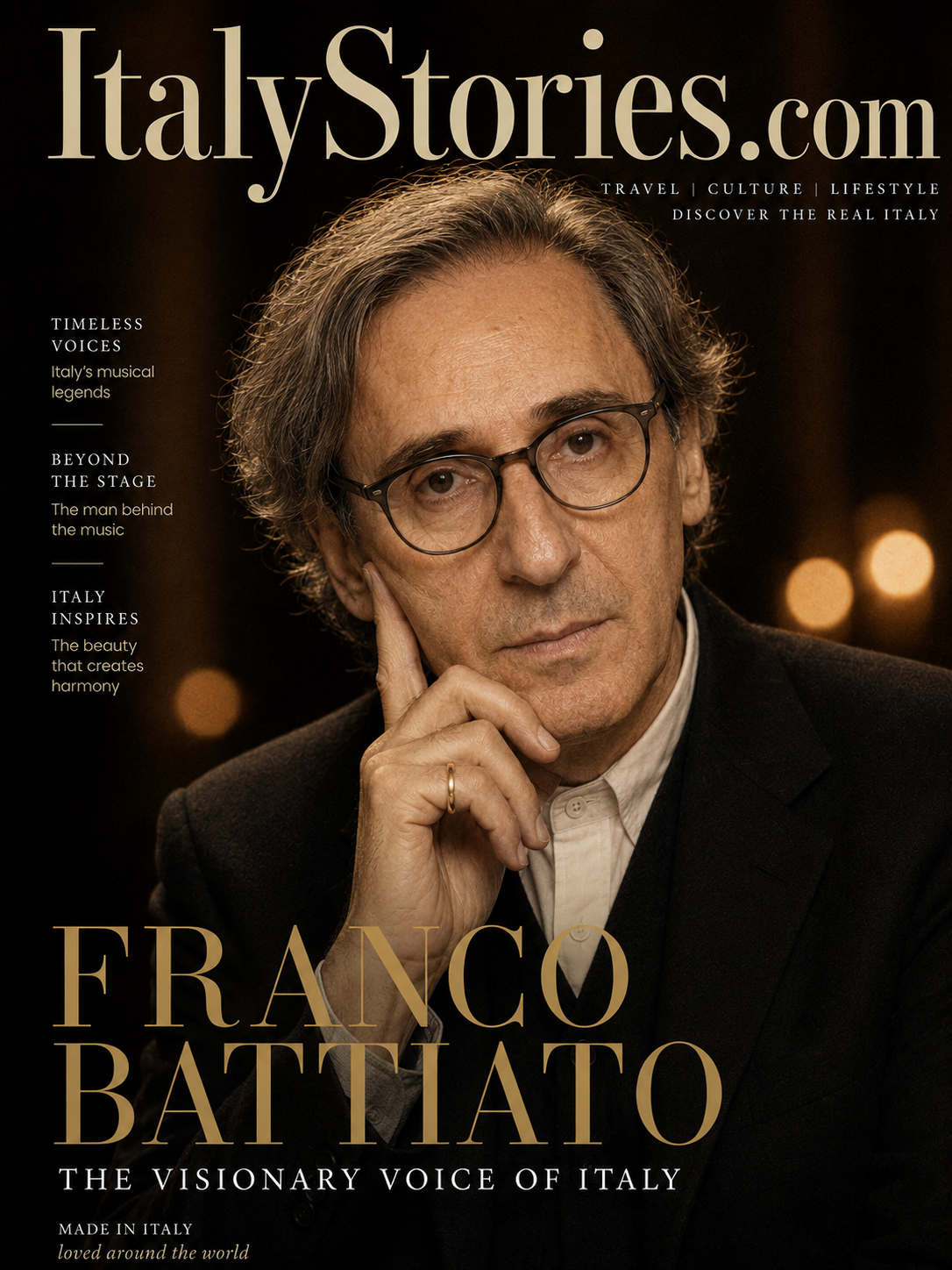
The Pop Star Who Asked the Wrong Questions
In the early 1980s, Italian radio began broadcasting songs that behaved as though the normal rules of popular music had been suspended. Their refrains were immediate, their rhythms were bright, and millions of people could sing them. Yet inside those melodies lived references to mysticism, political decline, Central Asian dances, Renaissance painting, Wagner, Arab culture, contemporary philosophy, advertising slogans and the strange habits of modern life.
The man singing them did not look or speak like a conventional pop star. Franco Battiato seemed both amused by fame and slightly detached from it, as if mass success were an unexpected experiment he had decided to observe from inside. He could write a chorus that filled summer beaches and then spend the next interview discussing consciousness, Gurdjieff, Sufi thought or the discipline required to escape mechanical habits.
This contradiction is the key to Battiato. He was capable of reaching the widest possible audience without simplifying his mind for it. His most popular songs were not concessions made after an avant-garde youth. They were another form of research. He had discovered that the same intellectual curiosity that once produced difficult electronic records could also be hidden inside an irresistible three-minute song.
Few Italian artists have moved through so many apparently incompatible worlds with such freedom: beat music, progressive rock, electronics, contemporary composition, new wave, opera, orchestral song, cinema, painting, spiritual research and mass-market pop. Fewer still managed to remain recognizable through every transformation.
Battiato did not build a career by defending a fixed style. He built it by changing. The real continuity was not genre but attention: an almost obsessive search for what lay beyond habit, fashion and the ordinary noise of the self.
Jonia: A Childhood in a Town That Disappeared
Franco Battiato was born on March 23, 1945, in Jonia, in eastern Sicily, in the province of Catania. The name itself carries a small historical oddity: Jonia was an administrative creation that soon disappeared, divided again into Giarre and Riposto. Battiato would later enjoy the paradox of having been born in a town that no longer existed.
He grew up close to the Ionian coast, in a landscape of sea air, citrus, heat, religious ritual and the looming presence of Mount Etna. Sicily would remain central to him even after long years in Milan. It was never merely a picturesque origin. It was a geography of memory and, eventually, a place of retreat.
His father, Salvatore, spent long periods away for work and had worked as a driver and dock laborer; his mother, Grazia Patti, was connected with the world of sewing and tailoring. The household was not an intellectual salon. Battiato’s later appetite for philosophy, theology, literature and music was largely self-created, born from curiosity rather than inheritance.
Music appeared early. He became fascinated with instruments and, while still young, began to play and perform. His adolescence was marked by the familiar tension between artistic desire and the expectations of practical life. Sicily in the 1950s and early 1960s offered beauty, community and strong traditions, but it did not offer an obvious path for a young man who wanted to investigate the outer edges of music.
The death of his father in 1964 accelerated the break with home. Battiato left Sicily, first passing through Rome and then settling in Milan. He was nineteen. The move was not only geographic. It placed him inside the city that would shape the first great half of his artistic life.
Milan: Cabarets, Small Jobs and the First Door into Music
Milan in the mid-1960s was very different from the Mediterranean world Battiato had left behind. It was industrial, fast, foggy, modernizing and culturally restless. The city was becoming one of the central laboratories of Italian music, publishing, design and television.
Battiato survived through modest work and small musical opportunities. He played guitar, appeared in cabaret environments and moved among performers who were themselves helping redefine Italian popular entertainment. One of the most important encounters of this period was with Giorgio Gaber, who recognized his unusual personality and encouraged him.
The young Battiato initially worked inside the conventions available to him. He recorded romantic and protest-oriented songs, appeared on television and tried the normal routes by which a new singer might become known. Some early singles were issued under the name Francesco Battiato before “Franco” became the public identity that would remain.
But something did not fit. The music industry of the late 1960s could offer him a career as a singer, yet he was increasingly interested in sound itself. He listened beyond the traditional Italian song form. Electronic instruments, progressive rock, contemporary composition and the European avant-garde suggested that music could be architecture, texture and experiment rather than merely melody plus lyric.
The decisive move in Battiato’s development was therefore not the discovery of a hit song. It was the discovery that he could abandon the path toward ordinary success before he had even achieved it.
The VCS3 and the Courage to Become Difficult
Around the end of the 1960s and the beginning of the 1970s, Battiato immersed himself in electronic music and experimental rock. The arrival of synthesizers such as the EMS VCS3 opened a new world. These machines were still exotic in Italian popular music. They did not simply imitate orchestral instruments; they generated sounds that seemed to belong to a future with no established vocabulary.
Battiato embraced them.
He worked near Juri Camisasca and the progressive-rock environment of the Osage Tribe, and entered the orbit of the Bla Bla label, one of the homes of adventurous Italian music. The albums that followed—Fetus, Pollution, Sulle corde di Aries, Clic and M.elle le “Gladiator”—created a body of work unlike anything he would later make during his pop breakthrough.
Fetus, released in 1971, drew inspiration from Aldous Huxley and imagined biology, technology and human development through electronic sound. Pollution pushed further into conceptual territory. Sulle corde di Aries combined experimental thinking with a more hypnotic and meditative sense of space. Clic moved toward abstraction and instrumental research.
These records did not make Battiato a household name. They did something more important first: they taught him that he did not need permission to change language.
The experimental years also brought him into contact with the wider European avant-garde. He was fascinated by composers such as Karlheinz Stockhausen and John Cage, by minimalism, repetition and the idea that silence and structure could be as important as melody. His work became progressively less tied to rock and more connected to contemporary composition.
By the second half of the decade, Battiato was making music so demanding that the audience for it became small. For many artists, that would have represented failure. For Battiato, it was another stage of training.
From Electronic Chaos to the Piano of “L’Egitto prima delle sabbie”
The later 1970s found Battiato moving even farther away from conventional song. Albums released through Ricordi explored severe, often difficult forms. Juke Box and the self-titled Battiato belong to a phase in which he was increasingly concerned with contemporary composition rather than pop structure.
The culmination came with L’Egitto prima delle sabbie, a work for piano that received the Stockhausen Prize in 1978. The recognition was symbolic. Battiato, who had begun by singing in clubs and recording commercial singles, had now gained acknowledgment in a field associated with experimental composition.
Yet artistic development does not always proceed in a straight line from popular to difficult. Battiato had already learned the hardest lessons of abstraction. The next challenge would be the opposite: could complexity be compressed without becoming superficial?
The answer arrived almost immediately.
Instead of remaining in the small world of contemporary music, Battiato returned to the song. He did not return as the same man who had left it. He brought with him electronics, philosophy, irony, repetition, unusual harmonic thinking and an ear trained by years of experimentation.
The result was one of the most surprising reinventions in Italian music history.
“L’era del cinghiale bianco”: The Return to the Song
In 1979 Battiato released L’era del cinghiale bianco, his first album for EMI and the beginning of a new period. The title referred to symbolic and spiritual imagery, but the music was suddenly far more accessible than the severe works that had preceded it.
This was not a retreat. It was synthesis.
The album and the following Patriots in 1980 introduced a new Battiato: melodic, witty, rhythmically modern, electronically alert and lyrically unpredictable. The songs contained quotations, cultural fragments, jokes and references that moved at unusual speed. A listener could enjoy the refrain without understanding every allusion.
An essential collaborator in this transformation was violinist and arranger Giusto Pio. Their partnership brought discipline and elegance to Battiato’s intuitive imagination. Pio could help translate eccentric musical ideas into arrangements that were both refined and playable. The combination of Battiato’s conceptual restlessness and Pio’s classical musicianship became fundamental to the sound of the period.
The songs also carried a new attitude toward pop language. Battiato could criticize consumer culture while using the bright tools of consumer-era music. He could write against conformity in a form designed for radio. This tension produced songs that were entertaining and destabilizing at the same time.
The commercial breakthrough was close. Almost nobody could have predicted how large it would become.
1981: The Year Battiato Conquered the Mainstream
In 1981 two events made clear that Battiato had entered the center of Italian music.
The first was “Per Elisa,” written with Alice and Giusto Pio and performed by Alice at the Sanremo Music Festival. The song won the festival. It had the energy of modern pop but none of the sentimental predictability often associated with Sanremo. Alice’s severe, elegant vocal presence matched Battiato’s writing perfectly.
The second event was La voce del padrone.
Released in 1981, the album became a phenomenon. It was the first Italian long-playing record to surpass one million copies sold and stayed at number one for eighteen non-consecutive weeks in 1982. Its seven tracks included “Summer on a Solitary Beach,” “Bandiera bianca,” “Gli uccelli,” “Cuccurucucù,” “Segnali di vita,” “Centro di gravità permanente” and “Sentimiento nuevo.”
There is almost no filler because the album is too short to hide any. Every song contributes a different angle on the same extraordinary synthesis: electronic rhythm, classical detail, absurdist quotation, philosophical unease and pop hooks.
“Centro di gravità permanente” became one of the most famous songs in Italian music, yet its central image is not a conventional romantic metaphor. It imagines the desire for an inner center stable enough to resist changing opinions and identities. Millions sang the refrain because the melody was irresistible; many later returned to the words and discovered another layer.
“Bandiera bianca” was sharper, a satirical inventory of cultural exhaustion and fashionable nonsense. “Cuccurucucù” assembled fragments of pop memory into a strange collage of nostalgia and distance. “Gli uccelli” transformed observation of flight into something almost metaphysical.
Battiato had achieved the apparently impossible: mass success without reducing his eccentricity.
Why “La voce del padrone” Changed Italian Pop
The importance of La voce del padrone cannot be measured only by sales. Its deeper effect was psychological. It changed what the Italian record industry could imagine as popular.
Before Battiato, sophisticated references and experimental production were often treated as belonging to separate cultural territories from commercial song. He showed that they could coexist. A synthesizer line, a string arrangement, a surreal quotation and a perfectly memorable chorus did not have to cancel one another.
This opened space for later generations of artists who wanted to be intelligent without sounding academic and accessible without becoming predictable.
Battiato also changed the relationship between lyric and listener. He did not always explain. He allowed strange words, names and images to pass through the song without stopping to make them convenient. This created mystery. Listeners could live with a song before fully understanding it.
That strategy respected the audience more than simplification would have. It assumed curiosity.
La voce del padrone therefore became a rare object: an album beloved by the general public and studied by critics, musicians and intellectuals. It entered popular memory while retaining the atmosphere of an experiment that had somehow escaped the laboratory.
The Songwriter Behind Other Voices
Battiato’s influence in the early 1980s extended beyond his own records. He became a crucial songwriter, producer and artistic guide for other performers.
Alice was one of the most important. Their musical relationship produced “Per Elisa” and later “I treni di Tozeur,” and she remained one of the singers most naturally aligned with his aesthetic. Her controlled voice could carry the cool intensity and spiritual distance of his writing without making it theatrical.
Giuni Russo was another extraordinary figure connected with Battiato’s world. Her album Energie, released in 1981, included material written with his involvement, including “Lettera al governatore della Libia.” Russo’s exceptional vocal range allowed Battiato to explore material that no ordinary pop voice could have handled.
Milva brought “Alexander Platz” to a broad audience, transforming a song Battiato had originally composed earlier into one of her signature performances.
He also wrote or contributed material for other major Italian artists over the years. These collaborations reveal a skill sometimes obscured by his image as an eccentric intellectual: Battiato understood voices. He could imagine how a song would change when inhabited by another personality.
The result was an influence larger than his own discography. In the early 1980s, a significant part of Italian art-pop carried traces of Battiato even when he was not the person at the microphone.
From “L’arca di Noè” to “Mondi lontanissimi”: Pop as Geography
The albums that followed La voce del padrone did not simply repeat its formula.
L’arca di Noè in 1982 contained “Voglio vederti danzare,” one of Battiato’s most enduring songs, built around images of dancing traditions from different parts of the world. What could have become exotic tourism instead functions as a meditation on ritual, movement and cultural memory.
Orizzonti perduti in 1983 turned more inward, while Mondi lontanissimi in 1985 explored distance, science, space and spiritual longing. Battiato’s titles themselves suggested movement: lost horizons, distant worlds, signals of life, trains across deserts.
Travel in his songs was rarely only tourism. It was a metaphor for changing states of perception.
This period also expanded his audience outside Italy. Spanish-language versions and international editions helped make him especially significant in Spain and parts of the European market. His pronunciation, melodies and unusual image carried well across borders because the music already seemed to belong to more than one cultural zone.
Battiato was Italian in language and sensibility, Sicilian in memory, European in artistic references and increasingly drawn toward the Middle East and Asian spiritual traditions. His music became a map with no stable center.
“I treni di Tozeur”: Eurovision Without Surrender
In 1984 Battiato and Alice represented Italy at the Eurovision Song Contest with “I treni di Tozeur.” They finished fifth.
The song remains one of the strangest and most beautiful Italian entries in Eurovision history. Its subject was inspired by Tozeur in Tunisia, an oasis landscape associated with mirages, salt flats and trains glimpsed against the desert horizon. The arrangement incorporated a passage linked to Mozart, giving the song a sudden classical eruption inside a modern electronic frame.
For a contest often associated with immediate spectacle, “I treni di Tozeur” was remarkably elegant and enigmatic. It did not imitate the dominant European pop language. It brought Battiato’s own vocabulary to the stage.
The performance also reinforced the artistic bond with Alice. Their voices were very different but complementary: his more conversational and detached, hers crystalline and severe.
The song later appeared in other-language versions and entered Battiato’s own catalog as a solo recording. Its endurance demonstrates something central to his international success. He crossed borders most effectively when he did not try to sound borderless.
Gurdjieff, Sufism and the Search for an Inner Discipline
Battiato’s spiritual interests are often described with the vague word “mysticism,” but his curiosity was more structured than that. He read widely across religious, philosophical and esoteric traditions, with a particular interest in the teachings of G. I. Gurdjieff, Sufi thought, Christian mysticism, Buddhism and the disciplines of self-observation.
He was not satisfied with spirituality as decorative imagery. He was interested in practice: attention, meditation, the observation of automatic behavior and the possibility of inner transformation.
These ideas entered the songs gradually. Sometimes they appeared directly, sometimes as atmosphere. The recurring desire to escape mechanical repetition, to find an inner center, to move beyond ego and habit, belongs to this search.
In 1985 Battiato founded the publishing house L’Ottava, which issued books by authors connected to Gurdjieff, Islamic mysticism and other traditions of spiritual investigation. An associated record label later released music positioned between classical composition, ethnic traditions and sacred research.
This activity is crucial for understanding him. The philosophy was not a marketing costume placed around the albums. He invested time and money in texts that most pop audiences would never encounter.
The famous songs and the obscure books belonged to the same project: the attempt to use culture as a tool for attention.
When Pop Was No Longer Enough: “Genesi” and the Classical Turn
By the mid-1980s Battiato had achieved a level of popular success that could have supported a comfortable career indefinitely. Instead, he began moving once again toward more demanding forms.
He had been working on Genesi, an opera that premiered at the Teatro Regio in Parma in 1987. The project marked a decisive return to large-scale composition and sacred-philosophical themes. Battiato was not abandoning pop, but he was refusing to let it define the limits of his work.
Fisiognomica, released in 1988, became one of the finest bridges between his popular and spiritual worlds. Songs such as “E ti vengo a cercare” and “L’oceano di silenzio” carried devotional intensity without belonging neatly to religious music. Their language suggested a search for another person that could also be heard as a search for the divine, for the self or for a state of consciousness.
The tour that followed was documented on Giubbe rosse, his first major live album. By then the Battiato concert had become an unusual event: electronic-pop classics could coexist with classical musicianship, spiritual songs and material he had written for others.
The audience followed him.
That trust is one of the great achievements of his career. Battiato trained a mass public to accept change.
Milo: Returning to Sicily Without Retreating from the World
In 1989 Battiato left Milan and returned to Sicily, settling in Milo on the slopes of Mount Etna.
The move can be misunderstood as retirement from modern life. It was not. Milo gave him distance, silence and a different rhythm, but he remained creatively active. His house, Villa Grazia, became a place for composition, reading, meditation and painting. The landscape looked toward both Etna and the Ionian coast, joining the volcano and the sea that had framed his childhood imagination.
For years, Lucio Dalla was among the notable neighbors in the area, creating the almost surreal idea of two of Italy’s greatest songwriters living close to one another in a quiet Sicilian village.
Milo also became the physical expression of Battiato’s resistance to celebrity culture. He did not need to live where the industry lived. He could work from a place built around concentration.
After his death, the Sicilian cultural authorities began procedures to recognize Villa Grazia as a place of cultural interest. The decision makes sense. The house was more than a residence. It was one of the laboratories in which Battiato’s later music, paintings and ideas took shape.
“Povera patria” and the Civil Voice
Battiato is often remembered as detached from ordinary politics, but that image is incomplete. His distance from party language did not mean indifference to civic decline.
“Povera patria,” released on Come un cammello in una grondaia in 1991, is one of the most direct political songs in his catalog. Its language is severe, describing a country degraded by abuse of power, incompetence and corruption.
The song became a reference point during periods of Italian political crisis because it was specific enough to sting and broad enough to survive the particular government of the moment.
This civil anger coexisted with the album’s refined classical material, including reinterpretations of nineteenth-century Lieder. The juxtaposition was typical Battiato: political disgust beside Schubert and Beethoven, contemporary Italy beside the European art-song tradition.
He refused the normal separation between “high” and “popular” culture because he did not believe the listener had to choose one level of attention. A record could protest the present and converse with the nineteenth century at the same time.
Baghdad, 1992: Music Against Isolation
On December 4, 1992, Battiato performed at the National Theatre in Baghdad.
The timing made the concert extraordinary. Iraq was living under severe international sanctions after the Gulf War, and the civilian population was suffering from shortages of medicine and basic goods. Battiato joined the humanitarian initiative Un ponte per Baghdad and traveled with Italian musicians and medical supplies.
The concert combined his own compositions with orchestral material and was performed with Italian and Iraqi musicians. The event later circulated in video form, and its proceeds were connected with humanitarian aid. Eight Iraqi children with serious medical conditions were brought to Italy for treatment through the initiative.
Battiato attracted criticism for traveling to a country whose regime was internationally condemned. His position was that helping civilians did not require political agreement with a government.
The Baghdad concert reveals the difference between his spiritual language and passive withdrawal. For Battiato, inner work was not meant to produce indifference. It was supposed to sharpen responsibility.
The trip also reflected his long fascination with the cultures of the Middle East. In Baghdad, those interests stopped being references inside lyrics and became physical encounter.
Opera, Sacred Music and “Messa Arcaica”
The 1990s intensified Battiato’s work in large-scale and sacred composition.
His second opera, Gilgamesh, appeared in 1992, drawing on one of humanity’s oldest surviving epic narratives. Messa Arcaica followed, first performed in 1993 in the Upper Basilica of Assisi. Structured around the traditional sections of the Christian Mass, the work is neither conventional liturgical music nor a pop artist’s decorative experiment with sacred atmosphere.
It reflects Battiato’s long search for forms capable of creating attention.
The music does not insist on spectacle. It often moves through repetition, suspended harmony, choral texture and contemplative space. In this sense, Messa Arcaica connects directly with the concerns of the experimental Battiato of the 1970s, even though the language is entirely different.
Decades later, the work continued to be performed in major memorial events. In 2025, during the year marking the eightieth anniversary of Battiato’s birth, Messa Arcaica was performed at the Pantheon in Rome as part of an official cultural tribute.
That later recognition confirms how difficult it is to describe Battiato simply as a singer-songwriter. The song catalog is only one part of the architecture.
Manlio Sgalambro: The Philosopher Enters the Song
A decisive new chapter began in the mid-1990s through Battiato’s collaboration with the Sicilian philosopher Manlio Sgalambro.
Sgalambro’s writing was sharp, paradoxical, pessimistic and intellectually provocative. He did not sound like a normal pop lyricist because he was not one. Battiato recognized that this difference could produce a new language.
Their collaboration shaped albums including L’ombrello e la macchina da cucire, L’imboscata, Gommalacca, Ferro battuto, Dieci stratagemmi and Il vuoto.
The partnership refreshed Battiato at precisely the moment when a veteran artist might have begun repeating his past. Instead, he entered one of the strongest phases of his career.
Sgalambro’s philosophical severity met Battiato’s melodic instinct. The result could be dark, comic, tender or metaphysical. Their songs often sounded as though abstract ideas had been forced into the body of pop and discovered they could dance there.
The collaboration also demonstrated Battiato’s unusual lack of ego about authorship. He did not need every word to be his in order for the artistic world to remain unmistakably his.
“La cura”: A Love Song Larger Than Romance
L’imboscata, released in 1996, contained “La cura,” the song that became perhaps Battiato’s most universally loved late-period composition.
It is often treated simply as a love song, and it certainly can be heard that way. The speaker promises protection from fear, failure, illness, injustice and the ordinary violence of life. The language is intimate but almost impossibly expansive.
That scale is what makes the song unusual.
“La cura” can be addressed to a lover, a child, a soul, another human being or even the fragile self one is trying to protect. The promise is so complete that it crosses from romance toward spiritual guardianship.
The melody remains controlled. Battiato does not oversing it. The restraint allows the words to become more powerful because the song never begs the listener to feel.
Its endurance has been remarkable. “La cura” has been performed by singers across generations and genres, used in ceremonies, television, personal dedications and public memorials. It entered Italian culture in the way only a few songs do: no longer belonging entirely to the artist who wrote it.
For a musician once associated with abrasive electronics and difficult composition, there is something beautiful in the fact that one of his greatest legacies is a song built around care.
“Gommalacca,” “Shock in My Town” and the Return of Electricity
Battiato’s late 1990s work was not only contemplative. Gommalacca in 1998 brought harder electronic textures and rock energy back into his sound.
“Shock in My Town” is one of the album’s defining tracks, mixing technological anxiety, urban aggression and a sense of civilization losing inner direction. Battiato’s voice remains relatively calm while the arrangement pushes around it, creating a productive tension between observer and environment.
The record showed again that age did not make him conservative. He remained curious about contemporary production and willing to place his voice against harsh or unfamiliar textures.
This ability explains much of his influence on later Italian alternative and electronic artists. Battiato did not act like an elder defending the sound of his youth. He kept listening forward.
“Fleurs”: Singing Other People’s Songs as Autobiography
In 1999 Battiato released Fleurs, an album largely made of songs written by others.
The idea might seem like a retreat after the conceptual intensity of his recent work. Instead, the record became another form of autobiography.
Battiato chose songs from Italian and French writers he admired, including Fabrizio De André, Sergio Endrigo, Jacques Brel, Charles Aznavour and Charles Trenet, along with material from other traditions. Recorded rapidly at his home in Milo with restrained arrangements, the album revealed what happened when his mature voice entered songs that had shaped his memory.
His interpretation of De André’s “Amore che vieni, amore che vai” is especially revealing. Battiato did not imitate De André. He removed the song from its original vocal identity and allowed its structure to appear in another light.
The Fleurs project later expanded with further volumes. These records demonstrated the seriousness with which Battiato listened to the song tradition around him. He had spent years breaking forms apart; he could now return to older melodies with humility.
The avant-gardist had become a custodian without becoming nostalgic.
Cinema, Painting and the Need to Change Medium
Music was never enough to contain all of Battiato’s interests.
He painted, sometimes signing works with the name Süphan Barzani, and exhibited his visual art. The paintings often carried the same attraction to sacred figures, Eastern imagery, symbolic portraiture and stillness found in his music.
In 2003 he made his feature-film directing debut with Perdutoamor, a semi-autobiographical journey between Sicily and Milan. The screenplay was written with Sgalambro. The film explored formation, memory and the cultural atmosphere of postwar Italy rather than following the logic of conventional pop-star cinema.
Musikanten followed in 2006, approaching the final years of Beethoven through an unconventional frame, and Niente è come sembra appeared in 2007. His cinema was often philosophically ambitious and not always easy, much like his experimental music.
The importance of these films lies less in whether Battiato became a major filmmaker than in the reason he made them. He needed new containers for the same questions.
What is identity? What survives time? How does consciousness change? What does art do to the person making it?
Battiato kept changing media because the inquiry remained unfinished.
Public Office and the Problem of Power
For a brief period between 2012 and 2013, Battiato served as a regional official in Sicily, appointed to oversee tourism and cultural initiatives.
The experience was short and controversial. His language, perfectly suited to the independence of an artist, did not always fit political institutions. The episode ended after only a few months.
Yet even this failed experiment is revealing. Battiato had spent decades criticizing cultural decline and mechanical public life. Entering government placed him inside the structure he had observed from outside.
He discovered, perhaps predictably, that artistic independence and political administration obey different rules.
The episode never became central to his legacy, but it confirms that his civil interests were real enough to make him risk practical involvement rather than remain only a commentator.
The Final Records: “Apriti sesamo,” Experiment Again, and “Torneremo ancora”
Battiato’s later discography continued to move between song and experiment.
Apriti sesamo in 2012 reunited him with Sgalambro’s intellectual world and offered one of the final major collections of new songs from their collaboration. In 2014, Joe Patti’s Experimental Group returned explicitly to electronic research, revisiting the spirit of the 1970s without simply reproducing it.
The anthology Le nostre anime in 2015 attempted to summarize an impossible career across pop, mysticism, classical composition and film. A 2016 tour with Alice reunited two voices whose artistic relationship had begun decades earlier.
Then came Torneremo ancora in 2019, recorded with the Royal Philharmonic Concert Orchestra. The title song became Battiato’s final new statement released during his lifetime.
Its central idea—return, transformation, the persistence of consciousness beyond a single form—was inseparable from the spiritual questions that had followed him for decades.
By then his health had limited public activity, and he announced his definitive retirement from the stage.
There was no dramatic farewell performance. The career ended as much of his life had been lived: with distance from spectacle.
Milo, May 2021: The Silence After the Music
Franco Battiato died on May 18, 2021, at his home in Milo. He was seventy-six.
His family kept the funeral private, consistent with the reserve that had surrounded his final years. Italy responded with an unusual intensity of mourning. Musicians from radically different generations and genres described him not simply as an admired artist but as someone who had changed the boundaries of what they thought Italian music could be.
The diversity of the tributes revealed the scale of his influence. Rock musicians, pop singers, electronic artists, classical performers, filmmakers, writers and public institutions all claimed a relationship with the work.
That breadth would have pleased the artist who had spent his life refusing categories.
He died in Sicily, close to Etna and the landscape from which he had first departed more than half a century earlier. The journey from Jonia to Milan, from electronic laboratories to million-selling albums, from Baghdad to opera houses, from pop television to meditation rooms, had returned to the island.
The Voice: Detachment as a Form of Intensity
Battiato’s singing voice was never based on vocal virtuosity. Its power came from something rarer: point of view.
He often sang with apparent detachment, keeping the line straight and resisting the emotional exaggeration common in Italian pop. This made his songs more mysterious. A lyric could be deeply moving while the singer remained almost calm.
That calm was not absence of feeling. It was discipline.
The voice also evolved. In the early experimental years it could be raw or buried inside electronic sound. During the 1980s it became clearer and more controlled, ideally suited to the cool architecture of the arrangements. In the later spiritual songs, age added a fragility that made the restraint even more affecting.
His pronunciation was another essential part of the style. Words arrived cleanly, allowing unusual names and references to remain audible. Battiato wanted the listener to hear language as sound but also to notice the words.
He proved that a singer did not need to display emotion constantly in order to create it. Sometimes the strongest performance is the one that leaves space for the listener to supply the final intensity.
Why Battiato’s Lyrics Still Feel Modern
Battiato’s lyrics age unusually well because they were never dependent on the normal vocabulary of their era.
He wrote about television, politics and consumer habits, but he rarely sounded like a topical songwriter trapped inside yesterday’s headlines. He placed contemporary details beside ancient images, foreign languages, philosophy, geography and fragments of remembered songs.
This collage technique anticipated the way modern culture is now experienced: multiple contexts arriving simultaneously, serious and trivial material mixed without warning, information and memory competing for attention.
At the same time, the deepest questions in the songs remain timeless. How does a person stop being mechanical? What is freedom? How can one care for another? Is there a stable self beneath changing identities? What survives death? Can beauty alter consciousness?
Battiato never answered these questions with a doctrine. He returned to them.
That is why listeners continue to discover new meanings in songs they have known for decades. The work does not close after the first understanding.
The Artist After Death: A Legacy Still Moving
Battiato’s death did not turn his work into a sealed museum.
The Franco Battiato Foundation has supported projects devoted to his artistic and philosophical legacy. Concert tributes have brought his music to the Arena di Verona, Milan Cathedral, the Pantheon and other major cultural spaces. Artists including Alice, Carmen Consoli, Mahmood, Jovanotti, Gianni Morandi, Gianna Nannini, Diodato, Subsonica and many others have interpreted his songs in public celebrations.
In 2025, marking eighty years since his birth, the official Foundation supported All’essenza, a major collection of Battiato’s thoughts drawn from decades of documented interviews. The same anniversary year included performances of Messa Arcaica and his mystical songs at the Pantheon in Rome.
These projects matter because they resist the easiest version of commemoration. Battiato is not remembered only through “Centro di gravità permanente” and the other hits. His philosophy, sacred music, experimental work, film and visual art are increasingly treated as parts of one archive.
The more complete the archive becomes, the stranger and more impressive the career looks.
Why Franco Battiato Still Matters
Franco Battiato still matters because he solved a problem that remains difficult for artists: how to reach millions without underestimating them.
He refused the idea that popular music had to be intellectually simple. He also refused the opposite idea that intelligence required obscurity.
He could write L’Egitto prima delle sabbie and La voce del padrone. He could compose opera and a summer hit. He could make an electronic record, arrange a song for Alice, study Gurdjieff, perform in Baghdad, paint a dervish, direct a film and then return to write “La cura.”
These were not separate careers accidentally carried by one person. They were different methods of the same search.
The young Sicilian who moved to Milan wanted to become a musician. The mature Battiato became something harder to name: a songwriter who behaved like a philosopher, an experimentalist who understood mass culture, a spiritual seeker suspicious of slogans, and an Italian artist whose curiosity made national borders feel too small.
His songs remain alive because they continue to offer two pleasures at once. They can be sung immediately, and they can be thought about for years.
That combination is rare.
It is also why Battiato’s real “permanent center of gravity” was never a musical style. It was the refusal to stop searching.
A Final Thank You from ItalyStories.com
Thank you for spending time with this story. ItalyStories.com was created to explore the people, places, voices and ideas that have carried Italy far beyond its borders. Franco Battiato’s life reminds us that Italian culture is not only heritage to preserve, but curiosity to keep alive. If this journey has made you want to discover another chapter of Italy, we would be delighted to welcome you to the next story.
[…] Cutugno winning in 1980 with “Solo noi.” Alice won in 1981 with “Per Elisa,” written with Franco Battiato, a victory that proved sophisticated pop could succeed within the festival machine. Riccardo Fogli […]