

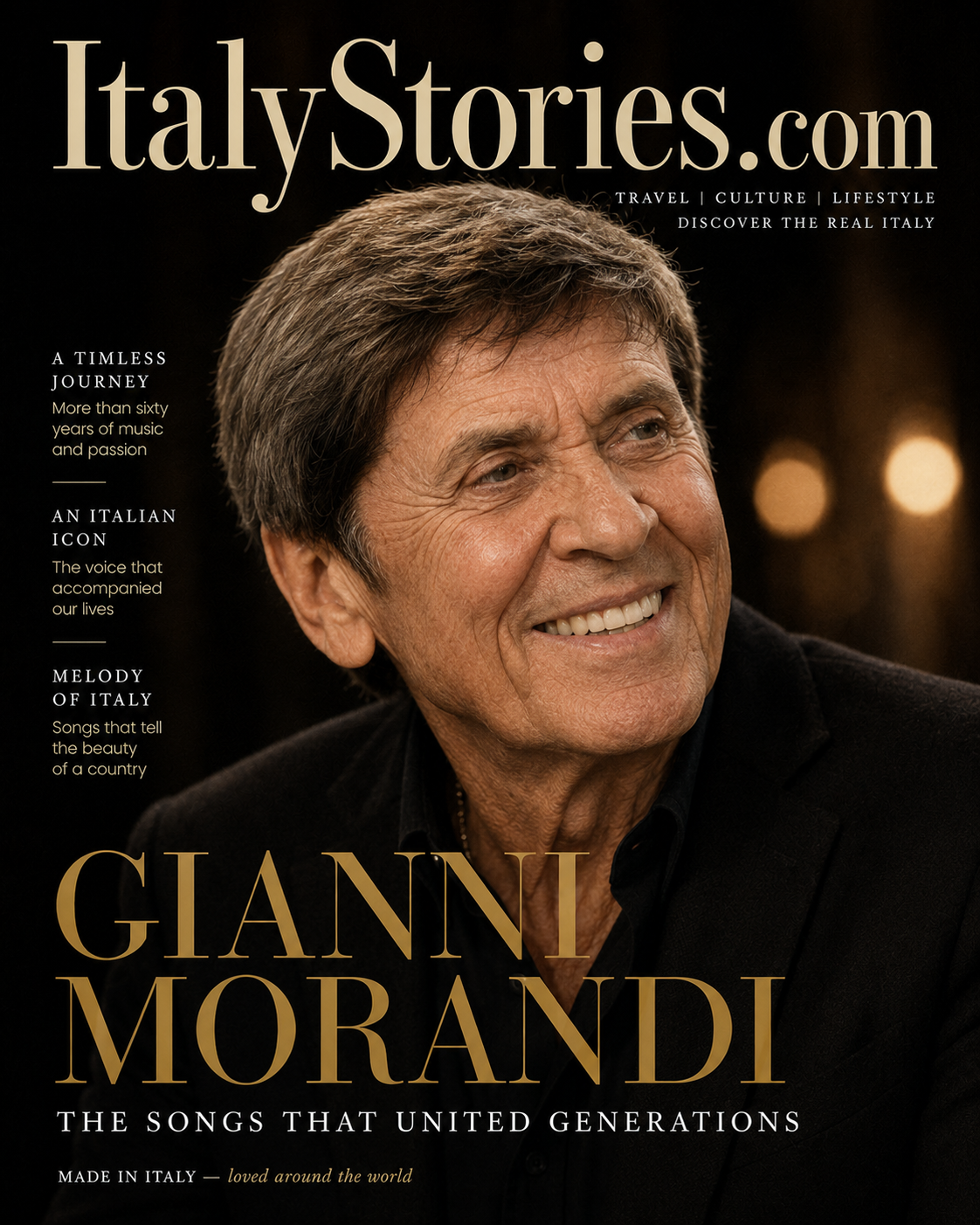
The Man Who Keeps Coming Back There are careers that can be summarized by a decade, a fashion, or a single great song. Gianni Morandi’s cannot. His story stretches from the village dance halls of postwar Emilia to the black-and-white television of the early 1960s, from the musicarelli cinema boom to Vietnam-era protest songs, from Sanremo victories to periods when the public seemed ready to move on without him, and from great partnerships with Lucio Dalla and Claudio Baglioni to a late-life creative renewal alongside Jovanotti and artists young enough to be his grandchildren. In 2026, more than sixty years after his first records, Morandi was still touring Italian arenas. The title of the show, C’era un ragazzo – Gianni Morandi Story, deliberately returned to the song that had marked one of the boldest moments of his youth. The tour celebrated sixty years of “C’era un ragazzo che come me amava i Beatles e i Rolling Stones,” but it was not simply an exercise in nostalgia. Morandi was still releasing new music, including “Hit Parade,” a 2026 duet with Alessandra Amoroso written by Jovanotti and Sixpm. This is perhaps the most revealing fact about him. He has never survived by pretending that time has stopped. He survives because he seems genuinely interested in what comes next. The phrase “eternal boy” has followed him for decades. It can sound like a television nickname, but in Morandi’s case it points to something deeper: curiosity, stamina, openness, and an unusual lack of resentment toward younger generations. He has repeatedly allowed new authors, new singers and new audiences into his career. Rather than defend his past like a museum, he keeps placing it in conversation with the present. That is why Gianni Morandi is not merely one of Italy’s best-known singers. He is one of the country’s great figures of popular continuity. His songs have accompanied courtships, military service, family lunches, television Saturdays, political anxieties, weddings, road trips, football matches and national rituals. Generations that disagree about almost everything can often sing the same Morandi chorus. To understand how that happened, however, we have to go back to Monghidoro, to a shoemaker’s son growing up in an Italy that had not yet become the prosperous country his songs would later help soundtrack. Monghidoro: A Childhood of Work, Politics and Songs Gian Luigi Morandi was born on December 11, 1944, in Monghidoro, a town in the Bolognese Apennines. The war was not yet over. The Italy of his birth was poor, fractured and exhausted, and the future that would later seem so optimistic in the years of the economic boom was still difficult to imagine. His father Renato was a shoemaker; his mother Clara worked hard to help support the family. Morandi has recalled a childhood in which work began early. He polished shoes, helped in his father’s shop and sold sweets at the local cinema. This was not the sentimental poverty sometimes added to celebrity biographies after success. It was the practical reality of a family with little money and a child expected to contribute. His father’s influence was strong and complicated. Renato was a committed communist and took his son’s education seriously. Monghidoro did not offer the easy educational opportunities of a city, so after elementary school much of Gianni’s instruction continued under his father’s strict supervision. Political newspapers, books and discussions entered the home. The boy might not have understood Marx or Lenin, as he later joked, but he grew up in an atmosphere where ideas, discipline and public life mattered. Music was there too. His parents sang. His father would sing while working leather; his mother loved the great popular voices of the period. Songs by Claudio Villa, Luciano Tajoli, Domenico Modugno and others belonged to a culture in which singing was not yet separated from ordinary life. People sang at home, in bars, at village gatherings, in dance halls. Before records turned performers into distant celebrities, music was something that happened among people. Morandi’s voice began attracting attention in that small world. He sang wherever he could and eventually found opportunities to audition and perform with local orchestras. In 1958, still a teenager, he was selected by Alda Scaglioni’s organization in Bologna after singing “Nel blu dipinto di blu,” the Domenico Modugno song that had just changed Italian popular music forever. Those early performances gave him something no studio could teach: the ability to face a room. Morandi’s later career would depend enormously on this instinct. Whether on television, in a stadium or with a guitar in front of a few people, he learned to communicate without creating distance between himself and the audience. His background also helps explain why fame never completely erased the image of the ordinary man. The smile, the handshake, the willingness to sing an old song again, the instinct to greet people rather than hide from them – all of that was rooted in a culture of direct social contact long before celebrity arrived. From Provincial Stages to RCA By the end of the 1950s and the beginning of the 1960s, Morandi was moving through the world of provincial entertainment: orchestras, summer venues, contests for new voices, village festivals and dance halls. The glamorous narrative of pop stardom often begins with a discovery, but discovery only matters when there is already something to discover. Morandi had spent years learning how to sing in public before the recording industry took serious notice. In 1962 he reached the turning point. RCA Italiana, one of the most important record companies in the country, signed him. Franco Migliacci, already a major lyricist and industry figure, became central to the young singer’s development. Morandi recorded “Andavo a cento all’ora,” a fast, youthful song that suited the new Italy of scooters, cars, television and acceleration. The title itself could almost serve as a symbol of the economic miracle. Italy was moving. Roads were expanding, consumer goods were multiplying, young people were acquiring tastes and identities increasingly distinct from those of their parents. Morandi arrived at precisely the moment when the country’s youth market was becoming culturally powerful. Soon came “Fatti mandare dalla mamma a prendere il latte,” one of those rare songs whose apparent simplicity becomes part of its immortality. The situation is almost comic: a young man tells a girl to invent an errand so she can leave home and meet him. Yet the song captures an entire social world. Courtship is supervised. Mothers matter. Streets and doorways become spaces of romance. Youthful desire has to negotiate the routines of family life. Decades later, children who had never lived in that social world still knew the song. That is one of Morandi’s most important gifts: he can make a specific historical situation feel immediately singable long after its original context has disappeared. Television amplified everything. His appearances introduced a face as important as the voice: open, energetic, slightly shy, smiling without irony. Morandi did not project danger. He projected possibility. For a country moving rapidly from rural hardship into consumer modernity, he looked like one of its sons stepping confidently into the new world. “In ginocchio da te”: When Success Became a National Phenomenon The real explosion came in 1964 with “In ginocchio da te.” Written by Franco Migliacci and Bruno Zambrini and arranged by Ennio Morricone, the song transformed Morandi from a successful young singer into a national phenomenon. The statistics alone are striking. The record remained at number one in Italy for seventeen weeks and sold more than a million copies. Morandi won the Cantagiro, one of the major musical competitions of the era. But numbers do not fully explain the effect. “In ginocchio da te” gave him a role in the emotional imagination of the country: the young romantic hero, sincere enough to kneel, dramatic enough to suffer, approachable enough for the public to believe him. The song also became a film. The musicarello – a film built around popular songs and a singing star – was one of the defining entertainment forms of 1960s Italy. Morandi appeared in In ginocchio da te, directed by Ettore Maria Fizzarotti, and then in related films such as Non son degno di te and Se non avessi più te. These productions may look naive to modern eyes, but they were culturally important. They fused records, cinema, youth fashion and celebrity into a single popular machine. Morandi was ideal for it because his persona could move naturally between screen and song. He did not need to become a complicated actor. The films extended the emotional universe already created by the records. The hits came quickly. “Non son degno di te” became another huge success and won the 1965 edition of Canzonissima. “Se non avessi più te,” “La fisarmonica,” “Notte di Ferragosto” and other songs kept him constantly in the charts. At one point in 1966, several Morandi titles appeared simultaneously in the Italian hit parade. This pace is important. Fame did not arrive gradually; it engulfed him. In a few years, the shoemaker’s son from Monghidoro became one of the most recognizable young men in Italy. Yet the very image that made him beloved also created a future problem. Morandi had become the symbol of clean, melodic, optimistic youth just as youth culture itself was preparing to become more restless, political and rebellious. To survive the coming change, he would need to complicate the image. A Love Song Meets the Vietnam War In 1966, Morandi recorded one of the most important songs of his career: “C’era un ragazzo che come me amava i Beatles e i Rolling Stones.” The title begins like a friendly recognition between young people. There was a boy, like me, who loved the Beatles and the Rolling Stones. The song then moves toward war. Written by Franco Migliacci with music by Mauro Lusini and arranged by Ennio Morricone, it tells of a young American whose ordinary life is interrupted by conscription and the Vietnam War. The boy who loved music is sent to fight and dies. The contrast between youth culture and military violence gives the song its force. For Morandi, the recording was artistically risky. He was associated with romantic songs and popular entertainment, not protest. The Italian media environment was cautious about direct references to the Vietnam conflict, and the song encountered censorship. Yet it endured and became one of the strongest anti-war songs in the Italian popular canon. Its significance is greater than the political message alone. “C’era un ragazzo” allowed the public to see that Morandi’s voice could carry something darker than adolescent love. The same sincerity that had made “In ginocchio da te” convincing could also humanize a story about war. The song’s international afterlife reinforced its importance. Joan Baez, one of the great voices associated with protest music, recorded it in Italian. A song born inside Italian pop had entered a much broader conversation about youth, music and war. For Morandi, it became a bridge between identities: the popular idol and the socially aware interpreter. He would never transform into a political cantautore in the mold of Francesco Guccini or Fabrizio De André. That was not his artistic nature. But he proved that mainstream song could carry moral weight without abandoning melody. Sixty years later, the song was still powerful enough to give its name to his 2026 arena tour. That longevity says everything. A song tied to Vietnam had outlived the historical moment because its deepest subject was not one war. It was the theft of youth by violence. Canzonissima, Military Service and the Peak of the 1960s The late 1960s confirmed Morandi’s extraordinary position. After the interruption of military service, he returned to a public that still wanted him. He won Canzonissima again with “Scende la pioggia,” the Italian adaptation of the Turtles’ “Elenore,” and then with “Ma chi se ne importa.” The victories demonstrated his command of the great television music rituals of the period. Canzonissima was not simply another contest. It was a national gathering. Families watched together, postcards became votes, songs entered kitchens and workplaces. To win meant penetrating deeply into the daily culture of the country. Morandi’s relationship with television was becoming inseparable from his musical identity. He understood camera intimacy. He could make a huge broadcast feel like a direct encounter. That gift later enabled him to move beyond singing into hosting, variety television and major live events. But the end of the 1960s also contained the first signs of instability. Italy was changing rapidly. The student movement, political conflict, new rock culture and the rise of more introspective singer-songwriters were shifting the terms of credibility. The cheerful idol of the early boom years could suddenly look too associated with an earlier innocence. Morandi reached 1970 still famous enough to represent Italy at the Eurovision Song Contest in Amsterdam. He performed “Occhi di ragazza,” composed by Lucio Dalla with lyrics by Sergio Bardotti and Gianfranco Baldazzi, and finished eighth. The song became a lasting part of his repertoire, and the Dalla connection would later grow into one of the most important friendships and artistic partnerships of his life. Yet Eurovision also stands near a dividing line. The first Morandi era – the era of unstoppable singles, musicarelli and national youth-idol status – was approaching its end. What came next would test him far more severely than early success ever had. When the Eternal Boy Suddenly Looked Out of Time One of the most interesting parts of Gianni Morandi’s career is that he did not remain permanently successful. He knows what decline feels like. In the early 1970s, the public mood changed, and so did musical taste. Rock grew harder, the cantautori became central cultural figures, political identity entered music more aggressively, and the old machinery of the 1960s youth star no longer guaranteed attention. Morandi, who had seemed almost invincible, found himself struggling to remain relevant. He has spoken openly about this period, recalling the feeling that at only twenty-seven he was already finished. That admission matters because it strips away the mythology of the effortless survivor. Reinvention is meaningful only when failure is possible. A famous symbolic episode came when Morandi appeared before a Led Zeppelin concert in Milan and faced hostility from part of the crowd. The clash was not simply about one performance. It represented the collision between two musical worlds. To a new rock audience, the clean-cut Italian pop idol could appear to belong to yesterday. Morandi did not solve the problem overnight. There were quieter records, attempts at repositioning, television work and the slow labor of rebuilding. This was the period in which he began to understand that a long career would require more than hits. It would require flexibility. He studied music more seriously, returned to performance from different angles and gradually freed himself from the need to remain the boy of 1964. That may be one of the hidden reasons he later aged so well in public. He had already lost the illusion that fame was permanent. Artists who never experience decline often become frightened when it finally comes. Morandi encountered it early enough to learn from it. He discovered that a public can leave – and that sometimes, if the relationship was deep enough, it can come back. Television, Acting and the Reinvention of Familiarity During the years when record sales were less dominant, Morandi expanded the other sides of his career. He acted, appeared in television fiction and increasingly demonstrated the hosting ability that would later make him one of Italy’s most trusted television presences. This diversification was not a retreat from music. It was a way of remaining in contact with the public while his musical identity matured. In Italian entertainment, television has often functioned as a second stage for singers, but Morandi used it especially well because of his natural accessibility. He could be formal without stiffness, comic without becoming a comedian, sentimental without seeming false. Audiences sensed that he genuinely liked people. That may sound like a small quality, but on television it is enormous. His acting work also broadened the public’s sense of him. In the 1984 television miniseries Voglia di volare, for example, he played a separated father navigating family tensions. The role belonged to a more adult world than the musicarelli of the 1960s. Morandi was no longer playing a fictional extension of a teenage pop star. He was entering middle age in public. That transition prepared the ground for the musical comeback that would follow. By the mid-1980s, he no longer needed to recover the past exactly as it had been. He could return as a mature interpreter whose earlier songs were part of his history rather than a costume he was forced to wear. “Uno su mille”: The Comeback Becomes a Philosophy In 1985, “Uno su mille” became one of the songs most closely associated with Morandi’s second great career. Its theme could hardly have been more appropriate: perseverance, the belief that only one in a thousand makes it, and the refusal to give up. The song’s importance lies partly in the way biography and repertoire fused. Listeners knew Morandi had already experienced extraordinary fame and a painful decline. When he sang about continuing despite the odds, the message did not sound theoretical. “Uno su mille” gave him a mature anthem. The young man who had once sung of secret meetings and romantic pleading could now sing about endurance. The optimism remained, but it had acquired scars. Two years later came another major public triumph. At Sanremo 1987, Morandi joined Umberto Tozzi and Enrico Ruggeri for “Si può dare di più.” The trio won the Festival. The title – “You can give more” – again suited Morandi almost too perfectly. It was a song about generosity and effort performed by an artist whose second career was becoming a lesson in both. The Sanremo victory was not merely a nostalgic reward for a beloved veteran. It demonstrated that Morandi still belonged to the contemporary center of Italian music. He had crossed from teen idol to adult institution without becoming inert. In the same period, “Gente di mare,” performed by Tozzi and Raf, represented Italy at Eurovision, while Morandi’s own path was moving toward a different but equally important partnership: Lucio Dalla. Lucio Dalla: Friendship, Contrast and the Song “Vita” Gianni Morandi and Lucio Dalla shared Emilia, fame and a long friendship, but artistically they were very different. Dalla was unpredictable, restless, harmonically adventurous and deeply associated with the cantautore tradition. Morandi was more direct, sunny, physical and instinctively connected to popular interpretation. Their differences made the partnership fascinating. The album Dalla/Morandi, released in 1988, and the tour that followed became major successes in Italy and abroad. The project allowed both men to enter each other’s musical worlds. They exchanged songs, energies and public identities. Morandi’s openness met Dalla’s eccentric intelligence. The song “Vita” became the emotional center of the collaboration. Written by Dalla and Mogol, it is one of those Italian songs that feels larger than its specific story. In Morandi and Dalla’s voices, the word “life” acquired different colors: one more open and declarative, the other more crooked and introspective. Together they created a balance neither would have produced alone. Their partnership also helped erase the old distinction between Morandi the interpreter and the supposedly more serious world of the cantautori. By the late 1980s, such hierarchies were becoming less useful. A great interpreter could stand beside a great songwriter not as a lesser figure but as a different kind of artist. The friendship mattered beyond the record. Morandi has repeatedly spoken of Dalla as one of the central people in his life. After Dalla’s death in 2012, the songs they had shared gained an additional layer of memory. “Vita” is now difficult to hear only as a hit. It has become a conversation preserved in music between two men, two styles and two versions of Emilia. A Voice Built for People Rather Than Perfection Morandi’s voice has never depended on mystery. It is immediately readable: bright, open, energetic, slightly nasal in its characteristic color, with a direct attack and a strong ability to carry melody. Technically, he is not remembered as an operatic virtuoso or as a singer obsessed with ornament. His art is interpretive clarity. The words arrive. The melody stays. The emotion is visible. That clarity explains why his songs work so well in communal settings. Morandi does not sing above the audience; he invites the audience into the song. Even in large arenas, his natural performance grammar remains that of shared singing. His vocal evolution is also interesting. The youthful records have speed, brightness and almost physical innocence. The mature voice gained weight and roughness without losing recognizability. Instead of hiding age, Morandi allowed it to deepen the older songs. A phrase about love sung at twenty and sung again at seventy does not mean the same thing, and he understands that. This is one reason his repertoire has survived live performance so well. The songs are not frozen replicas of their original recordings. They have aged with the singer and with the audience. The Public Man: Football, Running and the Art of Being Available Morandi’s public identity extends far beyond records. He became one of the founders and most recognizable participants in the Nazionale Italiana Cantanti, the charitable football team that brought musicians together for fundraising matches. The project perfectly matched his temperament: sport, public participation, charity and camaraderie. Running became another visible part of his life. Morandi completed marathons and half-marathons, including major international races. The image of the singer running is almost too symbolic: constant motion, endurance, an unwillingness to remain still. But perhaps his most significant public skill has been availability. Morandi is famous for taking photographs with people, responding warmly, appearing among ordinary crowds and using social media with a tone far less managed than many younger celebrities. This accessibility has sometimes been treated as a charming personality quirk. In reality, it is central to his longevity. Morandi has maintained an unusually reciprocal relationship with the public. He gives the impression that affection is not something he simply expects because of past success; it is something he continually returns. The effect is cultural. Italians often speak of “Gianni” as though he were a relative, neighbor or longtime acquaintance. Few stars reach that level of familiarity without losing respect. Morandi managed to become familiar and iconic at the same time. Claudio Baglioni and the Courage to Share the Stage In 2015 and 2016, Morandi entered another major partnership, this time with Claudio Baglioni. The project was called Capitani Coraggiosi – Courageous Captains – and the title captured both the scale and the playful self-awareness of the undertaking. Two artists with more than fifty years of career behind them joined repertoires, shared songs and performed long concerts that turned the history of Italian pop into a living dialogue. The initial series of events at Rome’s Foro Italico expanded into an arena tour, a live album and television broadcasts. Sony Music reported hundreds of thousands of spectators across the project. The collaboration worked because Baglioni and Morandi are different. Baglioni is associated with elaborate songwriting, romantic introspection and carefully built musical architecture. Morandi is associated with immediacy, interpretation and communal warmth. Together they created contrast rather than redundancy. More importantly, the project demonstrated Morandi’s lack of territorial anxiety. He has repeatedly shared stages with artists strong enough to challenge his own identity. Dalla, Baglioni, Jovanotti – none of them were decorative guests. They brought their own worlds. A star who is afraid of comparison tends to shrink with age. Morandi repeatedly expanded by standing next to other major figures. The 2021 Fire and a Song Called “L’Allegria” In March 2021, Morandi suffered a serious accident while burning brush in the garden of his home. He slipped and sustained burns to his hands, legs and other parts of his body. He spent twenty-seven days in the burns unit at the Bufalini Hospital in Cesena and later faced rehabilitation, particularly for his right hand. For a singer and guitarist, damage to the hands carries an obvious symbolic weight. Morandi had spent a lifetime using physical energy as part of his public identity; suddenly, recovery became literal. Then Lorenzo Jovanotti entered the story with a song. Morandi had previously asked Jovanotti to write something for him. After the accident, that conversation resumed, and “L’Allegria” arrived. Released in June 2021, the song felt almost uncannily suited to the moment. It was not happiness in the naive sense. It was the decision to move toward life after fear. The partnership between Morandi and Jovanotti became one of the most productive late-career encounters in Italian pop. Jovanotti brought rhythmic optimism, contemporary phrasing and a writer’s understanding of Morandi’s public essence. Morandi brought decades of history without sounding defensive about them. The accident could have marked the beginning of withdrawal. Instead, it became the prelude to another comeback. Sanremo 2022: A Sixty-Year Career Behaving Like a Debut At the 2022 Sanremo Music Festival, Morandi competed with “Apri tutte le porte,” written by Jovanotti. He finished third behind Mahmood and Blanco and Elisa, and won the Lucio Dalla Press Room Award. The result was remarkable not because an older singer had been politely honored, but because the performance felt genuinely alive. Morandi moved, smiled, sang and inhabited the song with the same appetite for contact that had defined him in the 1960s. The audience response did not feel like charity toward a legend. It felt like recognition of a current performance. “Apri tutte le porte” – “Open all the doors” – again seemed biographically perfect. Morandi’s career has repeatedly depended on exactly that gesture. When one door closed, he looked for another. The 2022 festival introduced him to a new wave of younger viewers who may have known his name before they knew his catalog. Social media transformed clips into shared moments, and his partnership with Jovanotti made him part of a contemporary pop conversation rather than a guest from history. A year later, Morandi returned to Sanremo as co-host alongside Amadeus for the entire 2023 edition. This role completed a circle. He had once been a competitor chasing the public’s vote. Now he stood at the center of the national festival as a trusted guide between generations. Evviva!, L’Attrazione and the New Generation Around Him The album Evviva!, released in March 2023, made the Jovanotti collaboration central rather than occasional. Several songs were written by Jovanotti, including the title track, while Morandi continued his dialogue with younger artists through new versions and collaborations. One of the most revealing recordings was “FATTI riMANDARE DALLA MAMMA A PRENDERE IL LATTE” with Sangiovanni. The title playfully reshaped the 1960s classic for a new generation. Instead of protecting the original as untouchable heritage, Morandi allowed it to be reopened. That instinct continued with L’Attrazione, released in December 2024. The album functioned partly as a career journey, combining iconic tracks with new material and fresh collaborations. The title song, written by Jovanotti and produced by Michele Canova, carried the partnership forward. A new version of “C’era un ragazzo” gathered a large group of younger Italian artists around Morandi, turning a 1966 anti-war song into a collective intergenerational recording. The symbolism was almost too perfect. The young singer who once sang about a boy who loved the Beatles and the Rolling Stones had become the elder artist surrounded by performers born decades after those bands first changed popular music. In 2024, Morandi also turned eighty. Rai celebrated the milestone, and his program Evviva! looked back across seventy years of Italian television. Yet even this retrospective role did not turn him into a monument. The emphasis remained on connection: old archive footage beside new guests, memory beside performance. Age, in Morandi’s career, became less a subtraction than an additional layer of meaning. 2026: Sixty Years After “C’era un ragazzo,” Still on the Road By 2026, Gianni Morandi had reached the kind of career length that almost stops sounding real. More than six decades had passed since his first RCA records, yet he returned to the main Italian arenas with C’era un ragazzo – Gianni Morandi Story, a tour built around the continuity of his repertoire. The 2026 concerts were explicitly tied to the sixtieth anniversary of “C’era un ragazzo che come me amava i Beatles e i Rolling Stones.” That song, once controversial and censored, had become one of the moral landmarks of his catalog. At the same time, he continued recording. In June 2026 he released “Hit Parade” with Alessandra Amoroso, a bright pop duet written by Jovanotti and Sixpm. The song played with the pleasure of lightness, radio memory and singing together. There is something almost architectural about this stage of Morandi’s career. The old songs support the new ones; the new collaborations illuminate the old songs. He is not trying to prove that he is twenty. He is proving that curiosity does not belong to an age. Few performers manage this balance. Some late-career stars become trapped inside nostalgia. Others strain so hard to appear current that they lose the identity people loved. Morandi’s solution has been simpler: remain himself, but keep opening the door. Why Gianni Morandi Still Matters Gianni Morandi matters because his career tells a larger Italian story. He emerged from postwar poverty and entered the age of the economic miracle. He became a youth idol when television was creating a national popular culture. He sang romantic songs at the height of the musicarello era, then risked a protest song about Vietnam. He experienced the humiliation of becoming unfashionable, rebuilt himself in television and music, returned with songs about perseverance, shared the stage with Lucio Dalla and Claudio Baglioni, won Sanremo, hosted Sanremo, survived a serious accident, and then found a new creative partner in Jovanotti. His catalog contains different Italies. “Fatti mandare dalla mamma” belongs to a country of supervised courtship and neighborhood streets. “In ginocchio da te” belongs to the melodramatic confidence of the boom years. “C’era un ragazzo” belongs to the political awakening of the 1960s. “Uno su mille” belongs to adult resilience. “Vita” belongs to friendship and reflection. “Apri tutte le porte” belongs to a late age that refuses closure. Morandi’s importance also lies in his relationship with the public. He has never cultivated distance as proof of greatness. His authority comes from the opposite direction: familiarity maintained over time. That is why the songs have united generations. Grandparents remember the original singles. Parents remember television and comeback records. Younger listeners know Sanremo 2022, Jovanotti, Sangiovanni, social media clips and arena shows. The same man exists in all those memories without becoming exactly the same person. His voice has changed. Italy has changed. The media have changed. The audience has changed. The contract has not. Gianni Morandi still walks onto a stage as if the most important thing is not that people remember him, but that for the next few minutes they will sing with him. That may be the secret of his extraordinary longevity. He never treated the audience as witnesses to his greatness. He treated them as partners in the song. A Final Thank You from ItalyStories.com Thank you for spending time with this story. ItalyStories.com was created to explore the people, voices, places and traditions that have shaped Italy far beyond its borders. If Gianni Morandi’s journey has made you curious about another chapter of Italian music and culture, we would be delighted to welcome you to the next story.
[…] mechanism worked at full strength. Ricchi e Poveri won in 1985 with “Se m’innamoro.” In 1987 Gianni Morandi, Enrico Ruggeri and Umberto Tozzi won together with “Si può dare di più.” In 1988 Massimo […]