

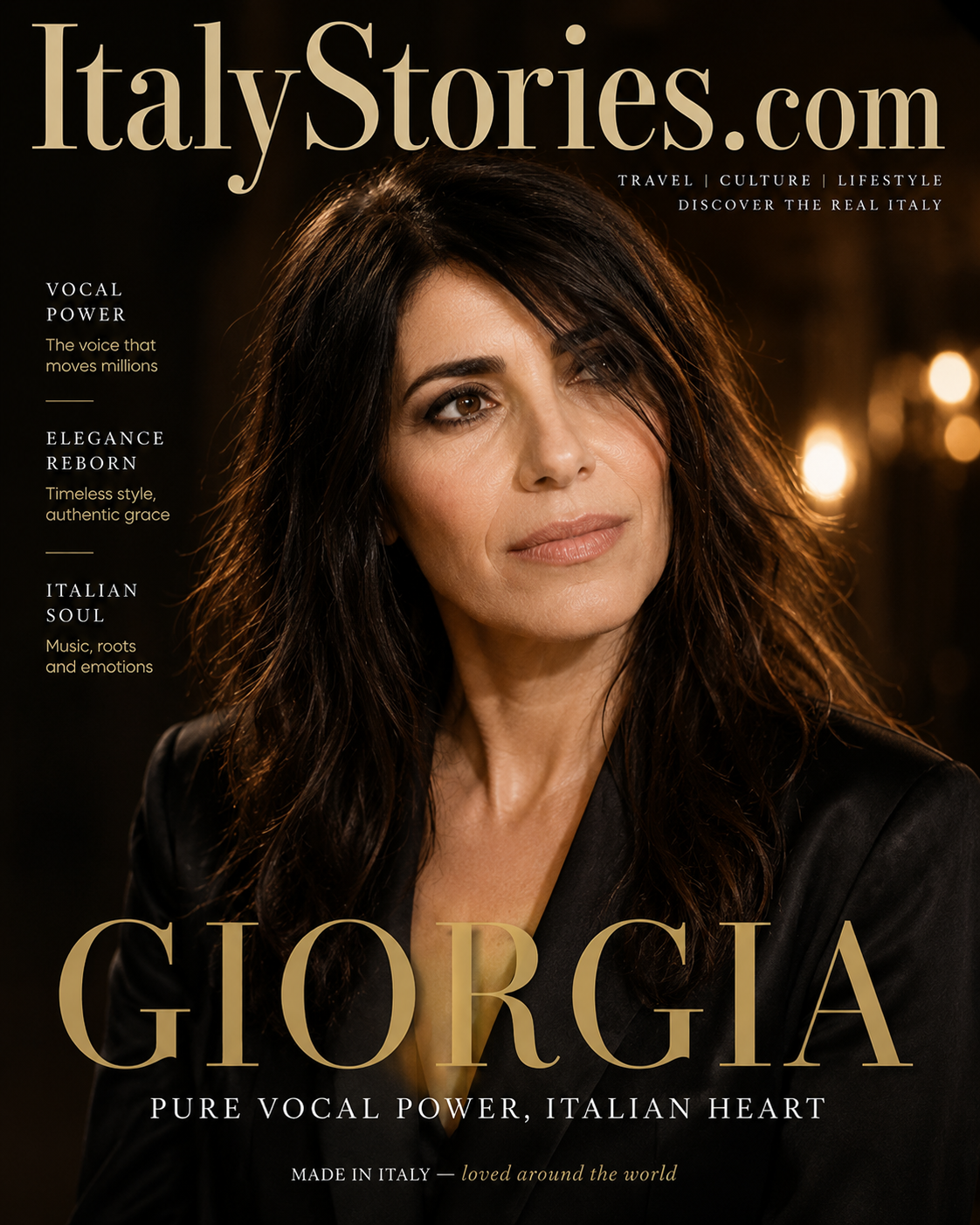
Thirty Years After Victory, the Voice Returned to Sanremo In February 2025, Giorgia walked back onto the stage of the Teatro Ariston carrying a history that few Italian singers can match. Thirty years had passed since the night in 1995 when “Come saprei” won the Sanremo Music Festival and made a twenty-three-year-old Roman singer the symbol of a new kind of Italian voice: technically astonishing, emotionally direct, rooted in soul and rhythm-and-blues, yet completely at home inside the Italian melodic tradition. This time the song was “La cura per me.” She did not win the Festival; she finished sixth. Yet the days and months that followed told a more interesting story than a ranking could. The song became one of the defining Italian singles of 2025, peaking at number two, earning multi-platinum certification and finishing second in FIMI’s annual singles chart. During Sanremo’s cover night, Giorgia joined Annalisa for Adele’s “Skyfall” and won the evening. The performance felt almost symbolic: one of the most admired vocalists of the previous generation sharing a stage with one of the most important voices of the present, and still sounding unmistakably herself. It was a reminder that Giorgia’s career has never depended on nostalgia. She has remained current because she keeps placing the voice inside changing musical worlds without losing its identity. Soul, pop, jazz, blues, electronic production, acoustic arrangements, film music, television, duets, Sanremo, stadium stages and intimate theaters have all become part of the same story. Her name is Giorgia Todrani, but in Italy one name has long been enough. “Giorgia” means not simply a singer, but a standard. Musicians speak about her technique. Audiences speak about the emotion. Other singers speak about the difficulty of her repertoire. Producers know that she can move from a whisper to full power without making the transition sound mechanical. And listeners who grew up with “E poi,” “Come saprei,” “Di sole e d’azzurro,” “Gocce di memoria” or “Il mio giorno migliore” often remember where they were when those songs became part of their lives. To understand why that happened, one has to go back before Sanremo, before the records, before the prizes—to Rome, to a family of musicians, and to a young woman who learned her craft in clubs long before television discovered her. Rome, a Family of Musicians and the Education of the Ear Giorgia was born in Rome on April 26, 1971, into a family in which music was not treated as a distant profession. It was part of daily life. Her father, Giulio Todrani, was a musician and singer, and the presence of music in the family gave her something more valuable than an early publicity story: it gave her an ear. Rome in the 1970s and 1980s was a complicated and fertile place for a young musician. The city carried the weight of Italian song, cinema, television and theater, but its clubs also offered a parallel education. Jazz, blues, soul, funk and American popular music could be heard alongside the traditional Italian repertoire. For a singer with curiosity and unusual natural ability, that meant the possibility of becoming something different from a conventional pop interpreter. Giorgia’s development was not built primarily around the idea of becoming a television personality. She sang. She rehearsed. She listened. She worked in clubs and formed a technical vocabulary that stretched across jazz, soul, blues and rock. This apprenticeship is central to understanding her later career, because it explains why her voice has always sounded more flexible than the label “Italian pop singer” might suggest. The club circuit teaches lessons that no formal competition can reproduce. A singer learns to improvise when the room is noisy, to shape a song when the audience is close, to react to musicians in real time, to discover which embellishments are musical and which are only decoration. Giorgia learned how to phrase before millions knew her name. She learned that a note is not impressive because it is high, but because it arrives at the right emotional moment. By her late teens, she was already performing seriously. Her early group experiences, including work under the name Giorgia Todrani’s Group, gave her the kind of practical confidence that later made apparently difficult performances look natural. She also sang advertising jingles, another form of apprenticeship requiring precision, speed and control. These years formed the foundation of everything that followed. When Giorgia eventually arrived at Sanremo, the public saw a newcomer. Musically, she was anything but inexperienced. A Voice Built from Soul, Blues and Italian Melody Giorgia’s voice is often described simply as “powerful,” but power alone does not explain why it is so recognizable. Many singers can produce volume. Giorgia’s distinction lies in the combination of control, tonal color, rhythmic intelligence, elasticity and emotional restraint. Her training in soul and rhythm-and-blues is audible in the way she approaches a phrase. She often bends into notes rather than striking them mechanically. She can delay a syllable against the beat, add a melismatic turn without losing the lyric, or open a sustained note so gradually that the crescendo feels like an emotional change rather than a technical display. That is one reason musicians have always respected her: the technique is present, but it is rarely the subject of the performance. There is also an unusual balance between strength and vulnerability. Giorgia can sing with an almost muscular clarity, especially in climactic passages, yet the sound can become fragile without losing support. Her lower register carries warmth; the middle voice has density and flexibility; the upper register can expand with dramatic force. Most importantly, she knows when not to use everything she has. Italian music has a long tradition of singers whose voices are immediately identifiable after a few syllables. Mina, Mia Martini, Ornella Vanoni, Giuni Russo and others each created a world through timbre. Giorgia belongs to that lineage, but her vocabulary reflects the music she absorbed from outside Italy as well. Stevie Wonder, Aretha Franklin, Whitney Houston, jazz singers and soul traditions can be heard in her sense of phrasing, not as imitation but as grammar. That grammar allowed her to transform Italian ballads. Instead of simply carrying melody, she could reshape it while singing. The note on the page became a starting point. This freedom would become essential when she began to perform songs that millions already knew by heart. A Giorgia live version rarely sounds like a careful copy of the record; it is often a new reading. Her greatest technical achievement may therefore be invisibility. Listeners hear feeling first. Only later do they realize how difficult the singing actually was. Sanremo Giovani, “E poi” and the First National Shock The official beginning of Giorgia’s national career came in 1993 when she won the first edition of Sanremo Giovani with “Nasceremo,” earning access to the following year’s Festival. In 1994 she entered the Nuove Proposte section with “E poi.” She finished seventh, a result that now feels almost irrelevant beside what the song became. “E poi” announced her to Italy. The song did not need a victory to do its work. Listeners heard a voice with a different kind of mobility and depth from much of the mainstream pop of the moment. There was soul in the phrasing, but also a clear Italian melodic identity. Giorgia could decorate a line, but she could also leave it exposed. She was young, but she did not sound musically naive. Her debut album, Giorgia, arrived in 1994 and quickly established that “E poi” was not a lucky accident. The record combined original material with a version of Lucio Battisti’s “Nessun dolore,” a choice that linked the newcomer to the great Italian songwriting tradition while also showing how freely she could inhabit someone else’s song. The same year brought encounters that accelerated her artistic reputation. Luciano Pavarotti invited her to Pavarotti & Friends, where she performed “Who Wants to Live Forever,” the Queen song written by Brian May. It was an audacious choice for a young Italian singer: large melody, dramatic architecture, emotional exposure. Giorgia did not sound intimidated by the context. She also appeared in major religious and public settings, including performances at the Vatican. These opportunities mattered because they placed her before audiences who might never enter a soul club or follow a new pop record. Very quickly, Giorgia became not simply a promising singer but a voice people wanted to test against difficult material. The tests kept coming. She kept passing them. 1995: “Come saprei” and the Night Everything Changed At Sanremo in 1995, Giorgia returned not as a newcomer but as a contender. The song was “Come saprei,” written by Giorgia with Eros Ramazzotti, Adelio Cogliati and Vladimiro Tosetto, and arranged by Celso Valli. It was a demanding ballad, full of long phrases, dynamic shifts and opportunities for a singer either to overstate or to reveal. Giorgia revealed. She won the Festival and, with the same song, also won the Critics Award, the Authors Award and the Radio and Television Award. It was the first time a female singer at Sanremo had swept those four recognitions in the same edition. The result mattered because it united different constituencies that often disagree: juries, critics, authors, broadcasters and the public. “Come saprei” is still a useful summary of Giorgia’s strengths. The melody gives her room to build, but the song never becomes an athletic demonstration. The lyric depends on uncertainty and emotional searching. The title itself—roughly, “How would I know?”—asks for interpretation rather than certainty. Giorgia sings it as a person discovering the emotion while expressing it. The album Come Thelma & Louise followed, carrying the Sanremo triumph into a larger artistic statement. Its success transformed Giorgia from a singer everyone was watching into one of the central figures of Italian music. The year also brought one of her most enduring international associations: the duet version of “Vivo per lei” with Andrea Bocelli. The song had originated with the group O.R.O., but in the Bocelli-Giorgia version it became a dialogue about devotion to music itself. Their voices could hardly be more different—his classically colored tenor, her soul-inflected flexibility—yet the contrast made the song memorable. In only a short period, Giorgia had moved from club stages to Sanremo victory, Pavarotti’s orbit, the Vatican and a duet that would travel beyond Italy. The speed was extraordinary. What protected her from becoming a temporary phenomenon was the depth of the musicianship underneath it. Success Without Repetition: “Strano il mio destino” The year after a major breakthrough is often dangerous. A singer who has just won Sanremo can be tempted to repeat the exact formula. Giorgia returned in 1996 with “Strano il mio destino” and finished third. More importantly, she demonstrated that she was not interested in becoming a museum of her own victory. “Strano il mio destino” is one of the songs that helped deepen her public image. It carries a more introspective atmosphere than the triumphant narrative surrounding “Come saprei.” The live-and-studio project that followed placed performance at the center, reminding listeners that Giorgia was at her best when the voice was allowed to breathe in real time. This period also revealed an important characteristic of her career: she has rarely seemed comfortable with the idea of simply being “the great voice.” She wanted authorship, experimentation and artistic growth. Technical excellence could easily have become a cage, especially in an industry that loves to market singers through superlatives. Instead, Giorgia increasingly searched for songs and collaborators who would complicate the image. The search led her toward one of the most important relationships of her musical life: Pino Daniele. Pino Daniele and “Mangio troppa cioccolata” The collaboration between Giorgia and Pino Daniele in 1997 was more than a prestigious meeting. It was a musical conversation between artists who understood rhythm, blues feeling and the possibilities of Italian language inside non-traditional grooves. Daniele produced and arranged Mangio troppa cioccolata after Giorgia had already collaborated with him on “Scirocco d’Africa.” The album allowed her to move away from the expectation that she should spend her career singing grand ballads. There was greater rhythmic looseness, more earthiness, more room for personality. The record reached number one and became one of the major successes of her catalog. Songs such as “Un amore da favola” showed a brighter, more physical Giorgia. “Arriva il temporale” and “Dimmi dove sei,” both linked to Daniele’s writing, placed her voice inside a world where groove mattered as much as vocal extension. Most importantly, Giorgia returned strongly as an author. On the album, songs such as “Come in un film” and “Tutto è possibile” carried her own signature. That transition matters historically. Giorgia had already proved that she could interpret material at the highest level. Now she was claiming more of the writing. From this point onward, authorship would become a consistent part of her identity. Working with Pino Daniele also helped situate her inside a broader Italian tradition of musical contamination. Daniele had spent his career making Neapolitan language, blues, Mediterranean rhythm, jazz and rock converse. Giorgia’s own instinct was similar in spirit. She did not want Italian pop sealed off from the world. She wanted it porous. The partnership gave her permission to be less “perfect” and more alive. Girasole, Ray Charles and a Voice That Could Travel By the end of the 1990s, Giorgia’s international musical connections were no longer curiosities. They had become part of her artistic environment. Her official biography records collaborations or performances with figures such as Luciano Pavarotti, Lionel Richie, Michael McDonald, Herbie Hancock and Ray Charles. These names matter not because celebrity proximity automatically confers greatness, but because they place her inside musical traditions that she had loved before fame. In 1999, Giorgia sang “Georgia on My Mind” with Ray Charles at a festival in Lucca. Few encounters could have been more symbolically appropriate. Charles represented one of the foundational voices of soul and rhythm-and-blues, traditions Giorgia had absorbed from the beginning. Singing beside him was not a stunt; it was a meeting with one of the sources. The album Girasole, released in the same broad period, continued her evolution as both performer and songwriter. The title track became another enduring song, warm and immediate without sacrificing musical personality. Giorgia was now moving easily between intimacy and scale, between Italian pop and international musicianship. Her ability to travel musically would later lead to live collaborations with musicians connected to Prince’s New Power Generation and with players who had worked with artists such as Whitney Houston, Aretha Franklin, Justin Timberlake and Michael Jackson. Again, the importance is not the list itself. It is what such musicians demand: precision, flexibility, rhythm, ears. Giorgia had all four. “Di sole e d’azzurro”: Sanremo 2001 and the Art of Not Needing to Win In 2001 Giorgia returned to Sanremo with “Di sole e d’azzurro,” written by Zucchero. She finished second. The song became one of the most beloved of her career. There is a pattern here worth noticing. “E poi” did not win in 1994, yet became a classic. “Di sole e d’azzurro” did not win in 2001, yet it remained part of the national songbook. In Giorgia’s career, festival placement has often been less important than what happens after the applause ends. “Di sole e d’azzurro” is a perfect vehicle for her mature voice. It demands expansiveness without heaviness, control without coldness. The melody rises, but the emotional effect depends on the gradual accumulation of light. Giorgia’s interpretation turns the song into something almost physical: the sense of opening windows after a difficult season. The album Senza ali, released around the same period, consolidated a more adult sound. Giorgia was no longer the prodigy who had shocked Italy with sheer vocal ability. She was an established artist now expected to have something to say. That expectation would become especially important in the years that followed, when personal loss changed the emotional gravity of her work. Loss, Silence and the Songs That Came After In 2002, Alex Baroni, a respected singer and Giorgia’s former partner, died following a road accident. Their relationship had ended, but the loss was profound and public. It would be easy to reduce the period to biographical tragedy, yet Giorgia’s later work shows something more complicated: grief entering art slowly, through absence, memory and the difficulty of continuing. The 2002 collection Greatest Hits – Le cose non vanno mai come credi was an enormous commercial success, remaining high in the charts for an extended period and eventually surpassing a million copies according to her official biography. The title—“things never go as you think”—acquired a painful resonance beyond marketing. In 2003 Giorgia wrote “Gocce di memoria” for Ferzan Özpetek’s film La finestra di fronte, over music by Andrea Guerra. The song became one of the defining recordings of her career and, according to her official discography, the best-selling Italian single of that year. “Gocce di memoria” is powerful because it does not dramatize grief cheaply. The song is about what remains: fragments, traces, the way memory refuses to behave according to logic. Giorgia sings it with restraint. The voice is large enough to explode, but she does not let it become spectacle. The sorrow is carried in the shape of the line. The album Ladra di vento placed “Gocce di memoria” alongside songs such as “Spirito libero,” “L’eternità” and “La gatta (sul tetto).” It marked another evolution: a more introspective, textural Giorgia, willing to let pain alter the sound without allowing it to define her forever. This period is important because it shows why technical brilliance alone is insufficient for longevity. The voice had always been extraordinary. Now listeners also heard a woman who had lived. MTV Unplugged: Removing the Protection of Production In 2005 Giorgia recorded the first Italian edition of MTV Unplugged. The format was almost designed to expose weaknesses: reduced arrangements, fewer production layers, little room for vocal camouflage. For Giorgia, it became a statement of artistic confidence. The project revisited major songs such as “E poi,” “Gocce di memoria,” “Di sole e d’azzurro,” “Girasole” and “Strano il mio destino,” but the acoustic setting allowed the interpretations to breathe differently. She also faced songs associated with Stevie Wonder, Marvin Gaye, the Jackson 5 and the Pretenders—material tied to traditions that had shaped her early musical life. The Unplugged recording revealed how much of Giorgia’s art depends on listening. She does not simply sing over a band. She interacts with it. The rhythmic placement changes, the dynamics move, and the voice responds to the musicians around it. The project also contained new songs touched by themes of abandonment, perseverance and fear. This made it more than a retrospective showcase. It became an emotional document of an artist rebuilding her relationship with performance after a difficult period. For audiences who knew Giorgia mainly through polished studio hits, MTV Unplugged offered the simplest proof of what musicians had known for years: the voice was not a studio construction. Mina, “Stonata” and the Confidence of Maturity In 2007 Giorgia released Stonata, an album that brought together social themes, emotional disconnection and an increasingly confident authorial voice. One track carried special symbolic weight: “Poche parole,” a duet with Mina, written by Giorgia herself. A duet with Mina in Italian music is never ordinary. Mina is not merely a successful singer; she is one of the central vocal references of the entire postwar era. For Giorgia, who had often been discussed in relation to the great Italian female voices, singing with Mina felt less like a coronation than a conversation across generations. The remarkable thing is that Giorgia does not disappear beside her. The two voices remain distinct. Mina carries her unmistakable authority and phrasing; Giorgia brings a more contemporary soul vocabulary and a different rhythmic elasticity. The duet demonstrates that Giorgia had reached a point where comparison no longer needed to be defensive. She had her own identity. Stonata also explored themes of human contact, listening and isolation. “Parlo con te” asks for communication in a world where people can be physically near and emotionally absent. These concerns gave the record a maturity beyond vocal showcase. By now, Giorgia had spent more than a decade proving that she could sing almost anything. The more interesting question had become what she wanted to say. Motherhood, Michele Canova and a New Pop Architecture After the birth of her son Samuel, Giorgia returned in 2011 with Dietro le apparenze, beginning a productive collaboration with producer Michele Canova Iorfida. The record marked another important transformation. Instead of retreating into safe adult-contemporary territory, she entered a more modern pop production environment while increasing her role as an author. The first major single, “Il mio giorno migliore,” became one of the most successful songs of her later career. Its energy surprised listeners who associated Giorgia primarily with large ballads. The production was contemporary, rhythmic and bright, but the voice remained unmistakable. The album also included “È l’amore che conta,” “Inevitabile,” “Dove sei,” and “Tu mi porti su,” written by Jovanotti for her. Giorgia’s official biography emphasizes how extensively she contributed as an author across the record. That matters: by this point she was no longer an interpreter occasionally writing songs, but a mature songwriter shaping the emotional direction of her albums. The collaboration with Canova continued into Senza paura in 2013. That album included “Quando una stella muore” and “I Will Pray (Pregherò),” a duet with Alicia Keys. The pairing made musical sense. Both singers are rooted in soul and R&B vocabulary, but each carries a different cultural and vocal identity. These records showed that Giorgia could enter contemporary pop production without losing the organic qualities that had defined her. She did not try to sound younger than herself. She let modern production meet an adult voice. That distinction is one of the reasons her later work has aged well. “Oronero”: Becoming More Herself, Not Less The 2016 album Oronero deepened the partnership with Michele Canova and confirmed Giorgia’s increasing confidence as a songwriter. Ten of its fifteen songs carried her signature, often alongside collaborators including Emanuel Lo and Pacifico. The title itself—“black gold”—suggested value extracted from darkness, and the album often feels like the work of someone no longer interested in proving vocal superiority. Giorgia uses the voice in service of atmosphere, narrative and texture. Songs such as “Oronero,” “Credo,” “Scelgo ancora te” and “Vanità” show an artist comfortable with maturity. This phase also demonstrates how her relationship with performance changed. In earlier years, audiences often waited for the impossible note. Later, they listened more closely to the interpretation. Giorgia had not lost power; she had gained the confidence not to foreground it constantly. The subsequent Oronero Live project included collaborations and a broad survey of her catalog, reinforcing how naturally the different phases could coexist. A song from 1994 could sit beside material from 2016 without making the earlier voice feel like another person entirely. Continuity became one of her quiet strengths. The International Circle: From Ray Charles to Herbie Hancock Giorgia’s international collaborations are unusually broad for an Italian pop singer, but what makes them meaningful is how often they connect with the musical language she had already chosen before fame. Ray Charles, Herbie Hancock, Lionel Richie, Michael McDonald, Luciano Pavarotti, Andrea Bocelli, Alicia Keys and other major figures appear at different points in her career. Herbie Hancock toured with her in Europe and praised her willingness to take risks. That phrase—willingness to take risks—describes an essential part of Giorgia’s musicianship. Improvisational cultures reward singers who can listen and respond, not merely reproduce. Her live bands have also included musicians with experience alongside Prince’s New Power Generation, Whitney Houston, Aretha Franklin, Justin Timberlake and Michael Jackson. These musicians come from demanding rhythmic traditions. To work credibly with them, a singer must understand time, groove and musical space. Giorgia’s internationalism therefore differs from a simple strategy of famous duets. It is rooted in musical compatibility. She did not adopt soul as a marketing layer after becoming successful. She had been singing that language before Sanremo. This is also why she has often sounded natural when singing in English. Accent matters less than phrasing, and phrasing is where her real fluency lives. Sanremo 2023: Returning After Twenty-Two Years In 2023 Giorgia returned to Sanremo as a competitor for the first time in twenty-two years with “Parole dette male.” The return carried emotional weight. The song looked backward at a past relationship and memory, and public discussion connected it to Alex Baroni. Giorgia performed it not as a woman revisiting celebrity history, but as an adult artist acknowledging that certain memories change shape without disappearing. The Sanremo return coincided with the album Blu, a record that placed her voice inside contemporary production without abandoning intimacy. It also showed a Giorgia more willing than ever to play with image, understatement and modern sonic detail. That same year she made an unexpected move into acting, taking the leading female role in Rocco Papaleo’s film Scordato. The choice was revealing. After decades in which the public had treated her voice as her defining instrument, Giorgia accepted a medium where silence, timing and physical presence mattered differently. In 2024 she co-hosted a night of the Sanremo Music Festival, demonstrating another side of her public personality: humor, spontaneity and comfort outside the protected role of singer. Soon afterward, television would become a larger part of her public life. X Factor, Cinema and the Discovery of a New Public Persona When Giorgia became the host of X Factor, many people expected elegance and professionalism. What surprised audiences was how funny and relaxed she could be. The television role revealed qualities that had always existed in interviews and live banter but had rarely been central to her public image: quick humor, self-irony, empathy and the ability to make performers feel safe. The success of the role changed the way some Italians saw her. For decades she had been “the voice,” a title that can become almost intimidating. X Factor made her more human without diminishing the artistry. She could guide a live television event, joke with judges, support young singers and still step onto the stage as one of the benchmark vocalists against whom they were being measured. Her relationship with cinema also expanded. She voiced Matangi in the Italian version of Disney’s Oceania 2 and wrote an original song for Ferzan Özpetek’s film Diamanti, renewing a connection with the director whose La finestra di fronte had been linked to one of her greatest songs. By 2026 Sky had confirmed Giorgia for a third consecutive year as host of X Factor. That continuity matters because television can be unforgiving to artists whose charisma depends solely on performance. Giorgia proved she could hold an audience even when she was not singing. For an artist whose reputation had been built on vocal excellence, discovering a second public language in her fifties was a remarkable late-career expansion. 2025: “La cura per me,” “Skyfall” and a New Peak Giorgia’s 2025 Sanremo participation may ultimately be remembered as one of the strongest examples of why the Festival’s final ranking never tells the whole story. “La cura per me” finished sixth. Yet the song became a huge commercial and cultural success. FIMI data show it reaching number two in the weekly singles chart, collecting multi-platinum certification and ending 2025 as the second biggest single of the year in Italy. Sony later described the song as a streaming and radio phenomenon with more than one hundred million combined audio and video streams. During the Festival, Giorgia and Annalisa won the cover night with “Skyfall.” The choice was almost mischievously difficult: Adele’s James Bond theme requires control, dramatic architecture and the ability to make a large vocal line sound inevitable. The two singers did not approach it as a competition. Their timbres complemented each other, and the performance became one of the most celebrated moments of the week. Later in 2025, Giorgia released the album G, which included “La cura per me,” “Niente di male,” “Golpe” and other new material, as well as a version of “La cura per me” featuring Blanco. The album placed her contemporary identity beside the weight of three decades of history. This is the key to Giorgia’s longevity. She does not ask younger music to validate her past. She enters the present on her own terms. Why Singers Study Giorgia Among musicians and vocalists, Giorgia occupies a special position. Her songs are often used as tests because they expose the difference between having a strong voice and knowing how to use it. “Come saprei” demands breath management, dynamic control and long emotional arcs. “Di sole e d’azzurro” requires a singer to build without shouting. “Gocce di memoria” punishes overstatement. “E poi” needs rhythmic intelligence and soul phrasing. Even lighter material such as “Il mio giorno migliore” requires precision if the voice is to remain free over the production. Young singers often imitate the visible parts: the runs, the high notes, the changes of color. The deeper lesson is harder. Giorgia listens. She responds to harmony. She understands when a phrase should move ahead of the beat or lean behind it. She knows that silence can create more tension than an ornament. Her career also teaches another lesson: vocal gifts are only the beginning. She has lasted because she developed songwriting, collaboration, repertory judgment, live instincts, humor, humility and the courage to move away from formulas that had already succeeded. The technical instrument made the first impression. The artistic intelligence built the career. A Public Image Based on Talent Rather Than Myth Giorgia has never constructed the kind of celebrity mythology that depends on distance, luxury or scandal. Her public image has remained unusually grounded for someone with such an imposing reputation. There is elegance in her stage presence, but also informality. She can appear glamorous and then disarm the room with a joke. She has often spoken with self-deprecation about the weight of expectations placed on “the voice,” as if suspicious of any title that risks turning a working musician into a monument. That attitude helps explain her relationship with fans. Audiences admire the instrument, but they also recognize the person behind it. This became especially clear through television, where her warmth and comic timing reached people who may have known the songs without knowing much about her personality. Her social commitments—support for environmental concerns, animal welfare and organizations working with children and families—also fit this public character. She has rarely treated activism as branding. It appears instead as part of a broader idea of responsibility. In an industry built on reinvention, Giorgia’s strongest reinvention has been gradual: becoming more completely herself. What Giorgia Changed in Italian Music Giorgia arrived at a moment when Italian pop needed proof that technical sophistication, soul phrasing and mainstream songwriting could coexist without sounding imported. She provided it. She helped normalize a more rhythmically flexible style of female pop singing in Italy. After her breakthrough, the vocabulary of R&B and soul could enter mainstream Italian music more naturally. Younger singers could use runs, blue notes, gospel dynamics and improvisational phrasing without those elements automatically sounding foreign to the language. But her influence cannot be reduced to technique. She also expanded expectations around interpretation. A song could be radically reshaped live and still remain faithful to its emotional center. A female singer could be both virtuoso and author. She could be international in vocabulary without abandoning Italian melody. Her career also complicated the idea of the “great voice.” Great voices are often placed outside ordinary pop culture, as if they belong only to prestige events or technical admiration. Giorgia kept hers inside songs people actually lived with. That may be her most important contribution. She made excellence feel close. Why Giorgia Still Matters More than thirty years after “E poi,” Giorgia remains one of the very few Italian singers whose presence can still create both expectation and trust. Audiences know the voice will be there. What keeps them interested is what she will do with it. Her career contains almost every form of validation available in Italian popular music: Sanremo victory, critics’ recognition, number-one albums, million-selling collections, film songs, major tours, international collaborations, duets with legends, awards, television success and songs that crossed generations. Yet none of those achievements fully explains the attachment people feel to her work. The deeper explanation is emotional credibility. Giorgia can make technically difficult singing sound like a natural consequence of feeling. She can stand beside Pavarotti, Ray Charles, Mina, Herbie Hancock, Alicia Keys, Andrea Bocelli or a younger artist at Sanremo and still retain a clear identity. She can sing a whisper or a climax without losing the person inside the sound. In 1995, Italy discovered a voice capable of winning everything in one Sanremo week. In 2025, that same voice returned and proved something more interesting: that longevity is not about preserving youth. It is about preserving curiosity. Giorgia’s instrument has always been extraordinary. Her real achievement has been learning, year after year, how to keep it human. A Final Thank You from ItalyStories.com Thank you for spending time with this story. ItalyStories.com was created to explore the people, places, voices and traditions that have shaped Italy far beyond its borders. If Giorgia’s journey has made you curious about another chapter of Italian music and culture, we would be delighted to welcome you to the next story.
[…] career extraordinary for an Italian pop singer, particularly in Spanish-speaking markets. Giorgia followed a similarly dramatic trajectory. She won among the newcomers in 1994 with “E poi,” […]