

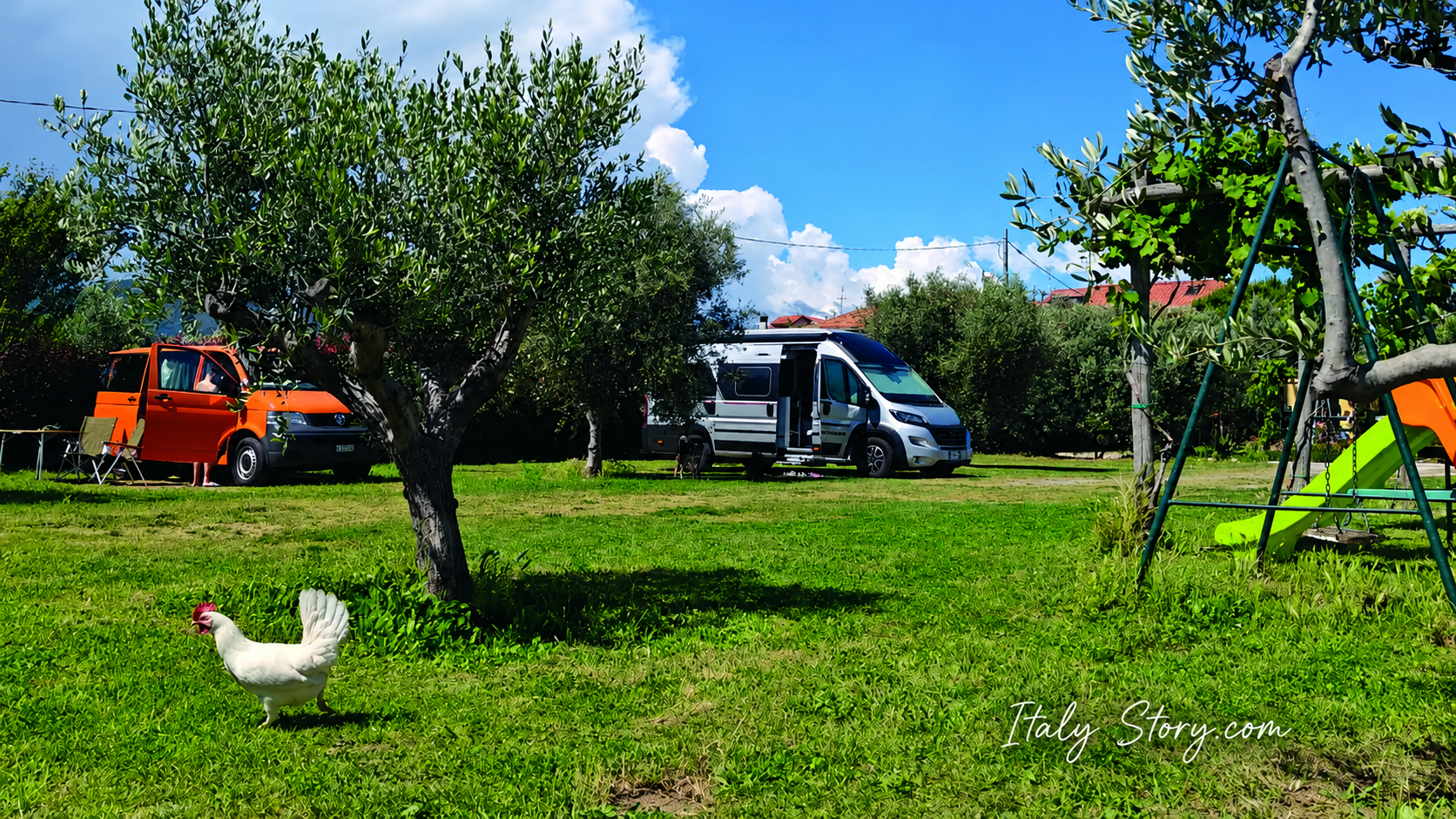
There is a particular moment, somewhere between night and morning, when traveling by camper in Italy begins to make sense.
It does not happen when you buy the vehicle. It does not happen when you unfold the map, choose the first destination, fill the water tank or arrange plates and glasses inside cupboards that seem far too small for everything you believe you need.
It happens later.
Perhaps on the third morning.
Perhaps after a week.
You wake before everyone else. The camper is silent. Through the curtain comes a line of pale light. You do not immediately remember where you are.
Then you open the door.
And Italy is standing outside.
Maybe it is the sea.
Not the idea of the sea, not a postcard, not the view from the balcony of a hotel room, but the actual sea a few meters from your doorstep, moving slowly under the first light of dawn.
You put water on the stove. The little moka begins to breathe, then gurgle, then release that smell which, in Italy, seems capable of making even an anonymous parking place feel temporarily like home.
You carry a cup outside.
Your feet are bare.
The road is still empty.
Somewhere in the distance a fisherman is already returning. A dog is walking beside an old man. The shutters of a house begin to open one by one.
And you understand.
The beauty of traveling through Italy by camper is not simply that you can see Italy.
It is that, for a little while, you can live inside it.
Not as a tourist who arrives, visits and leaves.
But as someone who wakes up there.
Someone who buys bread there.
Someone who hears the church bells before breakfast and the voices from the piazza after dinner.
Someone who occasionally gets lost, stops somewhere completely unplanned, changes direction because a road looks interesting and discovers that the place never mentioned in the itinerary becomes the one remembered forever.
That is the secret.
In a camper, Italy stops being a collection of destinations.
It becomes a sequence of mornings.
A smell of coffee.
A road climbing toward a village.
A plate of pasta eaten with the door open.
A conversation with a stranger.
A mountain appearing after a bend.
A bell tower in the distance.
A sunset you did not pay to see.
And suddenly, without really noticing when it happened, the journey becomes part of your life.
*The First Kilometers
Every camper journey begins with too much luggage.
This seems to be a universal law.
The first time you prepare for a long journey through Italy, you behave as though civilization might disappear somewhere beyond the motorway entrance.
You pack shirts you will never wear, books you will never read, three pans when one would have been enough, shoes for situations that will never occur and enough food to survive a small siege.
Then you leave.
The city slowly loosens its grip.
Buildings become warehouses, warehouses become fields, and the road opens.
At first you still think in terms of destinations.
Tonight we must reach there.
Tomorrow we must visit this.
On Thursday we should be somewhere else.
But Italy has a habit of dismantling plans.
You see a sign for a lake.
You take the exit.
You notice a medieval village sitting on a hill like something placed there deliberately for a painting.
You turn.
A local market appears in a town square.
You stop.
Then somebody tells you there is a beautiful road through the hills ten kilometers away.
And your carefully organized journey begins to collapse.
Fortunately.
Because the real camper journey begins when the plan loses its authority.
Italy rewards curiosity more than punctuality.
Its greatest treasures are often not hidden, exactly. They are simply located slightly to the side of wherever you intended to go.
The country is filled with roads that seem to whisper: *just another ten minutes*.
And ten minutes later you are somewhere you had never heard of.
There is a piazza.
A bar.
A fountain.
Three old men discussing politics with the seriousness of diplomats negotiating the future of Europe.
A woman arranging tomatoes outside a grocery shop.
A church whose door happens to be open.
Nothing extraordinary has happened.
And yet you stay for two hours.
This is how Italy travels with you.
Not through monuments alone, but through interruptions.
*The North: Where Mountains Teach You to Slow Down
In northern Italy the journey can begin among great mountains.
The camper becomes very small there.
You wake beneath the Dolomites or somewhere near the Alps and open the door to a world much larger than yourself.
Morning air enters the vehicle with almost alarming clarity.
It smells of pine, grass and cold stone.
Even in summer, there are places where the first minutes outside require a sweater.
Coffee tastes different in the mountains.
Perhaps everything does.
A simple piece of bread with butter and jam becomes breakfast with a view that luxury hotels spend fortunes trying to imitate.
Yet you are sitting on a folding chair.
Your table is slightly unstable.
The coffee cup does not match the plate.
And it feels perfect.
One of the great lessons of camper travel is how quickly the unnecessary things disappear.
At home, comfort becomes complicated.
In a camper, comfort may be dry socks, hot coffee and the knowledge that tonight you can sleep somewhere beautiful.
You travel through valleys where cows graze behind wooden fences, through towns where balconies overflow with geraniums, past mountain streams that run beside the road.
Then Italy changes.
It always changes.
That is one of the reasons traveling here on wheels is so extraordinary.
There are countries where you may drive hundreds of kilometers through landscapes that remain essentially the same.
Italy seems impatient with sameness.
A few hours can change everything.
Mountain becomes lake.
Lake becomes plain.
Plain becomes hill.
The architecture changes.
The food changes.
The accent changes.
Sometimes even the shape of the church tower changes.
You move through geography as though turning the pages of several different books bound into the same volume.
One morning you are looking at snow still trapped in a high mountain valley.
That afternoon you may be sitting beside Lake Garda watching olive trees move in warm wind.
Another day takes you through vineyards, stone farmhouses and small roads lined with cypress trees.
The distances are often surprisingly intimate.
This is one of Italy’s great gifts to the camper traveler: contrasts are close enough to belong to the same day.
You do not always have to choose between mountain and sea.
Sometimes you simply have breakfast in one and dinner near the other.
*A Country Measured in Coffee Stops
Eventually you begin measuring the journey differently.
Not in kilometers.
In coffees.
There was the coffee at the tiny bar near the lake.
The coffee served by a woman who called everyone *caro*.
The coffee in the village where the bar seemed unchanged since 1974.
The coffee taken standing at the counter beside two builders, a policeman and a man reading the sports newspaper.
Italian bars are wonderful places for camper travelers because they provide something the road sometimes lacks: temporary belonging.
You enter as a stranger.
You order an espresso.
You listen.
The television may be on somewhere in the corner. Cups strike saucers. Somebody discusses football. Somebody complains about the mayor. Somebody knows everybody.
If you return the following morning, there is a small chance the person behind the counter will recognize you.
And that small recognition feels strangely important.
Once, imagine stopping in a village not included in any itinerary.
You parked because the road was becoming narrow and everyone was hungry.
Nothing more romantic than that.
You walked toward the center and found a bar with four tables outside.
An elderly man was sitting alone.
He looked at the camper, then at you.
“Where are you going?”
It is one of the most dangerous questions anyone can ask a camper traveler in Italy.
Because the correct answer is rarely simple.
“South,” you say.
He laughs.
South is a very large place.
He asks where you came from.
Then the conversation begins.
Not because either of you planned it.
He tells you that he once worked in Turin.
That his children live elsewhere now.
That the road behind the church leads to an old monastery.
That the bakery closes at one.
That the best local wine is made by a man called Paolo who does not advertise because, according to the old man, “people who know, know.”
Half an hour later you know where to buy bread, where not to park, which road has the best view and why two families in the village have apparently not spoken to one another since 1987.
You leave knowing almost nothing that would appear in a travel guide.
And somehow knowing the place.
That is Italy by camper.
*The Luxury of an Open Door
Hotels have walls.
Campers have doors.
This sounds obvious until you understand what it means.
A hotel gives you a room in a destination.
A camper allows the destination to enter the room.
There are mornings on the Italian coast when you wake and leave the door open while preparing breakfast.
Light enters.
Air enters.
The sound of the sea enters.
Someone slices bread.
Someone searches for the jam.
Someone complains that the coffee is not ready.
A towel is hanging where it should not be.
There are crumbs everywhere.
Outside, the Mediterranean is turning blue.
You carry breakfast to the little table.
Nothing about the table is luxurious.
It may shake every time someone cuts bread.
There may be sand under your feet.
The plates might be plastic.
Yet it can feel more extravagant than breakfast in a grand hotel.
Because the real luxury is not the furniture.
It is proximity.
You are not looking at Italy through glass.
There is no reception desk between you and morning.
You are already outside.
That intimacy changes the way you experience places.
At night, you hear rain on the roof.
In the countryside, you hear insects.
Near a village, church bells become part of your private timetable whether you want them to or not.
Near the sea, wind moves around the camper during the night.
Sometimes these sounds wake you.
Sometimes the vehicle feels too small.
Sometimes somebody has left shoes directly in the path to the bathroom and you wonder how a supposedly civilized family has descended into chaos in only four days.
This is also camper life.
It should not be romanticized into perfection.
There are wet towels.
There are mosquitoes.
There are narrow roads that seemed wider on the map.
There are arguments about where to park.
There are moments when everyone is hungry at the same time.
There are reversing maneuvers observed by an entire Italian village as though you are participating in a national driving examination.
There is always one cupboard that opens during a turn.
And yet these inconveniences somehow become part of the affection.
Years later, nobody remembers the perfect motorway.
They remember the cupboard.
They remember the evening when rain forced everyone inside and six people tried to prepare dinner in a space designed for four.
They remember laughing.
A camper makes memories with very little material.
*The Road Through the Middle of Italy
Then come the hills.
Central Italy has roads that seem created for people who are not in a hurry.
They rise and fall between vineyards, wheat fields, olive groves and villages perched above the landscape.
Tuscany can appear almost suspiciously beautiful.
You have seen the images before: cypress trees, ochre farmhouses, soft hills folding into one another.
But driving through them slowly is different.
A photograph freezes the landscape.
The road reveals it.
The light changes every few minutes.
A hill disappears.
Another appears.
A ruined farmhouse catches evening sun.
A tractor moves slowly ahead of you and, for once, you do not mind.
Because the camper teaches a kind of acceptance.
Speed stops being the central objective.
There is always another view after the bend.
Umbria feels greener, more secretive.
Stone towns seem to grow directly from hillsides.
You stop for lunch somewhere you cannot properly pronounce.
There is no need to make the lunch complicated.
Bread.
Cheese.
Tomatoes bought that morning.
Olive oil.
Maybe slices of local salami.
The rear doors are open.
A distant bell rings.
No restaurant reservation could improve the moment.
Then there is Lazio, where countryside slowly begins to carry the gravitational pull of Rome.
Ancient things appear almost casually in Italy.
A wall.
A bridge.
A tower.
A fragment of road.
You may stop because you need fuel and discover that somewhere nearby people have been living, praying, trading or fighting for two thousand years.
This casual coexistence with history is another thing that makes Italy extraordinary from a camper.
History is not contained inside museums.
It stands beside provincial roads.
It appears behind supermarkets.
It rises from fields.
It occupies town centers where children kick footballs against walls older than entire nations.
Travel slowly enough and you begin to understand that Italy is not a country which possesses history.
It lives inside it.
*Markets: The Places Where Dinner Begins
One of the finest rituals of camper travel in Italy is the morning market.
You hear it before you see it.
Voices.
Metal structures being assembled.
Crates moving.
Vans unloading.
Then you enter the piazza and the town seems temporarily transformed.
Peppers.
Aubergines.
Peaches.
Melons.
Tomatoes in shapes supermarkets have taught us to consider imperfect.
Cheese wrapped in paper.
Fresh bread.
Olives.
Herbs.
Fish near the coast.
Mushrooms in the mountains.
The market reveals where you are more effectively than a road sign.
Italy changes through food.
Every region insists, with absolute sincerity, that certain things are made correctly only there.
Often the neighboring town disagrees.
This is wonderful.
For someone traveling by camper, local markets turn dinner into geography.
You buy what looks good rather than what appears on a meal plan.
That evening, inside the camper, you cook.
A little olive oil in the pan.
Garlic.
Tomatoes purchased that morning.
Perhaps some basil.
Water begins to boil.
The door is open because it is August and the little kitchen becomes hot instantly.
Outside, daylight is fading.
Someone pours wine into two glasses.
Children ride bicycles past.
A couple from another camper waves.
The smell of garlic escapes into the evening.
You drain the pasta and combine everything in the pan.
No elaborate recipe.
No chef.
No photograph.
Just pasta.
But this is Italy.
Ingredients do not always need to perform.
Sometimes they simply need to be good.
You eat outside.
The table is too small for the plates, bread, bottle, cheese and everything else, so things are constantly being moved.
The sun goes down.
The air becomes cooler.
Conversation becomes slower.
Across the landscape, the first lights appear in houses.
And perhaps this is the deepest pleasure of camper travel.
You begin to recover evenings.
Real evenings.
Not evenings filled by screens, appointments or the automatic routines of home.
An evening can become simply the period between dinner and sleep.
You sit.
You talk.
You walk into the village.
You buy gelato.
You return under a sky you had forgotten to look at.
Life becomes basic enough to become visible again.
*The Accidental Village
Every camper traveler eventually develops affection for places they never intended to visit.
Famous destinations are beautiful, of course.
Florence deserves its fame.
Venice can still stop you emotionally despite the millions of photographs taken there.
Rome is impossible to finish.
Naples refuses to be understood quickly.
But camper journeys are often defined elsewhere.
A road closure sends you in another direction.
A storm makes you stop early.
Someone sees a tower on a hill.
You need water.
You are tired.
You pull into a small town.
Initially, it is only practical.
Then you walk.
The village has one main street and a piazza.
Laundry hangs between windows.
A cat watches you from a step.
Two children chase each other around a fountain.
There is a small grocery shop where the owner seems surprised to see people she does not recognize.
You ask whether there is somewhere to eat.
She gives directions.
Then changes her mind.
“No, go to the other one.”
Why?
She shrugs in a way that contains decades of local knowledge.
You obey.
Dinner is simple.
The owner asks where you are from.
Another table recommends something you had not considered ordering.
By the end of the evening, the town has changed from a dot on the map into a human place.
The next morning you tell yourself you will leave at nine.
At ten thirty you are still there.
This happens constantly in Italy.
Places seduce you quietly.
They do not always announce themselves with monuments.
Sometimes the reason to stay is a bakery.
A view.
A conversation.
A staircase leading nowhere important.
A bell tower throwing its shadow across the square.
You cannot search online for these moments before they happen.
That is precisely why they matter.
*Toward the South
As you continue south, something in the journey becomes looser.
Perhaps it is the light.
Perhaps it is the heat.
Perhaps it is imagination.
Campania arrives with intensity.
Roads become louder.
Voices seem louder.
Scooters appear from directions that conventional geometry had not anticipated.
The camper suddenly feels enormous.
Then the landscape opens and the sea returns.
Italy is never far from water for very long.
That is another remarkable feature of crossing the country.
You can descend from mountains and, not many hours later, smell salt.
You can spend the morning among forests and the evening watching fishing boats.
The peninsula is narrow enough for landscapes to collide.
Near Naples, Vesuvius stands in the distance with that unsettling calm volcanoes possess.
The Bay curves in impossible beauty.
Laundry moves from balconies.
Espresso becomes even shorter, stronger, almost ceremonial.
You hear Neapolitan spoken and understand that Italy’s linguistic landscape changes as dramatically as the physical one.
Further south, Basilicata reveals emptier roads and landscapes that feel ancient.
Puglia stretches toward another sea.
Olive trees grow twisted and monumental in fields where the light seems to come not only from above but from every direction.
White towns rise from the land.
Dry-stone walls follow roads.
Evenings smell of dust, herbs and cooking.
The camper door remains open until late.
Some nights you barely go inside at all.
In Calabria, mountains and sea seem unwilling to separate.
Roads descend dramatically toward water.
Villages cling to slopes.
You may swim in the afternoon and later drive upward into cooler air.
Here again is that Italian compression of worlds.
The country refuses to make you travel far for contrast.
And every kilometer south appears to move you not merely geographically, but emotionally.
*Sicily: The Journey Becomes an Island
Then comes Sicily.
Even boarding the ferry with a camper feels symbolic.
You are carrying your temporary home across water.
The Strait is short, but psychologically it is enormous.
The mainland recedes.
Messina approaches.
The door opens.
You drive onto another world.
Sicily is Italy intensified and transformed. A camper journey can open naturally toward Palermo, Catania, historic Syracuse and, when the route continues over water, Lampedusa.
Landscape becomes theatrical.
Mountains rise from dry countryside.
Citrus groves appear.
Cities carry layers of Greeks, Romans, Arabs, Normans, Spanish rulers and generations of Sicilians who took everything history delivered and turned it into something unmistakably their own.
Driving a camper through Sicily demands time.
Not because the distances are enormous.
Because stopping becomes inevitable.
A bakery releases the smell of bread.
You stop.
A beach appears unexpectedly below the road.
You stop.
A man at a petrol station says that you absolutely must see a village twenty kilometers away.
You stop.
Lunch becomes long.
Afternoon becomes evening.
Schedules surrender.
And perhaps that is the correct way to understand Sicily.
Not through efficiency.
Through availability.
You must allow things to happen to you.
One evening you park close enough to hear the sea.
The day has been hot.
Very hot.
Inside the camper the heat has remained trapped, so everyone stays outside.
Dinner is almost embarrassingly simple.
Pasta.
Tomatoes.
A little cheese.
Fruit.
Cold water.
Wine.
There is sand on the floor.
Nobody cares.
The sky becomes orange, then pink, then purple.
The sun disappears behind the water.
For several minutes nobody speaks.
That silence is not emptiness.
It is fullness.
The kind of fullness modern life rarely gives us because we are always preparing for the next thing.
On the road, sometimes there is no next thing.
There is only sunset.
*Sardinia and the Feeling of Distance
If the journey carries you across another stretch of sea, Sardinia offers a different sensation.
Space.
The island can make Italy feel wild again.
The coast is famously beautiful, but the camper allows you to discover the interior, too, where roads move through landscapes that feel far removed from crowded beaches.
There are places where the wind becomes the loudest thing in the world.
Places where sheep seem to outnumber people.
Places where evening arrives over stone, scrubland and distant mountains.
Here, the camper becomes not merely transport but refuge.
You drive until something tells you to stop.
Maybe a beach.
Maybe a field.
Maybe a small inland town preparing for dinner.
You begin to recognize that your tiny moving house has changed your relationship with distance.
At home, distance separates.
In a camper, distance connects.
The road between two places is not empty time.
It is the journey itself.
*Rain on the Roof
Not every day in Italy is blue sky and open doors.
There are rainy days.
Fortunately.
Rain is important to camper life because it exposes the truth.
Romance must survive bad weather.
Imagine rain beginning in the afternoon somewhere in Emilia-Romagna.
At first you continue walking.
Then umbrellas become useless.
Everyone returns to the camper.
Shoes are wet.
Jackets are hanging everywhere.
Windows fog slightly.
Someone makes tea.
Someone reads.
Someone else sleeps.
Rain strikes the roof with a sound camper travelers eventually learn to love.
You are together in a small space.
Very small.
Almost absurdly small.
Yet there is comfort in it.
The world has temporarily reduced itself to a few square meters.
Outside is weather.
Inside is shelter.
Later, hunger begins.
You cook risotto.
Or soup.
Or whatever ingredients remain in the cupboard.
Steam fills the windows.
Music plays quietly.
Nobody goes anywhere.
And the day that appeared ruined becomes memorable.
A camper teaches you that travel does not require constant spectacle.
Sometimes the journey is simply being somewhere else while the rain falls.
*Living with Less, Feeling More
Perhaps the greatest transformation happens gradually.
At the beginning of a camper journey, the vehicle seems small.
After a few weeks, it seems sufficient.
Then you return home and your house seems enormous.
You realize how little was necessary.
A bed.
A table.
A stove.
Water.
A few clothes.
Something to read.
Someone you love.
The road.
Everything else begins to look negotiable.
This is not an argument against comfort.
It is an argument for perspective.
Camper travel strips daily life down to visible essentials.
You know exactly how much water you have.
You know how much electricity remains.
You know where your food is.
You learn to put things back because there is nowhere else for them to go.
You notice weather because weather matters.
You notice daylight because it changes what you can do.
You notice the landscape because you are moving through it slowly enough to care.
Most importantly, you notice time.
At home, days can disappear without leaving evidence.
On the road, Monday had the mountain lake.
Tuesday had the old man in the bar.
Wednesday had the market.
Thursday had the storm.
Friday had the beach.
Saturday had the village whose name everyone kept mispronouncing.
Days regain individuality.
Maybe that is why journeys feel longer than ordinary life.
Not because they contain more hours.
Because we are present for more of them.
*Italy After Dark
There is another Italy that camper travelers come to know.
Italy after dinner.
You leave the camper and walk.
Perhaps you have parked outside a village center.
The heat of the day has faded.
Windows are open.
Televisions glow behind curtains.
Families sit outside bars.
Children who seemed exhausted at six in the afternoon have somehow acquired new energy at ten thirty.
You walk toward the piazza.
This evening ritual exists everywhere in different forms.
The *passeggiata* is not a tourist attraction.
It is social architecture.
People walk because other people are walking.
They see.
They are seen.
They talk.
They stop.
They continue.
You buy gelato and participate badly but happily.
There is something deeply reassuring about Italian piazzas at night.
They remind you that public space can still belong to ordinary life.
The square is not merely something to photograph.
It is a communal living room.
You sit on a bench.
An old couple walks past arm in arm.
Teenagers occupy the steps of a church.
A dog sleeps beneath a chair.
Somebody laughs loudly from the café.
The bell tower strikes eleven.
You begin walking back toward the camper.
The streets become quieter.
When you reach your tiny home, you turn once more toward the village.
Its lights seem suspended in darkness.
Tomorrow morning you may leave.
And this is where camper travel becomes emotionally strange.
You repeatedly build tiny attachments and then abandon them.
For one night, a place becomes yours.
Then the road asks you to release it.
Perhaps that is why memories accumulate so quickly.
You are always saying goodbye.
But never tragically.
Because another place waits ahead.
*The People Who Live Beside the Road
Italy is beautiful without Italians.
But incomplete.
The encounters become the real map.
The baker who gives you an extra roll because it is the end of the morning.
The farmer who explains tomatoes with the seriousness of a scientist.
The mechanic who interrupts his lunch because your camper is making a worrying sound.
The woman at the market who tells you that the peaches you chose are wrong and replaces them with better ones.
The elderly man at the bar.
The children fascinated by a foreign license plate.
The other camper travelers who tell you about a place you had never considered.
These conversations are brief.
Sometimes language is imperfect.
Sometimes communication happens through gestures, laughter and the universal vocabulary of food.
But they matter.
Because travel becomes human when somebody looks back at you.
A landscape cannot recognize your presence.
A person can.
Years later, you may forget the name of the church you visited.
You may forget the date.
You may even forget which village it was.
But you will remember the old man saying, “Don’t take that road. Take the other one. It is longer, but more beautiful.”
And of course you took the longer road.
Because by then you had finally learned how to travel.
*Why Italy Is Different
There are extraordinary camper journeys all over the world.
Across Scandinavian fjords.
Through American national parks.
Along Atlantic coasts.
Across Australian deserts.
Through French countryside.
Each has its own beauty.
But Italy offers a particular kind of intensity.
It compresses enormous variety into human distances.
Within a relatively small territory, you pass through radically different landscapes, climates, cuisines, architectural traditions and histories.
The Alps do not feel like Sicily.
Tuscany does not feel like Puglia.
Naples does not feel like Turin.
Venice does not feel like Matera.
Sardinia does not feel like Umbria.
And yet they belong to one journey.
The camper is perhaps the perfect instrument for understanding this.
A plane jumps over the transitions.
A train follows the line.
A car gives freedom but usually demands accommodation at the end.
The camper turns transition into home.
You are still living while you move.
Your bed crosses the country with you.
Your coffee pot does, too.
The same little table stands before mountains, beside lakes, near vineyards and within hearing distance of the sea.
This creates continuity inside diversity.
The landscapes change.
Your tiny home remains.
And because your home remains, you can surrender more easily to change.
*The Morning You Stop Counting Days
There comes a morning when you no longer know exactly what day it is.
This is an achievement.
You wake somewhere on the Adriatic coast.
Sunlight is already strong.
Someone has gone to buy bread.
The camper door is open.
A swimsuit hangs outside.
You pour coffee.
You think briefly.
Wednesday?
Thursday?
It does not matter.
For most of the year, life is controlled by calendars.
Appointments.
Deadlines.
School.
Meetings.
Deliveries.
Reservations.
Schedules.
On a long camper journey, time slowly becomes physical again.
Morning.
Heat.
Hunger.
Evening.
Darkness.
Sleep.
The simplicity is almost prehistoric.
And deeply restorative.
You begin deciding where to go according to weather rather than obligation.
Too hot?
Head toward the mountains.
Rain coming?
Move south.
A local festival tomorrow?
Stay another night.
Beautiful place?
Stay two.
The journey begins to breathe.
So do you.
*Returning Home
Every camper journey eventually turns back.
The moment is always strange.
Road signs begin pointing toward familiar places.
Traffic increases.
The landscape becomes known.
You recognize junctions.
At some point you realize that tonight you will sleep in your own bed.
This should feel wonderful.
And it does.
But there is also a quiet resistance.
You have become accustomed to movement.
To not knowing exactly what is outside the door until you open it.
At home, you know what is outside the door.
That is both comforting and slightly disappointing.
You unpack.
The objects from the camper return to their ordinary places.
Laundry begins.
Sand appears from impossible corners.
Receipts fall from pockets.
A small stone picked up somewhere on the coast sits on the kitchen table.
Then someone asks the dangerous question.
“What did you like most?”
You try to answer.
The mountains?
Sicily?
That village in Umbria?
The beach in Sardinia?
Naples?
The market?
The sunset?
But the question is impossible.
Because what you loved was not one place.
It was the thread between them.
You loved waking up and moving.
You loved stopping.
You loved leaving.
You loved the possibility that a road sign could alter the day.
You loved drinking coffee outside.
You loved the feeling that home had wheels.
*If You Have Never Done It
Maybe you are reading this having never traveled by camper.
Perhaps the idea attracts you, but you imagine discomfort.
Small spaces.
Complicated logistics.
Driving something larger than your car.
Perhaps you tell yourself you will do it someday.
When you have more time.
When the children are older.
When work becomes quieter.
When life becomes simpler.
There is a problem with waiting for life to become simpler.
It rarely volunteers.
Sometimes you must create simplicity deliberately.
Rent a camper.
Do not buy one.
Do not plan three months.
Take a week.
Take ten days.
Choose Italy.
Do not try to see everything.
That would miss the point.
Choose a direction.
North.
South.
East.
West.
Then leave enough empty space in the plan for Italy to interfere.
Allow yourself to wake without knowing exactly where you will sleep that night.
Stop for bread.
Drink coffee at counters.
Buy tomatoes from markets.
Take the road the old man recommends.
Eat outside whenever weather allows.
Open the door in the morning before looking at your phone.
Listen to bells.
Walk through towns after dinner.
Cook simple pasta.
Let the children get dirty.
Let your shoes collect dust.
Let the camper become untidy.
Let time become slow.
And one evening, perhaps somewhere you had never intended to visit, you will sit outside after dinner.
The plates will still be on the table.
There will be half a glass of wine left.
The light will be disappearing.
Somewhere a church bell will ring.
You will hear voices drifting from a nearby piazza.
The camper will stand behind you, ridiculously small and suddenly precious.
And you may realize that you are happier than the circumstances appear to justify.
You own nothing about the place.
Tomorrow you will leave.
The table is folding plastic.
Dinner was inexpensive.
Your bedroom is three steps away from the kitchen.
Yet you will feel rich.
Because freedom has very little to do with luxury.
Freedom is opening a door and discovering that the world outside has changed.
*The Journey You Carry Home
This may be the final secret.
Camper travel does not end when you park the vehicle for the last time.
Italy follows you home.
Weeks later, you make coffee and remember that morning beside the sea.
You smell basil and remember the market.
Rain strikes a window and you remember the roof of the camper.
Someone mentions a town and suddenly you see an old man sitting outside a bar.
You open photographs and discover something strange.
The famous places are beautiful.
But the photographs that affect you most are often insignificant.
A table.
A road.
A cup.
A pair of shoes outside the door.
A supermarket parking ticket.
A sunset.
A badly parked camper.
Someone laughing while cooking pasta.
These are not photographs of Italy’s monuments.
They are photographs of your life inside Italy.
And that distinction matters.
Millions of people visit Italy every year.
They photograph the Colosseum.
They cross Piazza San Marco.
They stand before Michelangelo.
They admire the Amalfi Coast.
They visit Tuscany.
They see extraordinary things.
But a camper gives you another Italy.
The Italy between the famous places.
The Italy awake at seven in the morning.
The Italy closing shutters at night.
The Italy buying vegetables.
The Italy arguing at bars.
The Italy hanging laundry.
The Italy ringing bells.
The Italy preparing Sunday lunch.
The Italy found on provincial roads and behind signs you almost ignored.
This Italy is not always spectacular.
It is something better.
It is alive.
And when you move slowly enough through a living country, you stop feeling like an observer.
For a few extraordinary days, you become part of its rhythm.
Perhaps only temporarily.
Perhaps imperfectly.
But genuinely.
That is why traveling through Italy by camper is different.
You do not merely cross the country.
You allow the country to cross you.
You carry a tiny home through thousands of years of history, dozens of landscapes, hundreds of local identities and countless ordinary lives.
You fall asleep beneath mountains.
You wake beside water.
You eat where you stop.
You stop where curiosity tells you.
You learn that getting lost can be productive.
That small things can become stories.
That dinner does not need a reservation to be unforgettable.
That the best view is sometimes the one outside a door.
And that a journey is not measured by how many places you manage to see.
It is measured by how many places remain inside you after you have gone.
So if you have ever looked at a camper passing on the motorway and wondered where those people were going, perhaps the answer is simpler than you imagined.
They are going toward a morning they have never seen.
Toward a village they do not yet know.
Toward a sunset without a reservation.
Toward a conversation with a stranger.
Toward a plate of pasta cooked somewhere between one life and another.
And perhaps, without knowing it, they are going toward a version of themselves that remembers how little is required to feel completely alive.
**Because in Italy, when you travel by camper, the road does not simply take you from one place to another — little by little, it teaches you that home can be anywhere you open the door and find Italy waiting outside.**
[…] camper offered something the caravan could not provide as […]