

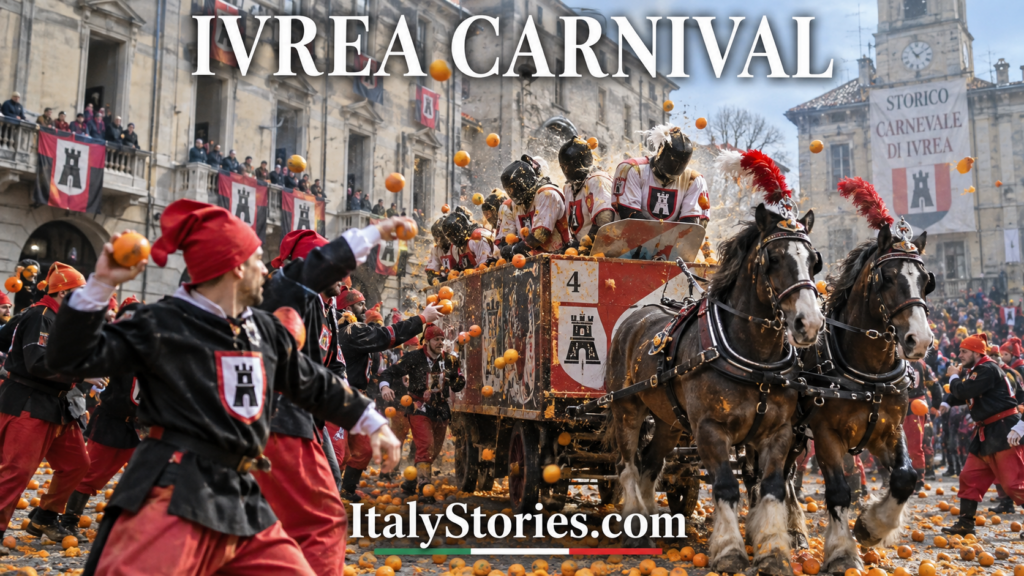
In most Italian cities, Carnival means masks, confetti and elegant parades. At the Ivrea Carnival, the air fills with oranges. They fly across medieval squares, burst against wooden carts and cover the streets in a bright, fragrant carpet. At first sight, the famous Battle of the Oranges may look like magnificent chaos. Yet this extraordinary tradition in Piedmont is not simply a giant food fight. It is the dramatic heart of a civic ritual shaped over centuries, a story in which history and legend have become almost impossible to separate.
Ivrea stands on the Dora Baltea River, north of Turin and close to the entrance of the Aosta Valley. For most of the year, it is a quiet northern Italian city with Roman origins, medieval streets and an important modern industrial heritage linked to Olivetti. During Carnival, however, its squares become a stage and its inhabitants become characters in a collective story about oppression, rebellion and freedom. Visitors do not merely watch a parade pass by. They enter a city that appears to remember with its whole body.
Eight Centuries of History and One Powerful Legend
The earliest written references to Carnival celebrations in Ivrea date back to the thirteenth century. Over time, rural seasonal customs, parish ceremonies, military traditions and political symbols were added to the festival. The result is not a reconstruction of one precise historical event but a remarkable accumulation of different eras. Medieval bonfires stand beside Napoleonic uniforms; ancient neighbourhood rituals coexist with nineteenth-century pageantry; a popular uprising is remembered through a battle whose present form developed much later.
At the centre of the Ivrea Carnival is the legend of Violetta, the daughter of a miller. According to the story, the city was oppressed by a cruel feudal lord who imposed taxes and claimed the right to spend the first night with newly married women. When Violetta was taken to the castle on her wedding night, she refused to submit. She drew a hidden dagger, killed the tyrant and showed his severed head to the people. Her act became the signal for rebellion: the citizens stormed the castle, destroyed it and swore that another fortress would never be built on that site.
It is a legend, not a literal historical record. The so-called right of the first night has no reliable documentary basis here, and Violetta cannot be identified as a proven historical individual. Behind the tale, however, lies a genuine memory of conflict. Ivrea rose against Ranieri di Biandrate in 1194, and the hated stronghold known as the Castellazzo was destroyed during the medieval struggles for control of the city. Carnival transformed these complicated events into a clear and emotionally powerful story: a courageous woman confronts a tyrant, and a community wins its freedom.
The Mugnaia, Ivrea’s Heroine of Freedom
Violetta is represented by the Vezzosa Mugnaia, the Charming Miller’s Daughter, the most beloved figure of the festival. Her ceremonial role was introduced in 1858, during the age of the Italian Risorgimento, when ideas of liberty, nationhood and civic virtue had enormous emotional force. Her white dress carries green and red details, echoing the colours of the Italian flag, while a red Phrygian cap recalls revolutionary freedom.
The identity of the Mugnaia is traditionally kept secret until her proclamation on Carnival Saturday. When she appears on the balcony of the Town Hall, the city greets her as far more than a beauty queen. She is the symbolic heroine of Ivrea. During the historical parade she travels in a gilded carriage, accompanied by the General, officers and other ceremonial characters, throwing flowers, sweets and greetings to the crowd. The contrast is striking: the battle belongs to the people in the streets, but the emotional centre of the story remains a woman dressed in white.
The General and his Staff introduce another layer of history. Their early nineteenth-century uniforms recall the Napoleonic period, when the older parish Carnivals were brought under a more unified form of authority. The first General was appointed in 1808. The fifes and drums that accompany the ceremonies add a sound that is instantly recognisable to local people: sharp wooden notes, military rhythms and melodies handed down through generations. Long before an orange is thrown, Ivrea has already begun telling its story through music.
The Battle of the Oranges
The Battle of the Oranges is fought on the Sunday, Monday and Tuesday of Carnival. Nine teams of aranceri on foot occupy different squares in the historic centre. Their opponents ride on horse-drawn carts and represent the soldiers of the tyrant. The fighters on the ground represent the rebellious population. As the carts enter a square, oranges begin to fly at astonishing speed. The horses are protected and carefully managed, while the cart fighters wear substantial protective equipment. On the ground, many participants rely on padded clothing, experience and courage.
The symbolism is medieval, but the orange-throwing tradition is much younger. In the nineteenth century, young women began tossing oranges from balconies towards the people and decorated carriages below. What started as a playful, almost courtly gesture became progressively more vigorous. Only after the Second World War did the organised teams on foot and the throwing carts give the battle the form recognised today.
Why oranges in a city near the Alps, where citrus trees are hardly part of the landscape? In nineteenth-century Piedmont, the orange was exotic, colourful and precious enough to serve as a festive gift. Later, it became a projectile and finally a symbol. Modern organisers use fruit unsuitable for normal retail sale, and the crushed oranges are collected after the event; in recent editions, the organic material has been recovered and turned into compost. The streets may look like the aftermath of an orange storm, but the process does not end when the battle stops.
This is not a free-for-all. The teams have identities, colours, emblems and territories. Participants follow regulations and a powerful code of respect. Skill, courage and loyalty matter. Rival aranceri may fight with extraordinary intensity and shake hands once the clash is over. That detail explains more about Ivrea than the spectacular photographs do: the battle represents rebellion, but it survives because the community accepts discipline.
Red Caps, Bonfires and Ancient Ceremonies
The Ivrea Carnival cannot be understood through the orange battle alone. From Fat Thursday, citizens and visitors wear the red Phrygian cap, shaped like a long sock. It expresses symbolic support for the revolt and transforms the crowd into part of the story. The cap is not merely a souvenir. In a festival where every costume and gesture carries meaning, it is a small declaration of allegiance to freedom.
Other ceremonies reach into the oldest layers of local tradition. The Zappate take place on Carnival Monday, when selected married couples symbolically begin digging the holes in which the Scarli will stand. Each Scarlo is a tall pole covered with dry heather and topped by the Italian tricolour. On Tuesday evening the Scarli are burned in the city’s historic parishes. The flames recall the destruction of the tyrant’s castle, but also something more ancient: the death of winter, the awakening of nature and the hope of renewal.
There is also the Preda in Dora, a ceremony connected with the destruction of the Castellazzo. A stone is taken from the old castle area and thrown into the Dora Baltea as a ritual declaration that no fortress of oppression will rise there again. History, civic memory and theatre become one gesture. Ivrea does not preserve its past behind glass; it carries it through the streets, places it in people’s hands and asks each generation to perform it again.
Even the end of the festival avoids an easy explosion of celebration. After the final fires, a solemn march closes Carnival. The music slows, the mood changes and the city seems to return gradually to ordinary life. Farewells are exchanged with the traditional promise of meeting again the following year. What began with colour and anticipation ends almost like a collective leave-taking.
More Than Italy’s Largest Food Fight
For international visitors, the Battle of the Oranges is the irresistible image: hundreds of people, historic buildings, horses, flying fruit and streets glowing orange beneath the winter sky. But reducing the Ivrea Carnival to a picturesque battle would miss its deepest meaning. This is one of those Italian traditions in which an entire city becomes both actor and audience. Families inherit roles, team loyalties pass between generations, musicians protect an old repertoire and volunteers work throughout the year to make a few extraordinary days possible.
The festival also reveals something essential about Italian culture. Italy’s identity does not live only in famous monuments or works of art. It survives in local customs, dialect phrases, neighbourhood rivalries, ceremonial characters and the stubborn decision to repeat an inherited ritual even when the modern world seems to have little room for it. Ivrea keeps its legend alive not because every detail is historically true, but because the values expressed by the legend still matter.
When the last oranges have been cleared away and the final Scarlo has burned, the city is physically the same. Symbolically, it has been founded again. The tyrant has fallen, the people have reclaimed the squares and Violetta has returned to remind everyone that freedom sometimes begins with a single refusal. That is why the Ivrea Carnival is unforgettable: beneath the noise, colour and spectacle, it is the story of a community choosing, year after year, to remember itself.
Follow ItalyStories.com to discover more Italian cities, places, characters and traditions that reveal the country beyond the usual postcards.