

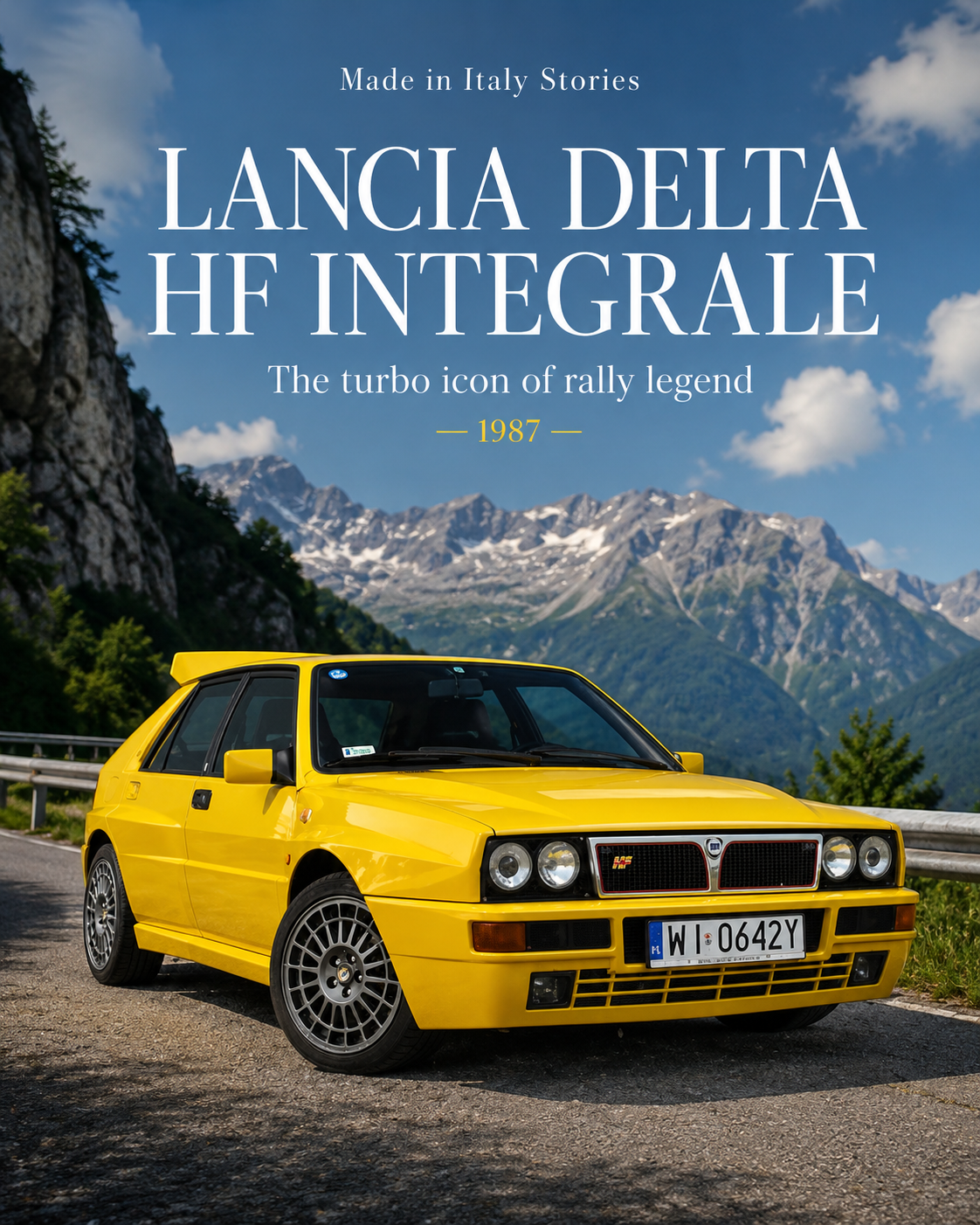
The Box-Shaped Hatchback That Became a World Rally Dynasty
The Lancia Delta HF Integrale may be the most famous example of an ordinary shape becoming extraordinary through competition. At first glance, the Delta was a practical five-door hatchback designed for European family life. By the end of the 1980s, its swollen arches, turbocharged engine and four-wheel-drive system had transformed it into the road-going symbol of one of the most dominant periods in World Rally Championship history. Few cars have travelled so far from sensible origins without losing sight of where they began.
The basic Delta appeared in 1979, styled by Giorgetto Giugiaro. It was clean, compact and modern, with the crisp lines that defined much of Italian design at the turn of the decade. The car won the 1980 European Car of the Year award and gave Lancia an important presence in the competitive family hatchback market. Nothing about the earliest versions suggested that this shape would soon become the uniform of rally heroes.
Motorsport changed the story. After the spectacular but dangerous Group B era ended in 1986, rallying moved toward Group A regulations, which required competition cars to remain more closely connected to production models. Lancia needed a new weapon quickly. The Delta, with turbocharged versions already available and a four-wheel-drive derivative in development, provided the answer.
The Delta HF 4WD appeared in 1986 and immediately demonstrated the potential of the layout. A turbocharged 2.0-liter engine sent power through a sophisticated four-wheel-drive system. For 1987 the HF Integrale developed the formula with wider tracks, flared wheel arches and increased performance. The car looked more muscular because it had become more muscular. Its appearance was not styling theatre; it reflected the need for grip, cooling and competition hardware.
The Integrale evolved rapidly. The eight-valve version gave way to the sixteen-valve model, which brought more power and further chassis development. Then came the Evoluzione cars, with still wider bodywork, revised suspension, stronger brakes and additional aerodynamic changes. Enthusiasts often argue about which version is the purest or most desirable, but every stage tells the same story: rally competition forcing the road car to become increasingly serious.
On the stages, the results were historic. Lancia won the World Rally Championship manufacturers’ title six consecutive times from 1987 through 1992, a record that defined the Delta era. Drivers including Miki Biasion and Juha Kankkunen claimed world championships, while the factory and its teams turned reliability, organization and relentless development into a competitive machine as formidable as the car itself.
The Delta succeeded because it was not dependent on one miraculous feature. The turbo engine produced strong power, the four-wheel-drive system delivered traction, the compact wheelbase gave agility, and the chassis remained predictable enough for drivers to use the performance on snow, gravel and tarmac. Rallying punishes specialization, and the Delta’s strength was its ability to be excellent almost everywhere.
Its road personality benefited directly from that development. An Integrale feels compact and alert in a way many later high-performance cars do not. The steering, turbo response and mechanical four-wheel-drive system require attention. There is lag, noise and physical information. The driver is not insulated from the process. That makes the car feel slower than a modern super-hatch in some objective measures but vastly more dramatic in subjective ones.
The boxy design became part of the legend. Giugiaro’s original clean hatchback shape was gradually stretched around the requirements of competition until the Integrale looked almost architectural. The flared arches, square headlights and upright greenhouse made it instantly recognizable. It was not conventionally exotic, yet parked beside sports cars it often attracts more attention because the shape carries so much history.
Liveries amplified the mythology. Martini Racing colors became inseparable from the Delta’s image, joining car and sponsor in one of motorsport’s most enduring visual identities. Photographs of Deltas airborne over crests or sliding through snow helped define rallying for an entire generation. The car became an international ambassador for Lancia at precisely the moment the brand’s road-car future was becoming more uncertain.
That contrast gives the Integrale a bittersweet place in Lancia history. It represents the company at the peak of global motorsport dominance, but it also stands near the end of the period when Lancia’s sporting identity was supported by extraordinary factory commitment. Later models could be stylish and successful, but the rally dynasty would never return in the same form.
Collectors now treat good Integrales with intense respect, and special editions have become especially valuable. Yet the car’s meaning is larger than rarity. It is the physical record of a factory learning from competition year after year. Each widened panel and revised component tells part of a championship story.
The Delta HF Integrale proves that a legend does not need to begin as an exotic object. Sometimes greatness comes from taking an intelligent everyday design, exposing it to the harshest form of competition and refusing to stop improving it. The result can become more iconic than machines created from the beginning to look special.
Follow Made in Italy Stories and tell us which Delta era is your favorite: the early HF 4WD, the Integrale 8V, the 16V, or the wide-bodied Evoluzione that became the ultimate road-going expression of Lancia’s rally dynasty.
[…] dimostra affidabilità. Una macchina che vince porta il proprio nome sui giornali. Felice Nazzaro, Vincenzo Lancia, Pietro Bordino e altri pionieri contribuiscono a costruire la reputazione sportiva della casa […]