

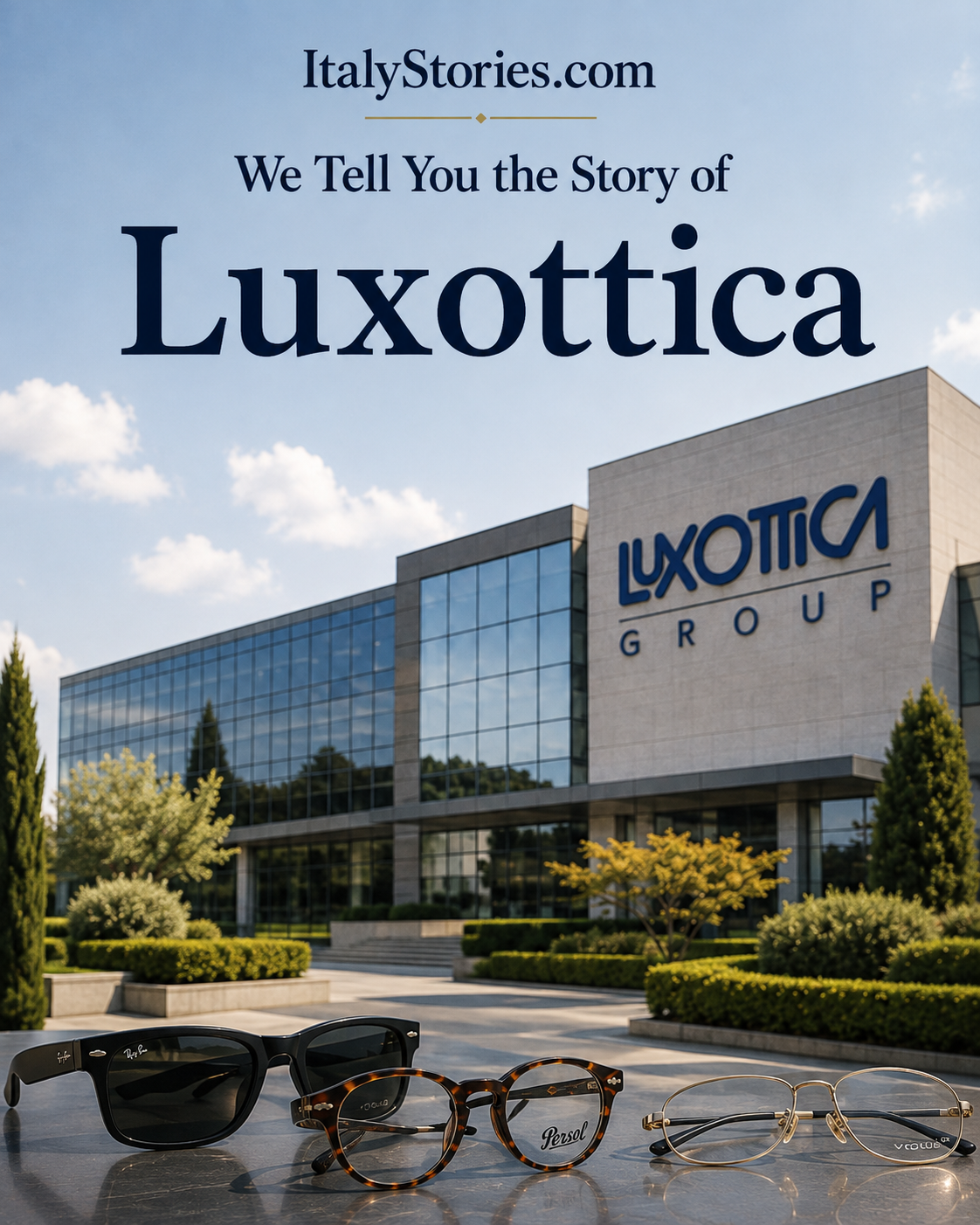
Luxottica: The Man Who Changed the Way the World Sees
From a small workshop in the Dolomites to a global empire of frames, fashion and vision.
ITALYSTORIES.COM
There are companies that begin with capital, inherited workshops or famous family names. Luxottica began with a boy who had almost nothing except his hands, his patience and an extraordinary instinct for what an ordinary object could become. Long before eyeglasses were displayed like jewelry in boutiques from Milan to Manhattan, Leonardo Del Vecchio understood that a frame was not merely a medical support for two lenses. It could be an object of design, a piece of identity, even a small declaration of personality. From that intuition, born in postwar Italy and refined among the mountains of the Veneto, came one of the most remarkable industrial stories the country has ever produced.
Leonardo Del Vecchio was born in Milan on May 22, 1935, the youngest of four children. His father, an immigrant from southern Italy who sold fruit, died before Leonardo was born. His mother, Grazia, worked and struggled to support the family, and when Leonardo was still a child she placed him in the Martinitt, Milan’s historic institution for boys without families able to care for them. He would later speak openly about those years. Growing up without a father and away from home left a mark that never disappeared, but it also gave him discipline and a fierce desire to become independent.
When he left the institute as a teenager, Del Vecchio became an apprentice in a Milanese workshop that made medals, trophies and small metal objects. The work demanded precision. He learned how metal behaved under tools, how a fraction of a millimeter could change the result, and how craftsmanship and industrial repetition could coexist. In the evenings he attended courses in engraving and design. He was not yet making glasses, but the essential language of his future company was already taking shape: metal, detail, manufacturing and the refusal to accept imperfect work.
In the late 1950s he moved north, closer to the eyewear district that had developed around the Dolomites. The Cadore area had generations of experience in making frames, components and optical products. Agordo, in the province of Belluno, offered something else as well: space for industry and local authorities interested in creating employment in a mountain territory from which many young people were leaving. In 1961, Del Vecchio founded Luxottica in Agordo. The name combined the ideas of light and optics, but the company itself began modestly, producing dies, metal components and semi-finished parts for other eyewear manufacturers.
For several years Luxottica remained behind the scenes. Other companies put their names on products that included pieces made in Del Vecchio’s workshop. But he disliked being dependent on customers who controlled the final product, the distribution and the relationship with the market. Step by step, he brought more manufacturing processes inside the company. Luxottica learned to make not simply a hinge or a temple, but an entire frame. In 1971 the company presented its first complete collection of prescription eyewear at MIDO, Milan’s international optical fair. It was the moment when Luxottica stopped being only a supplier and began to become a brand.
Del Vecchio’s real revolution, however, was not a single model of glasses. It was control. He believed that a manufacturer should understand and, whenever possible, manage every stage that separated the factory from the customer. In 1974 Luxottica acquired Scarrone, the distributor that had been selling its products in Italy. The move gave the company direct knowledge of the market. During the 1980s Luxottica repeated the strategy abroad, building subsidiaries, purchasing distributors and entering the United States, Germany, Japan and other important markets. The workshop in Agordo was becoming an international system.
At the same time, Del Vecchio sensed that society’s relationship with glasses was changing. For generations, spectacles had often been treated as an unfortunate necessity, something worn because the eyes required it. In the 1980s, fashion was beginning to transform accessories into powerful symbols of personal style. Luxottica stepped directly into that new world. In 1988 it signed its first major fashion licensing agreement with Giorgio Armani. The message was clear: eyewear could belong beside clothing, shoes, perfume and watches. A pair of glasses could carry the imagination of a designer and the prestige of a fashion house.
Then came the acquisitions that turned Luxottica from a successful Italian manufacturer into an empire of names recognized around the world. Vogue Eyewear joined the group in 1990. Persol, one of the great historic Italian eyewear brands, followed in 1995. In the same year Luxottica entered optical retail through the acquisition of LensCrafters in North America. Four years later came the purchase that changed the scale of the company forever: Ray-Ban. Created in the United States and famous for Aviator and Wayfarer models worn by pilots, actors, musicians and generations of young people, Ray-Ban had an extraordinary cultural reputation but was in need of revival. Under Luxottica, it became one of the most powerful eyewear brands in the world.
The logic continued. Sunglass Hut was acquired in 2001, giving Luxottica a vast global network devoted to sunglasses. Oakley followed in 2007, bringing performance eyewear, sports technology and a brand culture very different from Ray-Ban or Persol. By then Luxottica could design frames, manufacture them, distribute them, license fashion names and sell products through its own retail networks. Few companies had ever integrated the eyewear business so completely.
The financial markets followed the transformation. Luxottica listed on the New York Stock Exchange in 1990 and later on the Milan Stock Exchange in 2000. Yet for all its international reach, Agordo remained symbolic and practical at the same time. The mountain town where the adventure had begun became one of the centers of a global group. Thousands of people worked in and around the plant, and Del Vecchio cultivated a reputation for remembering the social dimension of the factory. Employee welfare programs, bonuses and later share ownership initiatives reflected his conviction that the people who built the company should share in its progress.
Luxottica’s growth was also a story about how Italy learned to sell craftsmanship at industrial scale without entirely losing the aura of craftsmanship. Persol could still evoke Turin, cinema and hand-finished details. Ray-Ban could remain American in mythology while becoming part of an Italian-controlled group. Fashion licenses could change with seasons and designers, while the factories relied on engineering, tooling and disciplined production. Del Vecchio had discovered how to connect two worlds that are often treated as opposites: mass industry and emotional desire.
By the 2010s, however, the eyewear business was changing again. Frames were only one part of a much larger world of vision. Lenses, optical technology, prescription services, retail networks and digital commerce were becoming increasingly connected. The next step was therefore larger than any previous acquisition. In 2017 Luxottica and the French lens specialist Essilor announced plans to combine. The transaction was completed in 2018, creating EssilorLuxottica, a global group bringing together one of the world’s strongest eyewear businesses with one of its great optical-lens specialists. In 2019 EssilorLuxottica completed its control of Luxottica, whose shares were delisted in Milan.
For Del Vecchio, the combination was a final act on the same theme he had pursued since the small workshop in Agordo: integration. First he had wanted to control the entire frame instead of making components for others. Then he had wanted distribution instead of depending on wholesalers. Then came brands, stores and global retail. With Essilor, the logic expanded from the frame to the complete world of vision itself.
Leonardo Del Vecchio died in Milan on June 27, 2022, at the age of eighty-seven. By then the child of the Martinitt had become one of Italy’s most important industrialists, and the company he had founded in a mountain town had helped redefine how the world thought about glasses. His death closed the life of the founder, but not the story he began. Luxottica continues within EssilorLuxottica, alongside brands including Ray-Ban, Oakley, Persol and Vogue Eyewear, as part of a business that now reaches from lenses and medical vision technology to retail and connected eyewear.
Perhaps the most extraordinary thing about Luxottica is that its story began with something so small: a metal component held between a young worker’s fingers. Del Vecchio spent a lifetime moving outward from that detail. From component to frame, from frame to brand, from brand to shop, from shop to global network, and finally from eyewear to the wider science and business of sight. He did not merely build a company that sold glasses. He helped turn glasses into fashion, identity and culture, and in doing so created one of the clearest examples of how Italian manufacturing can travel from a provincial workshop to the entire world without forgetting the value of a well-made object.
Continue your journey through the companies, machines and people that shaped Italy by discovering more stories on ItalyStories.com.