

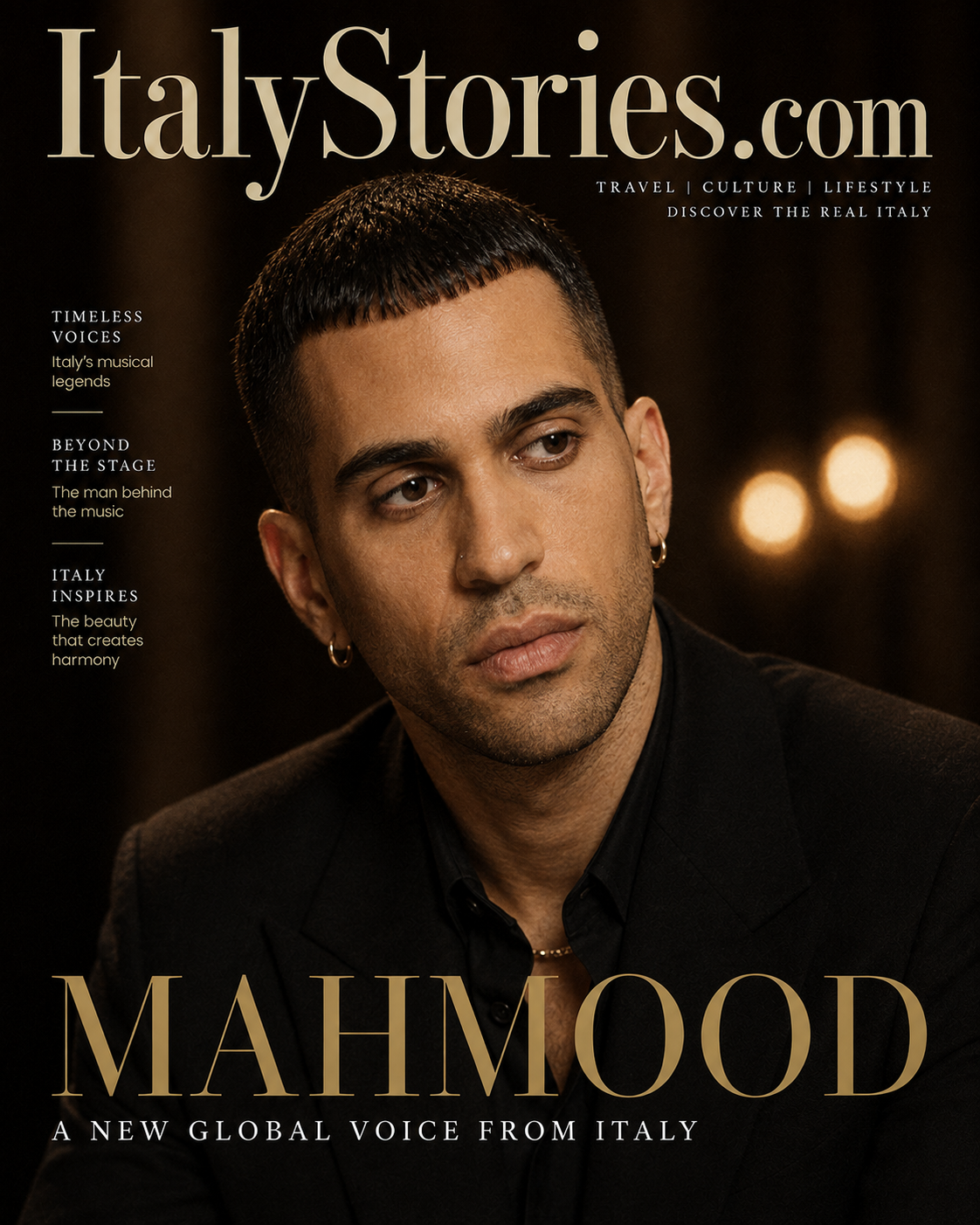
The Handclaps That Crossed Europe In the spring of 2019, audiences across Europe learned a rhythm before they learned a biography. A dry beat, a few handclaps, a tense melody, and a single word – “Soldi” – carried a young Italian singer from the Teatro Ariston in Sanremo to the Eurovision stage in Tel Aviv. Mahmood finished second at Eurovision with 465 points, but the result felt larger than a silver medal. The song was already traveling on radio, streaming platforms and social media, and listeners who did not speak Italian were repeating its refrain anyway. What made the moment important was not simply that Italy had found another successful singer. Mahmood sounded like a different idea of Italian pop. He did not arrive wrapped in the familiar international image of Italy – opera, mandolins, grand romantic ballads or nostalgic Mediterranean color. His music came from Milan, from contemporary R&B, urban production, North African echoes, fragmented family memory, fashion, club rhythm and the intimate language of a generation raised between cultures and digital worlds. His full name is Alessandro Mahmoud. His stage name, Mahmood, deliberately preserves the sound of his surname while turning it into something visually concise and internationally memorable. The artist behind that name would become one of the clearest examples of how Italian songwriting changed in the 2010s and 2020s: less interested in protecting old borders, more willing to mix languages, rhythms, identities and emotional registers without asking permission. The extraordinary part is how quickly the public image expanded after years of uncertainty. Before “Soldi,” there had been failed auditions, early competitions, songwriting for other performers, a Sanremo Giovani victory and a long apprenticeship that the wider public barely noticed. After “Soldi,” Mahmood became a two-time Sanremo winner, a two-time Eurovision representative, a sought-after author for other Italian stars, an arena performer and one of the most internationally legible voices of a new Italian generation. The handclaps were only the beginning. Milan, Gratosoglio and a Family Story That Entered the Songs Alessandro Mahmoud was born in Milan in 1992 to an Italian mother and an Egyptian father. He grew up in the southern area of the city, around Gratosoglio, a district far removed from the postcard Milan of luxury shopping and historic elegance. It is a landscape of apartment blocks, public housing, commuting families, immigrant stories and the ordinary mixture of metropolitan life. That geography matters because Mahmood’s music has always been strongly urban. Milan is not only where he was born; it is part of the emotional architecture of his songs. Streets, neighborhoods, trains, rooms, clothes, food, money, absence and family memory appear not as decorative details but as the material from which identity is built. His parents separated when he was young, and the complicated relationship with his father later became one of the emotional sources behind “Soldi.” Mahmood has repeatedly resisted simplistic readings of his identity. He grew up in Italy, speaks from an Italian cultural center, and has never presented himself as a spokesperson for an abstract category. Yet his Egyptian family background is undeniably present in his imagination – not as a marketing device, but as memory, tension and sound. His mother played the larger daily role in his upbringing. In interviews and songs, the family world appears less as sentimental ideal than as something unstable and real: love mixed with disappointment, financial difficulty, loyalty, absence and the effort of growing up. This complexity would later distinguish Mahmood from artists who build pop songs around generalized emotion. He writes from objects and scenes. A phrase in Arabic can appear next to Milanese slang; a luxury brand can sit beside a childhood image; a club rhythm can carry a song about abandonment. The modernity comes not from trying to sound “global,” but from accurately describing the life of someone whose world was already mixed before the music industry gave it a label. Before the Breakthrough: Piano, Voice and the Discipline Behind the Style The visual confidence of Mahmood’s later career can make the early musical discipline easy to overlook. As a child and teenager he studied singing, piano and solfeggio. Pop, urban music and R&B attracted him early, but the foundation was not casual. He learned how harmony works, how a melody sits against accompaniment, how breath changes a phrase, and how writing requires revision rather than inspiration alone. This technical background later became important because Mahmood’s songs often appear deceptively simple. A track may be built around sparse percussion and a few repeated melodic cells, yet the vocal line moves with unusual intervals and rhythmic placements. He often sings behind or across the beat, using silence almost as much as sound. His voice itself is not a conventional Italian bel canto instrument. It is narrow, flexible, sometimes nasal, often intimate, and instantly recognizable. The upper register can turn bright and fragile, while the lower phrases often sound close to speech. Rather than trying to dominate a song with power, Mahmood frequently lets production and vocal color create tension together. That approach was well suited to the new Italian pop landscape emerging around him. By the 2010s, the boundaries between cantautorato, rap, trap, electronic pop and R&B were weakening. Mahmood had enough traditional musical education to write melodies, but enough curiosity about contemporary production to avoid sounding traditional. The result was a style that could move from songwriter room to club beat to festival stage without becoming a different person each time. X Factor and the Useful Experience of Not Winning Mahmood first reached a national television audience through X Factor in 2012. He did not win. In fact, the experience did not transform him into an immediate commercial star. That may have been useful. Television talent shows can produce instant visibility, but instant visibility can also freeze a young performer before he has fully decided who he is. Mahmood left with exposure but without a definitive public identity. He still had to work. The years that followed were less glamorous and more important. He continued writing, performing and developing material, gradually entering the professional songwriting world. The distance between television recognition and artistic breakthrough taught him something that later became central to his career: visibility is not the same as authorship. He needed songs that sounded like him. By the time the public truly discovered Mahmood later in the decade, he was no longer simply a former talent-show contestant trying to restart a career. He had become a songwriter with a point of view, a vocal language and a growing network of collaborators. The failure to become famous immediately had given him time to become specific. Sanremo 2016: “Dimentica” and the First Ariston Test In 2016 Mahmood reached the Sanremo stage for the first time in the youth section with “Dimentica.” He placed fourth among the young artists, a respectable result that nevertheless did not produce the kind of national explosion associated with later appearances. The significance of “Dimentica” lies in hindsight. It shows an artist already moving away from generic pop toward a more personal mixture of R&B phrasing, electronic production and emotional restraint. But the final form was not yet complete. Sanremo is uniquely demanding because it exposes a song to almost every kind of Italian listener at once. Young audiences, older viewers, radio programmers, critics and casual television spectators all judge the same three minutes. Mahmood’s first appearance gave him experience inside that machine without yet making him one of its stars. He returned to writing. This period also strengthened his work for other artists. Rai’s later artist profile would note songs written for performers including Elodie, Michele Bravi and Marco Mengoni, as well as hooks and contributions for rappers such as Fabri Fibra, Gué and Marracash. These credits matter because they show Mahmood learning the architecture of popular songs from different perspectives. Writing for someone else forces a songwriter to separate ego from craft. The melody must work even when another personality occupies it. Mahmood learned that lesson before most people knew his name. “Gioventù bruciata”: The Songwriter Finds His Own Language The breakthrough before the breakthrough came in 2018 with the EP Gioventù bruciata and the song of the same name. The title – “Burnt Youth” – suggested a generation less romantic about growing up than the Italian pop tradition often had been. Mahmood wrote with compressed images, urban vocabulary and emotional ambiguity. The music was contemporary but not trapped inside one genre. It could carry electronic production, melodic writing and rap-adjacent rhythm without becoming any one of those things entirely. In December 2018, Mahmood performed “Gioventù bruciata” at Sanremo Giovani. He won the competition and also received the critics’ prize. The victory gave him entry into the main Sanremo festival of 2019. The structure of his rise is almost too perfect as a narrative: a young artist comes through Sanremo Giovani and then, only weeks later, wins the main festival. Yet what made the result possible was the less visible work before it – the failed early television breakthrough, the first Sanremo appearance, the writing sessions, the experiments, the years of shaping a language. By early 2019, Mahmood was ready for one song to compress all of that history into three minutes. “Soldi”: A Family Argument Becomes a European Hit “Soldi” won the 2019 Sanremo Music Festival and changed Mahmood’s career overnight. The title means money, but the song is not really about wealth. It is about the emotional damage that money can represent inside a family: promises, absence, disappointment, loyalty and the memory of a father who moves in and out of a child’s life. The genius of the song is the contrast between subject and form. Instead of arranging family pain as a slow piano ballad, Mahmood and his collaborators built a tense, rhythmic track with a refrain driven by handclaps. The production gives the lyric forward movement, almost as though the singer is walking quickly through memories he would rather not stop to examine. Arabic words and phrases enter naturally, not as exotic decoration but as fragments of family memory. The sound of “waladi waladi habibi ta’aleena” became part of the song’s identity and helped underline something essential: Mahmood’s Italy included cultural material that older definitions of Italian pop had often kept outside the frame. The Sanremo victory generated intense discussion in Italy, some of it musical and some of it political or identity-based. Mahmood largely refused to let other people turn his biography into a slogan. He insisted on being treated first as an artist. The song itself made the strongest argument. At Eurovision 2019 in Tel Aviv, “Soldi” finished second with 465 points. Rai reported that the performance earned an ovation and that the song received the Composer Award. The result returned Italy to second place at Eurovision for the first time since 2011 and transformed Mahmood into an international name. A private wound had become a public anthem without losing its specificity. After “Soldi”: “Barrio,” Touring and the Problem of the Second Chapter The most dangerous moment after a giant breakthrough is the song that comes next. A successful artist can repeat the formula, reject it too aggressively, or become paralyzed by expectation. Mahmood answered “Soldi” with “Barrio,” a track written with Davide Petrella and produced by Charlie Charles and Dardust. The song kept the urban pulse but shifted the emotional landscape toward a love story set in a popular neighborhood. Universal Music reported strong early streaming numbers, while the accompanying European live schedule demonstrated that Mahmood’s international audience had not disappeared after Eurovision. Performances in cities including London and Barcelona helped establish him not merely as a festival curiosity but as a touring artist. The period also included collaborations and writing that expanded his musical network. Mahmood was becoming comfortable moving between mainstream pop and the Italian rap ecosystem, between fashion culture and songwriter craft, between radio and more experimental production. The central challenge was identity: could he remain recognizable without turning “Soldi” into a template? The answer, over the next albums, would be yes. “Ghettolimpo”: Mythology, Street Language and a More Ambitious Pop World In 2021 Mahmood released Ghettolimpo, an album whose title joined two apparently incompatible worlds: the ghetto and Olympus. The word is an invented collision, and the album behaved the same way. Mythological imagery, urban language, fashion references, sensuality, family memory and modern production coexist without apology. Mahmood was no longer introducing himself. He was building a universe. Songs such as “Inuyasha” showed his ability to write dramatic melody over contemporary production, while collaborations broadened the palette. The project reinforced his status as an artist interested in visual narrative as much as audio identity. Covers, videos, styling and stage design were not separate from the music; they helped communicate the same idea of a hybrid world. This is another reason Mahmood became internationally legible. Global pop after 2010 increasingly expects artists to create coherent visual and sonic identities. Mahmood understood that instinctively, but unlike performers whose visual style covers weak songs, he also had the songwriting foundation to support the image. Ghettolimpo demonstrated that “Soldi” had not been an isolated collision of good timing and festival attention. There was a larger artistic architecture behind it. “Brividi”: Two Male Voices and a Different Kind of Sanremo Love Song In 2022 Mahmood returned to Sanremo with Blanco and “Brividi.” The song won the festival. Rai described it as the story of two young men from different generations who experience love with similar fear, intensity and uncertainty. That framing helps explain why the song had such immediate force. “Brividi” is a duet between male voices that does not depend on competition, irony or emotional distance. Both singers are vulnerable. The arrangement gives them space rather than forcing constant vocal overlap. Mahmood’s more controlled, fluid phrasing contrasts with Blanco’s rougher emotional attack. Their differences become the point. The commercial response was enormous. Rai reported that “Brividi” set a then-record for first-day Spotify streams in Italy with 3,384,192 plays and debuted at number five on Spotify’s global chart, at that time the highest global debut for an Italian-language song. The victory sent Mahmood back to Eurovision, this time in Turin, Italy, following Måneskin’s victory the previous year. Representing the host country brought a different kind of pressure. Mahmood was no longer the surprising newcomer of 2019. He was an established international figure returning to Europe’s biggest song stage. That transformation in only three years is one of the clearest signs of how quickly his career expanded. A Writer for Other Stars: Elodie, Marco Mengoni, Rap and the New Italian Pop Network Mahmood’s importance in contemporary Italian music cannot be measured only through his own recordings. Rai’s official artist profile lists songwriting work for Elodie, Michele Bravi and Marco Mengoni, along with contributions to tracks connected with Fabri Fibra, Gué and Marracash. These credits reveal how naturally he moves between pop and rap environments. For Elodie, songs such as “Nero Bali” and “Andromeda” became important parts of her repertoire. For Marco Mengoni, “Hola (I Say)” showed Mahmood’s ability to participate in the songwriting of an artist with a very different vocal identity. This network matters because contemporary Italian pop is increasingly collaborative. The old image of the cantautore alone with a guitar has not disappeared, but a new model has developed around writing rooms, producers, features and cross-genre collaboration. Mahmood belongs fully to this environment while still retaining the authorial identity that Italian listeners expect from a serious songwriter. He can write a hook for a rapper, a melody for a pop singer and an autobiographical song for himself without treating those activities as contradictions. The common denominator is rhythmically precise emotional writing. The Voice: Fragility as a Technical Choice Mahmood’s singing is sometimes described mainly through timbre, but the more interesting feature is control. He often lets the voice sound fragile without losing musical precision. That distinction matters. Actual loss of control produces uncertainty; Mahmood uses controlled instability as expression. The upper register can sound exposed and almost weightless. The middle voice is more conversational, allowing words to carry rhythmic detail. He frequently changes the attack of syllables, using breath and consonants to create groove. In songs such as “Soldi,” the voice is part of the percussion. In “Brividi,” it becomes a more open melodic instrument. His influences from R&B are audible in phrasing and ornament, but he rarely overuses vocal runs. He tends to keep decoration subordinate to the emotional line. The result is a voice suited to contemporary production: recognizable in a few seconds, flexible over electronic beats, and intimate enough to remain convincing when the arrangement becomes sparse. For a modern pop artist, recognizability is often more valuable than traditional vocal grandeur. Mahmood has it in abundance. Fashion, Image and the Refusal to Separate Music from Style Mahmood’s public image has always been unusually attentive to clothes, photography and visual detail. This is not accidental. Fashion is part of the language through which contemporary pop communicates identity, especially for artists whose audience is international and digitally connected. Mahmood uses styling not merely to appear glamorous but to create characters and moods around each phase of his work. The visual identity has also allowed him to play with masculinity in ways that differ from older Italian pop models. Softness, jewelry, tailored clothing, sportswear, exposed skin and theatrical silhouettes can coexist. There is no need to resolve them into a single fixed definition. This flexibility mirrors the music itself. Mahmood’s generation grew up with cultural categories already mixing in everyday life. Genre, language, gender presentation and national identity are less likely to be treated as sealed boxes. His style reflects that reality rather than announcing it as theory. For audiences abroad, the result can look strikingly contemporary. For younger Italians, it often looks simply familiar. Sanremo 2024: “Tuta Gold” and the Return Without Needing to Win Mahmood returned to the Sanremo Music Festival in 2024 with “Tuta Gold.” By then, the meaning of a Sanremo appearance had changed for him. He no longer needed the festival to prove that he belonged in the industry, and he did not need to win to make the song matter. “Tuta Gold” became one of the major commercial songs of the edition. The track draws on images of tracksuits, adolescence, money, memory and urban social codes, transforming clothing into emotional archive. A gold tracksuit is not only an object; it becomes a sign of a particular period, a neighborhood, relationships and aspirations. FIMI’s 2026 Sanremo report listed “Tuta Gold” at 500,000 certified copies by week 06/2026, placing it among the festival songs with the strongest recent certification results. The statistic confirms what radio, streaming and live audiences had already made obvious: the song outgrew its competition ranking. This is a mature form of festival power. Mahmood used Sanremo not as a desperate return to visibility but as a national stage for a new chapter. “Nei letti degli altri”: The Album Behind the Gold Tracksuit In March 2024 Mahmood released Nei letti degli altri, his third studio album, three years after Ghettolimpo. The title – “In Other People’s Beds” – immediately suggests intimacy, secrecy, desire and the strange emotional spaces people enter when relationships become complicated. The album extends Mahmood’s longstanding interest in private life without turning confession into simple diary. Its track list includes “Tuta Gold,” “Personale” with Geolier, “Overdose,” “Cocktail d’amore,” “Sempre/Jamais” with Angèle, “Neve sulle Jordan” with Capo Plaza and “Paradiso” with chiello and Tedua. The guests place the album inside a broad European and Italian urban-pop network. The production is equally varied, involving collaborators such as Michelangelo, Dardust, BGRZ and others. Rather than chase one uniform sound, Mahmood uses different producers to build rooms inside the same house. The album’s strength is emotional coherence. Beds, clothing, phones, substances, memory and physical closeness repeatedly become symbols of attachment and distance. Mahmood has always been good at turning objects into emotional evidence. Nei letti degli altri may be the clearest expression of that method. Europe Again: The 2024 Tour and a Pop Language That Travels Without Translation The 2024 tour around Nei letti degli altri confirmed that Mahmood’s international audience was no longer tied only to Eurovision. Universal Music listed European dates in Luxembourg, London, Paris, Zurich, Geneva, Cologne, Amsterdam and Brussels, with several shows sold out. Later Italian arena dates extended the project into larger domestic venues. The important detail is language. Mahmood has not built his European career by abandoning Italian. His songs often travel in their original language, supported by rhythm, visual presentation and emotional clarity. This mirrors the broader transformation of global pop in the streaming era, where audiences are increasingly comfortable listening across linguistic borders. For Italian music, this is significant. Previous generations often faced pressure to record translated versions in order to reach foreign markets. Mahmood belongs to a world in which the language itself can become part of the appeal. His success suggests that contemporary Italian pop can be international without first making itself less Italian. 2025: “Sottomarini” and the Career After the Album Cycle In February 2025 Mahmood returned with the single “Sottomarini,” previewed around the Sanremo period and released through Universal Music. The campaign connected the song to a striking childhood image: bright pink wigs appeared around Sanremo, referencing a wig Mahmood wore as a child and used in the single’s visual world. The gesture was playful, but it also fit his larger artistic method. Childhood objects become symbols; private memory becomes design. Universal Music also announced new 2025 dates for the N.L.D.A. Tour in major Italian arenas, describing the show as a theatrical rave built from dreamlike and underground imagery. That phrase is useful because it captures how far Mahmood’s live identity had developed from the restrained figure many Italians first saw at Sanremo 2019. The songs had become part of a larger performance language involving choreography, staging, styling and electronic energy. By 2025, Mahmood was no longer merely the artist who had taken “Soldi” to Eurovision. He had a catalog deep enough to sustain a full theatrical arena show and a visual identity coherent enough to make the concert itself part of the artwork. Public Identity Without Becoming a Symbol Owned by Others Mahmood’s biography has repeatedly invited other people to define him: Italian, Egyptian-Italian, Milanese, queer icon, fashion figure, Eurovision star, urban singer-songwriter. He has generally resisted allowing any single category to own the whole story. That resistance is artistically important. Identity is present throughout his work, but rarely as a lecture. It emerges through language, family memory, desire, clothing, neighborhood references and the people around him. The approach is more powerful precisely because it is not simplified. Mahmood represents a changing Italy not by announcing that he represents it, but by existing naturally inside it. His career would have been difficult to imagine in the same form thirty years earlier. Today, the mixture of Milanese upbringing, Egyptian family memory, R&B influence, rap collaborations, Italian songwriting and European pop visibility feels less like contradiction and more like reality. That may be one of his most important cultural effects. Why Mahmood Matters Mahmood’s historical position is still being written. He is young enough that any final verdict would be premature. But several things are already clear. He helped redefine what could win Sanremo. “Soldi” was structurally, rhythmically and culturally different from the traditional festival ballad, yet it became the winning song and then nearly won Eurovision. He proved that Italian-language pop could move internationally in the streaming era without relying on nostalgia. He became an important songwriter for other artists, helping connect pop and rap songwriting cultures. He expanded the visual language of the Italian male pop star, treating fashion and performance as part of authorship rather than decoration. And he built songs from a contemporary Italy that is urban, mixed, contradictory and emotionally complex. The most important achievement may be the simplest one: the songs still work when the discussion around identity is removed. “Soldi” works because its rhythm and family story are strong. “Brividi” works because the voices communicate fear and desire. “Tuta Gold” works because a piece of clothing becomes memory. The biography deepens the music, but the music does not require biography to survive. The Next Chapter Is Still Open At the time of writing, Mahmood’s most recently verified major studio chapter includes Nei letti degli altri and the 2025 single “Sottomarini,” supported by the continuing N.L.D.A. live project. That means the story is unfinished in the most interesting sense. Mahmood has already experienced the career events that would define a complete biography for many artists: a national festival victory, international breakthrough, Eurovision success, a second Sanremo win, major albums, arena tours, collaborations and songs written for others. Yet he is still at an age when reinvention is not retrospective; it is ahead. The boy from Milan who studied piano and voice, appeared on a talent show without winning, returned through Sanremo’s youth system and then changed the sound of the festival with handclaps has become one of the artists through whom the rest of Europe hears contemporary Italy. The next question is no longer whether Mahmood can cross borders. It is what kind of music he will bring back after crossing them. A Final Thank You from ItalyStories.com Thank you for spending time with this story. ItalyStories.com was created to explore the people, voices, places and ideas that continue to reshape Italy in the eyes of the world. If Mahmood’s journey has made you curious about another chapter of contemporary Italian culture, we would be delighted to welcome you to the next story.
[…] and theatricality. Ermal Meta and Fabrizio Moro won with “Non mi avete fatto niente.” In 2019 Mahmood won with “Soldi,” a decisive moment. The song sounded unmistakably contemporary, personal and […]