

Malaguti: The Sound of Growing Up
A story of bicycles, mopeds, teenage freedom, racing dreams, and the day an eighty-year family factory fell silent.
ITALYSTORIES.COM
Before Malaguti became a name painted on mopeds, scooters and racing fairings, it was the name above a small bicycle workshop in Bologna. In 1930, Antonino Malaguti opened his business in a city where mechanical skill was almost a local dialect. Bologna and the surrounding Emilia-Romagna region were filling with workshops in which steel, engines and ambition were being shaped by hand. Malaguti began modestly, repairing bicycles and then building his own. There was simply a craftsman, a shop, and the belief that two wheels could give ordinary people a little more freedom.
The Second World War interrupted almost every Italian story of industry, but it did not erase Malaguti. When peace returned, Italy was poor, energetic and desperate to move again. Cars were beyond the reach of most families. A light, inexpensive motorised bicycle could change the geography of daily life, carrying workers farther and shortening the road between home and opportunity. Malaguti understood that hunger for mobility. In the post-war years the company moved from bicycles toward motorised machines, producing frames for small auxiliary engines such as the famous Mosquito and gradually developing true mopeds of its own.
By the late 1950s, the transformation was clear. Malaguti was no longer simply a bicycle maker experimenting with engines. Small motorcycles and mopeds were becoming the heart of the company, and the brand was beginning to travel beyond its Bolognese home. The machines were practical and accessible, but they carried an Italian quality: they were designed not only to function, but to be wanted. That distinction would become essential when a new generation of young riders appeared during the economic boom of the 1960s.
Italy was changing quickly. Teenagers had more independence, popular music was louder, clothes were brighter, and the moped was becoming something more than transportation. It was a first declaration of identity. Malaguti learned to speak directly to this new public. Its lightweight motorcycles became sportier and more playful, giving fourteen-year-olds a taste of the gestures, sounds and rituals of larger motorcycles at a price families could still contemplate. The factory was no longer merely selling mobility. It was selling the sensation of growing up.
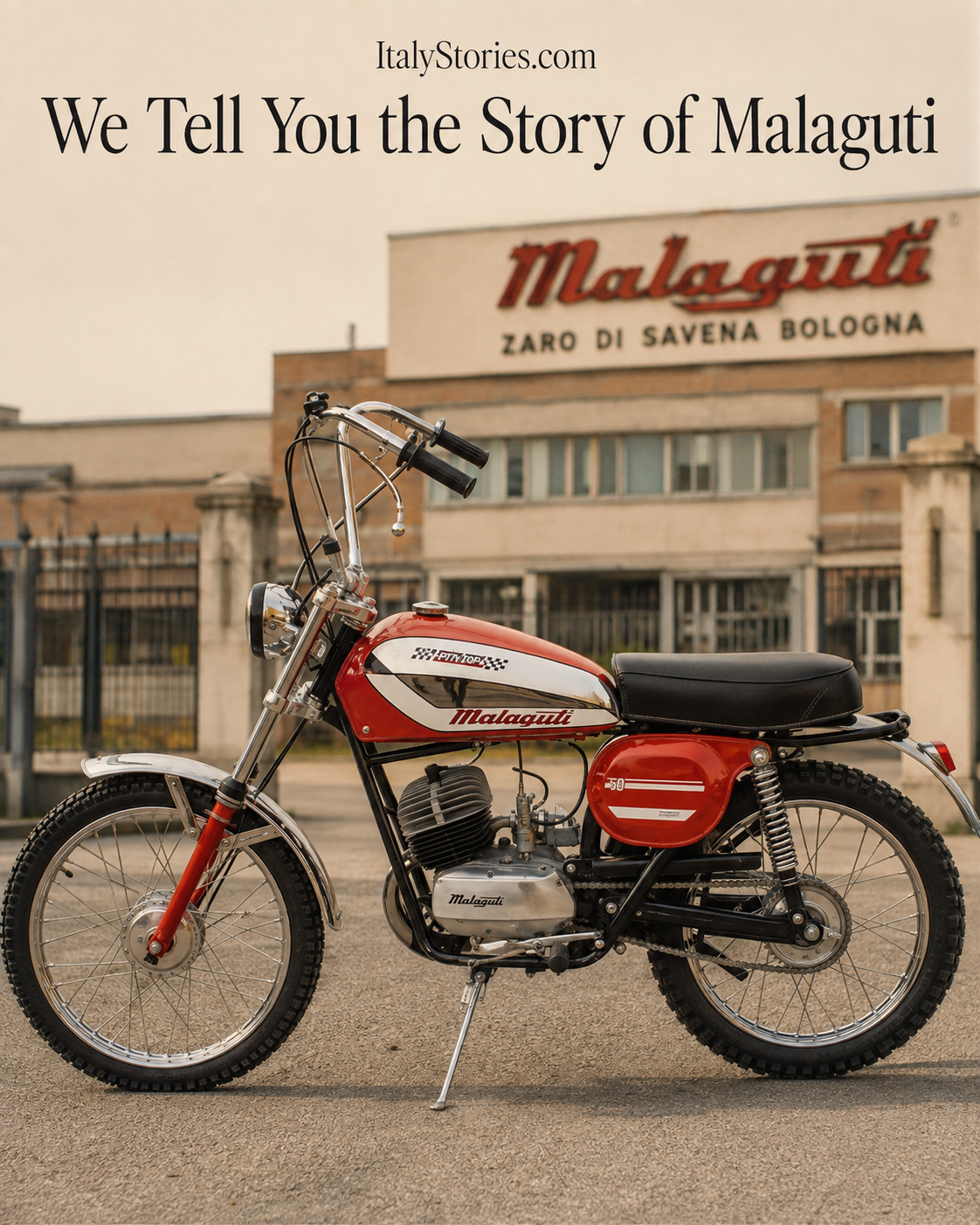
That idea found its perfect expression in 1974 with the arrival of the Malaguti Fifty. It belonged to the uniquely Italian family of mopeds later nicknamed “tuboni,” machines whose large central tubular frame also served as the fuel tank. The architecture was simple, light and inexpensive, but the Fifty turned it into an object of desire. Over the following years Malaguti continually revised the model, adding different engines, equipment, graphics and increasingly sporty details. The Fifty became one of the defining adolescent vehicles of its era.
The early 1980s pushed the concept further. Versions such as the Fifty HF, Full CX and especially the Fifty Top transformed the humble 50cc moped into something that looked almost rebellious. Disc brakes, bold colours, more sophisticated suspension and, on the Top, liquid cooling and richer instrumentation made the little machine feel far more serious than its displacement suggested. To adults it could still be dismissed as a moped. To the teenager who had saved for it, polished it and waited impatiently for the legal age to ride it, it was a motorcycle in everything that mattered.
The Fifty also illustrates one of Malaguti’s greatest strengths: the company understood that machines live in memory as much as in garages. Owners remember the first ride without a parent, the route to school, the smell of two-stroke oil, the forbidden modifications and arguments over whose bike was faster. By the time production ended in 1997, the Fifty had passed through an extraordinary number of versions and had become a cultural object, especially in northern and central Italy. The Fifty Top, with its aggressive look and high-specification equipment, remains one of the most remembered expressions of that world.
Malaguti did not survive on nostalgia alone. As the European market moved away from geared mopeds and toward automatic scooters, the company adapted. In the 1990s it created a new generation of machines with names such as F10, F15 Firefox, Madison and, above all, Phantom F12. Introduced in the early 1990s, the Phantom became one of the most successful sporty scooters of its period. Its sharp bodywork, compact proportions and youth-oriented image made it a familiar sight outside schools, cafés and football grounds. For a new generation, the Phantom performed the same emotional job the Fifty had done before it.
The company remained family controlled, and that mattered. Malaguti never became one of the gigantic multinational motorcycle groups. Its identity was tied to Bologna, to a network of specialist suppliers and to a way of manufacturing typical of the Italian Motor Valley, where relatively small companies could create machines with a personality larger than their balance sheets. Components often came from specialist firms in the region, creating an ecosystem in which manufacturers competed fiercely but shared the same mechanical culture.
At the beginning of the new century, Malaguti even allowed itself a racing dream. In 2003 the company entered the 125cc World Championship with Team Semprucci. Fabrizio Lai and the young Spaniard Julián Simón rode the Bologna-built machines. The project involved specialist partners including Engines Engineering, Ducati Energia and Paioli. It was an audacious move for a company known primarily for scooters and small-capacity motorcycles. Malaguti did not conquer the championship, but the effort said something important about the family’s ambition: after more than seventy years, the company still wanted to prove that its name belonged in the most demanding arena of two-wheel competition.
Yet the market beneath Malaguti was changing faster than racing could transform the company. European demand for traditional 50cc mopeds and scooters weakened. Regulations became more demanding, younger customers increasingly had other ways to spend their money, and competition from large European and Asian manufacturers intensified. The global financial crisis that began in 2008 made a difficult environment worse. For a medium-sized family manufacturer, the cost of developing new engines and models while meeting increasingly complex emissions standards became harder to sustain.
The decline was painful because it happened not to an anonymous factory but to a company woven into the industrial history of Bologna. By 2011 production had been halted and the Malaguti family searched for a buyer or industrial partner. Proposals came and disappeared while workers waited through months of uncertainty. The factory at Castel San Pietro Terme, once filled with the noise of assembly lines and engines, approached silence. About 170 employees faced the end of their jobs, and the regional authorities and trade unions tried without success to construct a rescue.
On 31 October 2011, the production story of the original Malaguti company came to an end after more than eighty years. It was more than a corporate closure. For Bologna it was another wound in a motorcycle district already suffering from the crisis. For former employees it was personal. For riders, it seemed almost impossible that the name behind the Fifty and the Phantom could simply stop making motorcycles. The last machines left behind a strange contrast: brightly coloured scooters and mopeds in a factory whose future had gone grey.
But Italian industrial names have a habit of surviving their factories. The Malaguti brand did not disappear forever. In 2018 the Austrian KSR Group acquired and relaunched the name, presenting a new generation of motorcycles and later electric bicycles. The revived company speaks of the “Spirit of Bologna,” linking new products to Antonino Malaguti’s original workshop. The ownership, industrial structure and machines are different from those of the historic family company, and the distinction matters. What returned was the brand and its memory, not the old factory exactly as it had been.
Perhaps that is the most fitting ending to the Malaguti story. The original company was born because a young man looked at a bicycle and imagined that it could become something more. Eight decades later, the factory closed because the world of mobility had changed again. Yet the objects it made continue to move through another kind of landscape: memory. A restored Fifty Top parked outside a café can still make a man in his fifties become fourteen for a moment. A Phantom F12 can still summon the sound of an Italian schoolyard in the 1990s. Machines are made from steel, aluminium, plastic and rubber, but the best of them acquire another material with age: emotion.
Malaguti never became Ferrari, Ducati or Vespa, and that may be precisely why its story deserves to be told. It belonged closer to ordinary life. Its motorcycles and scooters were often the first machines people could call their own. They carried students, workers, girlfriends, friends, groceries and impossible teenage dreams. The factory may have fallen silent in 2011, but for hundreds of thousands of Italians, the sound of Malaguti is still the sound of a key turning, a small two-stroke engine catching, and the road suddenly becoming larger than the neighbourhood.
Continue your journey through the companies, machines and people that shaped Italy by discovering more stories on ItalyStories.com.