

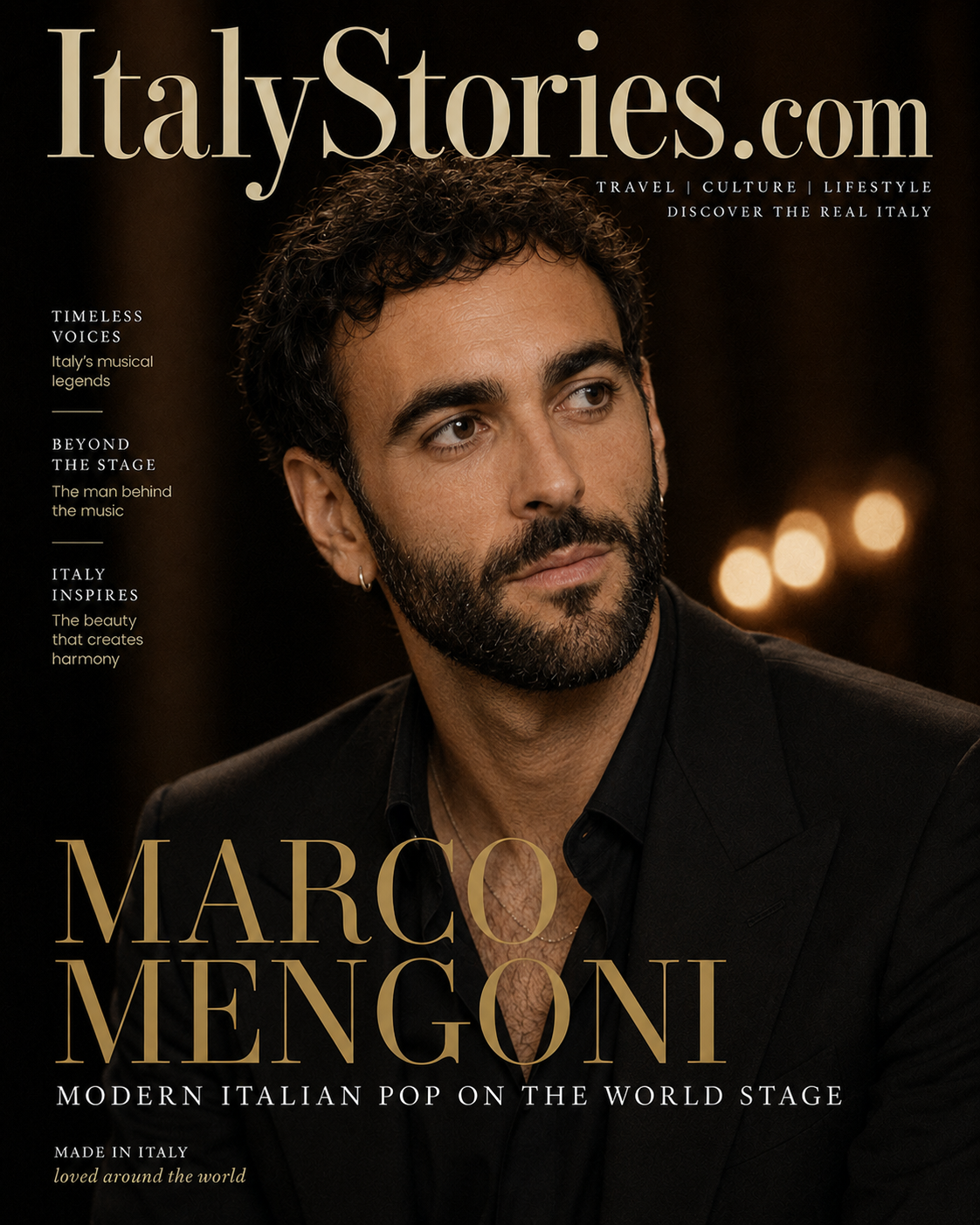
The Night He Returned to Sanremo and Changed Scale Again
In February 2023, Marco Mengoni walked back onto the stage of the Teatro Ariston carrying something unusual: the burden of being the obvious favorite and the memory of having already won the Festival di Sanremo ten years earlier. Success can make a return more dangerous than a debut. A new artist has little to lose. An established artist risks comparison with his own past.
Mengoni sang “Due vite.” The song did not arrive like a nostalgic attempt to repeat “L’essenziale,” the ballad that had won Sanremo in 2013. It was denser, more adult and more inward-looking, built around the unstable territory between waking and dreaming, between the self we show and the one that emerges when control weakens. His performance was technically assured, but what mattered more was the tension inside it: the feeling that a singer famous for vocal power had learned how to make restraint equally dramatic.
He won the Festival for the second time. A few months later, he represented Italy at the Eurovision Song Contest in Liverpool and finished fourth with a specially arranged version of “Due vite.” The moment completed a remarkable circle. In 2013, after his first Sanremo victory, he had gone to Eurovision as a newly consecrated Italian star. In 2023, he returned as one of the defining male voices of his generation, an artist who had spent the intervening decade reshaping his sound, his writing and his relationship with the stage.
The distance between those two Eurovision appearances tells the real story of Marco Mengoni. It is not simply a story of prizes or platinum records. It is the story of an artist who entered Italian popular culture through television and then refused to remain only the product of television; a singer who possessed an extraordinary instrument but had to learn that virtuosity alone is not identity; a performer who moved from pop immediacy toward soul, R&B, electronic textures, orchestral ambition and increasingly personal songwriting.
By the mid-2020s, his place in Italian music was no longer debatable. The more interesting question had become how someone from Ronciglione, a small town in northern Lazio, had turned a talent-show victory into one of the most durable and internationally visible careers in contemporary Italian pop.
Ronciglione: The Boy Before the Television Lights
Marco Mengoni was born on December 25, 1988, in Ronciglione, in the province of Viterbo. The town sits in the Tuscia area of Lazio, far from the industrial machinery of Milanese pop and far from the mythology of Rome’s center. That geography matters because Mengoni’s story begins not in a major music academy or a famous artistic family, but in a relatively small community where ambition had to imagine its own road outward.
He began singing young and gradually developed a fascination with different styles rather than a single genre. The voice was the obvious gift, but the deeper formation came from listening. Soul and R&B mattered, as did Italian songwriting, pop, rock and the dramatic vocal traditions that dominate television talent culture. Before fame, he performed in local contexts and worked through the ordinary stages by which a young singer discovers what his instrument can actually do in front of other people.
The young Mengoni’s voice already had qualities that would later become unmistakable: flexibility, a bright upper register, an expressive falsetto, an ability to shift from breathy intimacy to full-throated intensity, and a rhythmic instinct that distinguished him from more traditional Italian ballad singers. But raw gifts are not careers. They require discipline, taste and the ability to decide what not to do.
That last lesson would become crucial. Singers with unusually agile voices are often encouraged to prove themselves constantly. They can turn every phrase into an exhibition. Mengoni’s mature artistry would depend on moving in the opposite direction: learning when a vocal flourish added meaning and when silence, grain or a lower tone could communicate more.
Before any of that refinement, however, came the breakthrough mechanism that transformed many Italian careers in the 2000s: television.
X Factor 2009: The Talent Show That Became a Launchpad
In 2009, Marco Mengoni entered the third Italian edition of X Factor. He was twenty years old when the wider public first encountered him. He competed in the 16–24 category under the guidance of Morgan, one of the judges most associated with musical experimentation and repertory choices that pushed contestants beyond straightforward radio pop.
Mengoni quickly became the contestant audiences watched for the voice. Week after week, he demonstrated range, theatrical instinct and an unusual ability to reinterpret material rather than merely reproduce it. According to Sky’s own retrospective, his run through the program was effectively unstoppable: he reached the final without ever being sent to the elimination showdown and won the season.
His winning single, “Dove si vola,” became his first major commercial success and gave its title to the EP released immediately after the show. Yet the most important result of X Factor was not the single. It was visibility. Italian audiences had seen him develop in real time. They had watched a talented but still unfinished singer become a public personality.
Talent shows can produce a paradox. They create instant familiarity, but that familiarity can become a prison. Viewers may continue to see the artist as a contestant long after the competition ends. The industry may rush to capitalize on recognition before an authentic sound has formed. Many winners discover that the applause of a final episode does not automatically become a ten-year career.
Mengoni’s task after X Factor was therefore harder than simply releasing music. He had to convert a television narrative into an artistic one. The early years show him doing exactly that, sometimes unevenly, often boldly, always with the sense that he understood the danger of being reduced to “the great voice from the talent show.”
Re Matto and the First Sanremo: Learning to Occupy the Stage
In 2010, only months after winning X Factor, Mengoni entered the Sanremo Music Festival with “Credimi ancora.” He finished third and won attention not only for the voice but for a performance style that already seemed unusually physical and modern. That period was captured in the project Re matto, whose title became an early nickname and public identity.
The early Mengoni was intense, eccentric and eager to test boundaries. His styling, movement and vocal arrangements often pushed toward theatricality. There was a sense of a young performer discovering that the stage could be a space of transformation. He did not present himself as the polite heir to traditional Italian male pop. He was more restless than that.
This phase also revealed the influence of international pop and soul. Mengoni’s phrasing was often more elastic than the straight melodic delivery common in Italian radio ballads. He liked rhythmic displacement, sudden dynamic changes and the dramatic effect of moving from low, almost spoken lines to explosive high passages.
There were risks. The more expressive tools a young singer has, the harder it is to choose among them. Critics sometimes heard excess where fans heard electricity. Yet the tension was productive. Mengoni was building a vocabulary. The point of an early career is not to arrive fully purified; it is to discover which instincts are essential.
By 2011 and 2012, he was already moving toward a more mature artistic framework. The transformation would become unmistakable in 2013.
“L’essenziale”: When Simplicity Became the Breakthrough
The 2013 Sanremo Music Festival was a turning point not because Mengoni was unknown, but because he appeared newly focused. Under that year’s competition rules, each major artist presented two songs in the first stage. Mengoni brought “Bellissimo” and “L’essenziale.” The latter advanced and ultimately won the Festival.
The title means “the essential,” and the song itself represented a kind of aesthetic stripping away. After the maximalism of his early years, “L’essenziale” relied on direct melody, emotional clarity and a performance in which the voice served the song rather than dominating it. That balance was new and important.
The song’s success was immediate and extensive. It led to the album #PRONTOACORRERE and brought Mengoni to the Eurovision Song Contest in Malmö, where he finished seventh. For an Italian artist of his generation, Eurovision was not yet the global cultural juggernaut it would become in the social-media era, but it still offered a vast international platform. Mengoni used it to present an Italian-language song without attempting to erase its identity.
The #PRONTOACORRERE period also showed a broader songwriting ambition. The album involved multiple writers and collaborators and ranged across polished pop, rock and international production. Cesare Cremonini contributed “La valle dei re,” while other songs expanded the sonic palette around Mengoni’s voice.
Most importantly, the 2013 phase established a new public relationship. Mengoni was no longer primarily the former X Factor winner with spectacular vocal ability. He had become a major Italian recording artist in his own right.
From Performer to Author: “Guerriero” and a New Emotional Center
The next major phase began with “Guerriero,” released in late 2014 ahead of Parole in circolo. The song, written by Mengoni with Fortunato Zampaglione and produced with Michele Canova, became one of the defining pieces of his career.
“Guerriero” matters because it is both a pop anthem and an intimate promise. The central image of the warrior is not militaristic; it is protective. The song speaks about strength directed toward another person, about the emotional armor people build and the willingness to stand beside someone when fear arrives. Mengoni’s performance begins with control and gradually opens into a broad, cathartic refrain.
The song also marked a deeper shift in authorship. Mengoni was becoming increasingly involved in writing and conceptual decisions. Sony described Parole in circolo as part of a “playlist in progress,” a project that rejected the idea of an album as a permanently closed object. For Mengoni, the studio had become a continuing laboratory.
Parole in circolo explored acoustic instrumentation, electronics and experimentation while making greater use of his lower register. That detail is significant. The young singer had often been identified with high notes and vocal agility. The mature singer began to discover that the darker areas of the voice could create intimacy and authority.
Songs such as “Esseri umani” and “Io ti aspetto” expanded this period’s emotional and rhythmic language. Mengoni’s pop was becoming more deliberate, more textural and more interested in the relationship between production and meaning.
“Ti ho voluto bene veramente”: A Journey Inward
Later in 2015 came “Ti ho voluto bene veramente,” another collaboration with Fortunato Zampaglione, produced by Michele Canova. It introduced Le cose che non ho, the second part of the project begun with Parole in circolo.
The title carries a difficult emotional weight: “I truly loved you.” It is a sentence spoken after something has already changed. The song avoids the easy drama of accusation and instead moves through memory, recognition and separation. Mengoni sings it with a controlled melancholy that shows how far he had traveled from the constant vocal exhibition of his early career.
The accompanying video, filmed in Iceland, turned the song into the first chapter of a visual narrative. That choice reflects another aspect of Mengoni’s work: he has repeatedly treated music projects as broader aesthetic worlds. Photography, video, stage design, fashion and digital interaction are not merely promotional additions. They are part of how he frames the songs.
Le cose che non ho consolidated a period of enormous commercial success. By the end of the subsequent Marco Mengoni Live cycle, Sony was documenting a catalogue dense with multi-platinum certifications, major streaming numbers and more than 300,000 spectators across two live legs.
The numbers confirmed the scale. The artistic value lay in the method. Mengoni had successfully turned a post-talent-show career into an evolving body of work with recognizable emotional and sonic concerns.
The Voice: Power Is Only Half the Story
Marco Mengoni’s voice is often described in terms of power, range and flexibility, and understandably so. He can move rapidly between registers, use falsetto with precision, push into a bright upper range and then retreat into a darker, breathier tone. He possesses the kind of instrument that makes vocal coaches and casual listeners notice immediately.
But technical description explains only part of his appeal. The more interesting quality is timbral instability in the best sense: his voice can change character quickly. It can sound metallic, fragile, smoky, almost spoken, then suddenly expansive. This gives him access to several emotional positions within a single song.
His soul and R&B influences are especially audible in phrasing. He often bends around the beat rather than sitting rigidly on top of it. He uses ornament not only as decoration but as emotional hesitation or release. In uptempo material, this creates groove; in ballads, it can create vulnerability.
Over time, he also learned to use imperfection. A perfectly clean sound is not always the most expressive. Mengoni increasingly allowed breath, grain and physical strain to remain audible when they served the text. That maturation is one reason his later performances often feel more compelling than the technically flashier work of his youth.
What makes the voice recognizable, then, is not a single trick. It is the combination of flexibility, tonal color, rhythmic intelligence and a growing willingness to let meaning determine technique.
Atlantico: Looking Outward Without Losing the Center
In 2018, Mengoni entered another phase with Atlantico. The project was announced through the simultaneous release of “Voglio” and “Buona vita,” two songs with deliberately different personalities. Sony described them as signals of an artistic turn shaped by contrasting musical experiences.
Atlantico was a fitting title. By then, Mengoni’s musical imagination was openly transnational. Travel had become part of both the sound and the visual language. The project incorporated influences that reached beyond standard Italian pop, touching on electronic production, soul, world-music colors and rhythmic experimentation.
Yet the record did not abandon his core strengths. Songs still revolved around human connection, anxiety, desire and the search for meaning. Mengoni’s outward curiosity was never tourism for its own sake. He used new sounds to refresh the emotional architecture of his music.
This period also reinforced his position as a live performer capable of increasingly elaborate productions. His concerts had become carefully designed experiences in which staging, lighting, arrangement and visual identity interacted with the songs. He was developing the rare ability to perform at scale without losing vocal detail.
By the end of the decade, Mengoni had become one of the few Italian male pop artists able to combine mainstream radio success, large live audiences, strong streaming performance, high-fashion visibility and a reputation for serious musical craft.
Materia: Building an Album as a Trilogy
The Materia project, released across three chapters between 2021 and 2023, was one of Mengoni’s most ambitious structural ideas. Rather than issue a single conventional album, he divided the work into Materia (Terra), Materia (Pelle) and Materia (Prisma), each with a distinct conceptual and sonic emphasis.
Terra suggested roots, origins and physical grounding. Pelle—skin—moved closer to contact, vulnerability and emotional exposure. Prisma implied refraction: light breaking into multiple colors, identity viewed through different angles. Together, the three parts formed a map of Mengoni’s artistic preoccupations: where we come from, how we feel, and how many versions of ourselves can coexist.
The trilogy also allowed him to explore soul, gospel, electronic pop, funk, intimate songwriting and orchestral color without forcing every idea into the same frame. Collaborations and production choices broadened the palette, but the voice remained the anchor.
Materia was not only artistically expansive; it was commercially powerful. By 2024, Italian press was reporting that the trilogy had accumulated multiple platinum certifications, while Mengoni’s total career certifications and streaming numbers had reached a scale that placed him among Italy’s dominant contemporary artists.
The trilogy prepared the emotional and aesthetic ground for his second Sanremo victory. “Due vite” did not feel like a sudden detour. It felt like the concentrated expression of questions the Materia era had been asking all along.
“Due vite”: Two Selves, Two Worlds
“Due vite” was written by Marco Mengoni and Davide Petrella, with music credited to Petrella and Davide Simonetta. Its structure is more intricate than the simplicity of a conventional festival ballad. The lyric moves through images that blur the border between dream and waking life, intimacy and estrangement, the person one is and the person one might be under different conditions.
This ambiguity is one reason the song worked so well on the Sanremo stage. Festivals reward immediate emotional impact, but “Due vite” also offered interpretive depth. It could be heard as a love song, an internal dialogue, or a meditation on parallel selves.
Mengoni’s performance made the architecture intelligible. He began in a relatively contained space, allowing the lyric to lead, then expanded into the climactic sections without losing control. The vocal power was present, but the drama came from pacing.
Winning Sanremo in 2023, exactly a decade after “L’essenziale,” carried symbolic weight. The two songs form useful bookends. “L’essenziale” was about stripping life to what matters. “Due vite” was about accepting complexity. The artist who had once needed to simplify himself had grown into one capable of holding contradiction.
Eurovision, Again: Italy on the World Stage
When Mengoni returned to Eurovision in Liverpool in 2023, he was one of the relatively small group of Italian artists to represent the country more than once. Ten years had passed since Malmö. The Eurovision itself had changed, becoming even more global through streaming, social media and fan culture. Mengoni had changed just as dramatically.
He presented a specially arranged version of “Due vite” and finished fourth. The result confirmed his international credibility and introduced his mature performance style to another enormous audience.
International success for Italian singers is always complicated. Language can be a barrier, but it can also become an asset when the song is strong enough. Mengoni has often chosen not to erase Italian identity in pursuit of foreign accessibility. He has recorded Spanish-language versions and cultivated audiences outside Italy, but his most important international moments have often come through Italian songs.
That approach links him to a wider tradition stretching from Domenico Modugno to contemporary acts such as Måneskin: the idea that Italy does not need to imitate the Anglo-American market perfectly in order to participate in global pop culture. Distinctiveness can travel.
The Stage Becomes a City: Stadiums, Arenas and a New Scale
By the 2020s, Marco Mengoni’s live career had expanded to stadium scale. This transition is not automatic. Many successful recording artists cannot sustain the physical and emotional demands of very large venues. Stadium performance requires not only hits but narrative control, visual imagination and the ability to make tens of thousands of people feel addressed.
Mengoni’s 2023 stadium tour culminated in a major show at Rome’s Circo Massimo. The location itself carried symbolic significance. Few spaces in Italy suggest public spectacle more powerfully. For an artist born less than forty years earlier in a small town in Lazio, the image was extraordinary: the local journey had expanded to one of the capital’s most monumental stages.
He returned to stadiums in 2025 with an even larger operation. Before the tour began, hundreds of thousands of tickets had already been sold. The run included major Italian stadiums and was followed by an autumn arena tour extending into Europe.
The SIAE report released in 2026 placed Mengoni at the top among Italian artists for total live spectators in 2025, with more than 670,000 people across his summer and autumn tours. That statistic captures the scale of his popularity better than any single chart position. Mengoni had become not only a streaming and radio presence but a mass live artist.
Yet his best stadium performances retain one of his early strengths: the sensation that the voice is still doing real work. The production may be enormous, but the emotional center remains human breath.
Public Image: Fashion, Vulnerability and Control
Marco Mengoni’s public image has evolved almost as deliberately as his music. The early years emphasized eccentricity and theatricality. Later phases moved toward a more refined, fashion-conscious aesthetic, often balancing masculine tailoring with softness, fluidity and visual experimentation.
This evolution matters because contemporary pop stars communicate through image as intensely as through sound. Mengoni has understood that clothing, photography, stage design and gesture can extend the emotional world of music. Yet he rarely allows image to replace the work. The visual language changes; the central artistic themes remain recognizable.
He has also spoken publicly at different times about vulnerability, fear, self-acceptance and the pressures of public identity. Without turning private life into spectacle, he has allowed audiences to see that confidence is not a permanent condition. This has deepened his relationship with fans, particularly younger listeners who recognize the conflict between performance and insecurity.
His public character combines control and self-questioning. He can appear highly polished on a major stage while singing songs built around doubt, contradiction and emotional fracture. That tension is one of the reasons he feels contemporary. Modern celebrity often requires perfection; Mengoni’s strongest work keeps insisting that being human is more complicated.
The People Around the Voice
A career of this scale is always collective. Marco Mengoni’s development has been shaped by producers, songwriters, musicians, directors and creative collaborators who helped convert instinct into form.
Morgan played an important early role at X Factor, challenging him as a performer and helping frame his television breakthrough as something more musically ambitious than a conventional talent-show path.
Michele Canova became a major production figure during the mid-2010s, helping shape the polished but emotionally detailed sound around songs such as “Guerriero” and the Parole in circolo era. Fortunato Zampaglione was central as a co-writer on “Guerriero” and “Ti ho voluto bene veramente,” two songs crucial to Mengoni’s evolution as an author.
Cesare Cremonini contributed “La valle dei re,” demonstrating the respect Mengoni had earned within the Italian songwriting community. Later, Davide Petrella and Davide Simonetta helped build “Due vite,” a song whose success depended on the marriage between lyrical ambiguity and controlled melodic ascent.
The Younuts directing team, visual designers, tour directors and musicians have also been important to the increasingly cinematic identity of his projects. Modern pop authorship is not only the person holding the microphone. Mengoni’s strength has been to collaborate without dissolving himself inside the collaboration.
International Reach Without Abandoning Italian
Mengoni’s international career has taken several forms. After his first Eurovision appearance, he pursued the Spanish-speaking market with translated recordings, including “Incomparable,” the Spanish version of “L’essenziale,” which performed strongly in digital sales. Later tours extended into major European cities, and his 2023 European arena run included sold-out dates in cities such as Brussels, Frankfurt and Paris.
His international profile differs from that of an artist who simply records an English-language album and relocates stylistically. Mengoni’s approach has been more gradual. He has tested other languages and markets while keeping Italian songwriting at the center of his identity.
That strategy is culturally significant. Italy has long exported opera, film music and heritage imagery more easily than contemporary pop. Artists like Mengoni contribute to a newer picture: modern Italian music as something capable of competing in current production, performance and visual standards without disguising where it comes from.
The goal is not necessarily to become an American-style global celebrity. It is to make Italian pop feel native to the international stage. Mengoni has increasingly done exactly that.
2024–2026: After the Second Coronation
What happens after a career-defining victory? The temptation is to repeat the winning formula. Mengoni instead kept moving.
In 2024 he returned to Sanremo in a different role, co-hosting the opening night of the Festival alongside Amadeus. The image was significant. Eleven years earlier he had arrived as a competitor trying to redefine himself. Now he stood on the same stage as an established figure of Italian popular culture, capable not only of performing but of carrying a national television event.
Later that year he released “Mandare tutto all’aria,” opening another sonic chapter built around synthesizers, drum machines, sequenced tracks and sampling. The song suggested that the Materia trilogy was not going to become a permanent template.
In 2025 came “Sto bene al mare,” recorded with Sayf and Rkomi, an unusual summer track that used Mediterranean and contemporary pop colors while keeping an undertow of dislocation and unease. The year was dominated by the extraordinary live scale of Marco negli Stadi 2025 and the subsequent European arena run.
By 2026, Mengoni remained visibly in motion. He collaborated with Angelina Mango on “Canto d’Amore,” a song written around human contradiction, imperfection and the rejection of impossible standards. The collaboration was especially fitting for an artist whose mature work has increasingly treated vulnerability not as weakness, but as material for connection.
Reports and his own live comments also pointed toward new music beyond the Materia era. The exact form of the next chapter was still emerging, which may be the most Mengoni-like position of all: not finished, not fixed, still searching.
Why Marco Mengoni Matters
Marco Mengoni matters because he embodies a transition in Italian popular music. He belongs to the first generation for whom the talent show could be a legitimate entry point rather than a permanent stigma, but he also demonstrates that television exposure is only the beginning. The career became important because he built beyond the format that discovered him.
He matters as a vocalist because he helped reintroduce soul and R&B-inflected phrasing into mainstream Italian male pop without abandoning the melodic tradition that Italian audiences value. He matters as an author because he gradually moved from interpretation toward increasingly personal writing and conceptual album-making.
He matters as a live performer because he has shown that contemporary Italian pop can operate at stadium scale with the production ambition of international touring culture. And he matters symbolically because his international achievements—two Eurovision appearances, European tours, multilingual releases—suggest a version of Italian identity that is modern, flexible and outward-looking.
Perhaps most importantly, he matters because he has allowed growth to remain visible. The early singer and the mature artist are clearly the same person, but they are not the same performer. The transformation is part of the story. He did not hide the process of becoming more precise, more vulnerable, more controlled and more interested in what lies beneath vocal spectacle.
That is why his career has lasted. The audience did not only watch him succeed. It watched him change.
The Essential Thing Was Never Just the Voice
Marco Mengoni began with the kind of voice that can open doors quickly. But extraordinary voices are common enough that music history is filled with singers who arrived loudly and disappeared. What distinguishes him is what he built after the door opened.
He learned how to turn range into interpretation, television recognition into authorship, fashion into visual language, hit singles into long-form projects, and concerts into collective experiences. He moved from Ronciglione to X Factor, from X Factor to Sanremo, from Sanremo to Eurovision, from arenas to stadiums, and from the need to prove what his voice could do toward the more interesting question of what a song could reveal.
“L’essenziale” once asked what remains when unnecessary things fall away. A decade later, “Due vite” accepted that no self is ever entirely simple. Between those songs lies the map of Mengoni’s artistic growth.
By 2026, he was still only in his thirties, yet he had already accumulated the kind of career milestones that many artists never reach: two Sanremo victories, two Eurovision appearances, multi-platinum albums, billions of streams and tours drawing hundreds of thousands of people. Those facts explain his scale. They do not fully explain his importance.
The deeper achievement is that beneath the scale, one can still hear a singer searching. In pop music, that is often the difference between a star and an artist.
A Final Thank You from ItalyStories.com
Thank you for spending time with this story. ItalyStories.com was created to explore the people, voices, places and ideas that carry modern Italy far beyond its borders. If Marco Mengoni’s journey has made you curious about another chapter of Italian music and culture, we would be delighted to welcome you to the next story.
[…] Scanu won in 2010, Roberto Vecchioni in 2011 with “Chiamami ancora amore,” Emma in 2012, Marco Mengoni in 2013 with “L’essenziale,” and Arisa in 2014 with “Controvento.” The winners themselves […]