

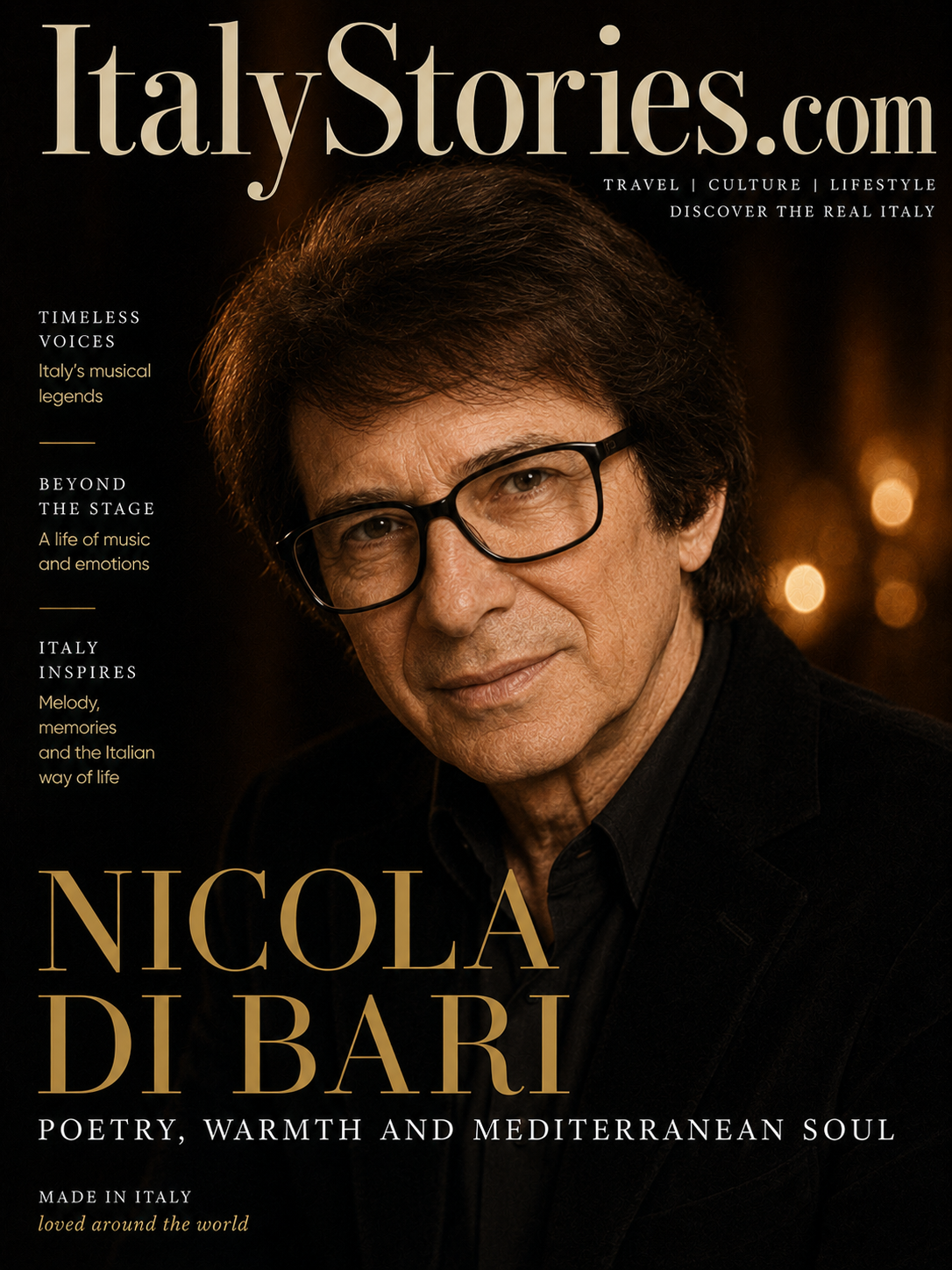
In March 1972, Nicola Di Bari stood at the center of the Festival di Sanremo for the second year in a row. Twelve months earlier, “Il cuore è uno zingaro” had made him a winner beside Nada. Now “I giorni dell’arcobaleno” had won again. The achievement placed him in a small group of performers who conquered Italy’s most important song contest in consecutive editions.
The television image suggested certainty: the dark suit, the composed face, the unmistakable rough-grained voice. Yet the story behind it was built from departures, reversals and long stretches of doubt. The singer known as Nicola Di Bari had been born Michele Scommegna in a farming family in Zapponeta, a small town on the Adriatic plain of northern Puglia. He had left home, worked in Milan, sung in clubs and entered a record industry that could turn one successful song into national fame—and one disappointing result into silence.
His two Sanremo victories were not the beginning of that journey, nor were they its end. They were the visible summit of a career that linked rural southern Italy to the television age, the Italian melodic tradition to the emerging singer-songwriter culture, and the domestic market to an enduring audience in Spain and Latin America. Di Bari’s music travelled because it sounded local without being provincial. His voice carried dust, distance and tenderness, and listeners far from Puglia recognized something of their own lives in it.
Zapponeta Before the Stage Lights
Michele Scommegna was born on 29 September 1940 in Zapponeta, in the province of Foggia. The town faces the Adriatic and lies within a landscape shaped by agriculture, salt flats and seasonal labor. His family expected work to be practical. His father and brothers were connected to farming, and the decision was made that Michele should study rather than simply follow the same path.
He attended school in Manfredonia, but music was not initially presented as a profession. In the official biography published under his stage name, the decisive memory is almost cinematic: as an adolescent, during the feast of Zapponeta’s patron saint, he found himself singing near an elderly ice-cream seller whose sadness had caught his attention. The episode matters less as a legend of instant discovery than as an image of the kind of singer he would become. Di Bari’s voice did not belong to conservatory polish. It seemed to emerge from observation, sympathy and ordinary public life.
The south into which he was born was still marked by limited opportunities and migration. During the 1950s and 1960s, millions of Italians moved from villages and agricultural regions toward northern industrial cities or abroad. Di Bari’s own movement to Milan belonged to that transformation. Like many southern migrants, he carried his place of origin with him even when work required a new identity.
That background helps explain the emotional geography of his later songs. Roads, departures, memories of home and the dignity of people without glamour recur throughout his repertoire. The voice may be singing about love, but behind the love story there is often a traveler.
Milan: Work by Day, Music by Night
In Milan, the young Scommegna found employment while trying to enter the city’s musical world. The northern capital was expanding rapidly. Factories, publishing houses, television, advertising and record labels were reshaping Italian culture. Nightclubs offered an informal school for singers who did not yet have contracts. A performer learned how to read a room, survive an indifferent audience and make a familiar melody sound personal.
He adopted the name Nicola Di Bari, choosing an identity that immediately declared a southern origin. The name was not a rejection of Michele Scommegna so much as a stage sign visible from a distance: Italian, southern and memorable. Bari, the major city of Puglia, gave national audiences a geographical reference even though he came from Zapponeta. On ItalyStories, the broader cultural landscape of the region can be explored through Bari and Lecce.
Di Bari’s early voice was sometimes described as coarse or cavernous. That quality might have seemed a disadvantage in an era that still valued smooth vocal finish. It became his signature. He did not sound like a salon singer. He sounded as if the song had already passed through experience before reaching the microphone.
The first recordings and competitions brought attention without immediate security. He had to learn the unstable rules of Italian popular music: regional festivals could open doors, radio could create recognition, and Sanremo could change a career overnight. But there was no guarantee that one appearance would lead to another.
The First Sanremo Lessons
Di Bari reached Sanremo in 1965 with “Amici miei,” performed in the festival’s paired system with Gene Pitney. The song finished second. For a relatively new singer, the result was substantial, and the partnership with an American star showed how Sanremo functioned at the time: Italian songs were presented in two versions, often pairing a domestic performer with an international name.
He returned with Pitney in 1966 for “Lei mi aspetta” and again in 1967 for “Guardati alle spalle.” The sequence gave Di Bari visibility but also taught him how quickly momentum could weaken. “Guardati alle spalle” did not achieve the expected result. In a market driven by festivals and singles, a setback could force a singer to rebuild almost from the beginning.
The 1967 festival was shadowed by the death of Luigi Tenco. Di Bari later recorded an album devoted to Tenco’s songs, an act that placed him in conversation with a more introspective current of Italian songwriting. He was never simply a conventional interpreter waiting for material. He wrote music, selected repertoire with care and increasingly sought songs in which melodic accessibility did not cancel emotional complexity.
The difficult years were essential. They prevented the later victories from becoming a story of effortless ascent. Di Bari had already experienced national television, near-success and retreat. When the right song arrived, he knew what was at stake.
“Il mondo è grigio, il mondo è blu”: A Door Reopens
In 1968, “Il mondo è grigio, il mondo è blu” restored Di Bari’s commercial momentum. The song was an Italian adaptation connected to Eric Charden’s French hit “Le monde est gris, le monde est bleu.” Its success showed Di Bari’s ability to inhabit material that had crossed borders. Italian popular music of the period frequently translated and transformed French, British and American songs, but the strongest versions depended on an interpreter who could make the borrowed structure feel native.
Di Bari’s voice supplied that transformation. The contrast between gray and blue suited a singer whose timbre already contained shadow. He did not brighten the song artificially. Instead, he made melancholy sound companionable.
“Vagabondo,” released in 1970, gave an even clearer form to his public identity. The wanderer in the song is not a picturesque tourist. He is a figure of restlessness and freedom, moving because stillness cannot contain him. The theme connected naturally with audiences in an Italy shaped by internal migration and with listeners abroad who understood the mixture of nostalgia and movement.
These successes prepared the ground for the song that would define the next phase of his career.
“La prima cosa bella”: The Song Someone Else Almost Sang
“La prima cosa bella” arrived at Sanremo in 1970 and became one of the essential Italian songs of its decade. Di Bari composed the music; Mogol wrote the lyrics. According to the commonly documented history of the song, Gianni Morandi had been considered as an interpreter but did not take it to the festival. The RCA then entrusted it to Di Bari, paired with the newly formed Ricchi e Poveri.
The song finished second at Sanremo, but its life far exceeded the ranking. Its melodic opening is immediately recognizable, and the text turns the act of singing into a gift offered to a beloved person. The emotion is direct without being empty. Di Bari’s grainy delivery prevents the sweetness from becoming decorative, while the brighter ensemble sound of Ricchi e Poveri offers a contrasting version.
Commercially, “La prima cosa bella” became a major hit and confirmed that Di Bari could be both author and popular interpreter. Culturally, it belongs to the moment when Italian song was learning to combine the accessibility of the festival tradition with the personal authorship associated with the cantautori.
Decades later the title continued to circulate, including through Paolo Virzì’s 2010 film “La prima cosa bella.” That afterlife demonstrates the strength of a song able to summon a period without remaining trapped in it. For many Italians, a few notes are enough to recover a family room, a radio, a summer or a person.
Two Sanremo Victories in Two Years
In 1971, Di Bari returned to Sanremo with “Il cuore è uno zingaro,” paired with Nada. The song won. Its central metaphor—the heart as a gypsy that cannot be chained—was perfectly matched to the singer of “Vagabondo.” Movement was again emotional and geographical at once.
The victory altered his position in the industry. He was no longer the persistent competitor who had once finished second and then struggled. He was a national star. In the same year he won Canzonissima with “Chitarra suona più piano,” defeating strong competition and reinforcing his presence in Italian homes. Canzonissima, tied to the national lottery and broadcast by RAI, reached a vast family audience. Success there could be as important as Sanremo.
Then came “I giorni dell’arcobaleno” in 1972. The song won Sanremo and sent Di Bari to the Eurovision Song Contest in Edinburgh, where he finished sixth. Its lyric addresses a young woman crossing from adolescence into adulthood, and its tone is more reflective than triumphant. Winning twice consecutively did not require Di Bari to repeat the same musical formula. What remained constant was the credibility of the voice.
Two successive Sanremo victories placed him in festival history. They also captured an era in which a melodic singer could dominate national culture without separating entertainment from authorship. Di Bari could write, interpret, appear on television and reach listeners who might never identify themselves as followers of “serious” songwriting.
The Voice: Gravel, Warmth and Restraint
Di Bari’s voice is often described through physical textures: rough, dark, husky, cavernous. Those terms are accurate but incomplete. The essential quality is the balance between weight and tenderness. A coarse voice can become aggressive; his rarely does. He uses the roughness to make vulnerability believable.
His phrasing is economical. He does not decorate every line or stretch emotion into a demonstration. The melody remains clear, and the words are delivered with the slightly worn authority of someone recounting experience rather than inventing it for the stage. This made him particularly effective in songs about travelers, lost love and memory.
Pronunciation also matters. Even when singing standard Italian, his sound retained a southern gravity. It did not depend on dialect, but it suggested a life outside the polished centers of national media. For audiences in Spain and Latin America, that quality translated well. The language changed; the emotional texture did not.
The voice evolved with age, naturally becoming heavier, yet the recognizability remained. A Di Bari recording can be identified within a few phrases because timbre, pacing and personality are inseparable.
Puglia Inside the Songs
Di Bari’s professional life took him far from Zapponeta, but Puglia remained a moral and imaginative point of origin. “Paese,” one of his significant songs, looks back toward the small town with affection complicated by departure. The village is neither mocked as backward nor idealized as paradise. It is the place that formed the traveler and the place the traveler can never entirely recover.
This tension belongs to a larger Italian story. The economic boom is often represented by motorways, household appliances and northern factories. For migrants from the south, it also meant separation from family, dialect and landscape. Popular songs became portable homes. They allowed listeners in Milan, Turin, Germany, Switzerland or Argentina to carry a recognizable emotional vocabulary.
Di Bari’s success showed that the southern experience could occupy prime-time television without being converted into folklore. His stage name announced Bari, his biography began in Zapponeta, and his international career demonstrated that local roots could increase rather than limit a singer’s reach.
Spain and Latin America: A Second Career Beyond Italy
From the 1970s onward, Di Bari recorded extensively in Spanish. The decision was commercially intelligent, but it worked because the music already possessed qualities valued across Latin markets: strong melody, romantic directness and a voice marked by lived emotion.
Songs including “Vagabondo,” “La prima cosa bella,” “Il cuore è uno zingaro” and “Chitarra suona più piano” found new lives in translation. He toured and built a following in Spain and Latin America that remained loyal even when Italian television and record companies gave him less attention.
This pattern complicates any simple narrative of decline. From the second half of the 1970s, his visibility in Italy diminished, as Treccani notes, but abroad he continued to be treated as an important representative of Italian song. The same performer could appear nostalgic in one market and fully contemporary in another.
Latin American audiences did not need detailed knowledge of Puglia or Sanremo to understand him. His themes—departure, devotion, wounded pride, the desire to return—belonged to societies with their own histories of migration. Italian identity became an entry point rather than a barrier.
Cinema, Television and a Changing Public Image
Di Bari’s fame also brought him into cinema. In 1972, director Carlo Lizzani cast him in “Torino nera.” The film placed the singer in a dramatic context far removed from the festival stage. He was not attempting to abandon music for acting, but the role reflected a period when successful singers moved naturally among records, television variety shows and films.
Italian entertainment in the 1960s and 1970s was highly interconnected. A Sanremo performer might appear in a musicarello, host a television segment, act in a drama and record songs for foreign markets within the same few years. Di Bari’s public image benefited from this circulation. He seemed familiar without becoming frivolous.
His appearance reinforced the music: serious eyes, restrained movement, no need for flamboyant choreography. The authenticity that audiences perceived was part of the performance, but it was grounded in biography. He had worked before becoming famous and had known the insecurity of losing momentum.
When the Center of Italian Pop Moved
By the late 1970s, Italian popular music was changing. New singer-songwriters, rock influences, disco, private television and different promotional systems altered the market. The classic melodic singer remained loved, but the industry increasingly divided artists into current stars and nostalgic names.
Di Bari continued to record. “Lei mia,” released in the later 1970s, was especially successful in South America, and he maintained an international schedule. Yet the reduced visibility at home could make a continuing career look like disappearance.
There is no need to invent a dramatic fall. The reality is more instructive. Popular taste moved, record-company priorities changed, and an artist strongly associated with a previous era received less domestic promotion. The songs, however, stayed in circulation through radio, cover versions, television retrospectives and family memory.
In 2000 he released “Un lungo viaggio d’amore,” a title that accurately described both his repertoire and the relationship with his audience. Later appearances confirmed that the voice and the familiar songs still carried immediate recognition.
The People Who Helped Shape the Repertoire
Di Bari’s career was personal but never solitary. Mogol’s contribution to “La prima cosa bella” connected him to the most influential Italian lyricist of the period. The paired performances with Gene Pitney introduced him to Sanremo’s international system. Nada’s version of “Il cuore è uno zingaro” created a generational and vocal contrast that helped the song win.
Ricchi e Poveri brought a different brightness to “La prima cosa bella,” allowing audiences to hear the composition from two angles. Luigi Tenco represented another kind of relationship: a colleague whose death marked the 1967 festival and whose songs Di Bari later honored on record.
The record labels and television institutions also mattered. SAAR gave him early opportunities; RCA supported the decisive period around “La prima cosa bella” and the Sanremo victories. RAI’s festivals and variety programs turned records into shared national events.
Understanding these relationships prevents the biography from becoming a myth of individual destiny. Di Bari’s talent required songs, arrangers, musicians, producers, television cameras and audiences ready to recognize themselves in what he sang.
Numbers That Matter—and Those That Do Not
Di Bari’s historical standing does not require inflated sales claims. The secure landmarks are already substantial: second place at Sanremo in 1965 with “Amici miei”; second place again in 1970 with “La prima cosa bella”; consecutive Sanremo victories in 1971 and 1972; the 1971 Canzonissima victory; and sixth place for Italy at Eurovision in 1972.
Beyond the rankings lies a more difficult measure: endurance across languages. His catalogue was recorded in Spanish, circulated widely in Latin America and survived changes in the Italian market. “La prima cosa bella,” “Vagabondo,” “Il cuore è uno zingaro” and “Chitarra suona più piano” remain reference points of melodic Italian music.
Specific global sales figures vary across biographies and promotional materials, so they should be treated cautiously. The international career is better demonstrated by Spanish-language recordings, repeated touring and the continued visibility of his repertoire outside Italy.
Why Nicola Di Bari Still Matters
Nicola Di Bari’s story is not only the story of a man who won Sanremo twice. It is the story of how postwar Italy learned to hear the south in a new way. The boy from Zapponeta entered the national media without erasing the roughness of his voice or the emotional landscape from which it came.
His finest songs are simple in the demanding sense: their melodies can be remembered after one hearing, but their emotional balance depends on interpretation. In another voice, they might become sentimental. In his, tenderness carries the weight of work, departure and return.
He also represents an international Italy often overlooked in domestic histories. While fashions changed at home, audiences across Spain and Latin America preserved his songs as living repertoire. That loyalty was not merely nostalgia for Italy. It was recognition of a singer who made migration and longing sound universal.
Return to the television image of 1972. The second Sanremo victory appears less like a miraculous peak than the convergence of everything that had come before: a farming family, a southern town, Milan clubs, early disappointments, the right collaborators, a voice no teacher could have manufactured and songs strong enough to cross an ocean. The rainbow in the winning title did not erase the gray years. It made them visible as part of the color.
Thank you for spending time with the story of Nicola Di Bari. Continue exploring the voices, cities and journeys that shaped modern Italy through ItalyStories.com.
[…] a title that sounded almost like a social slogan disguised as a catchy popular song. Nada and Nicola Di Bari won in 1971 with “Il cuore è uno zingaro,” Nicola Di Bari again in 1972 […]