

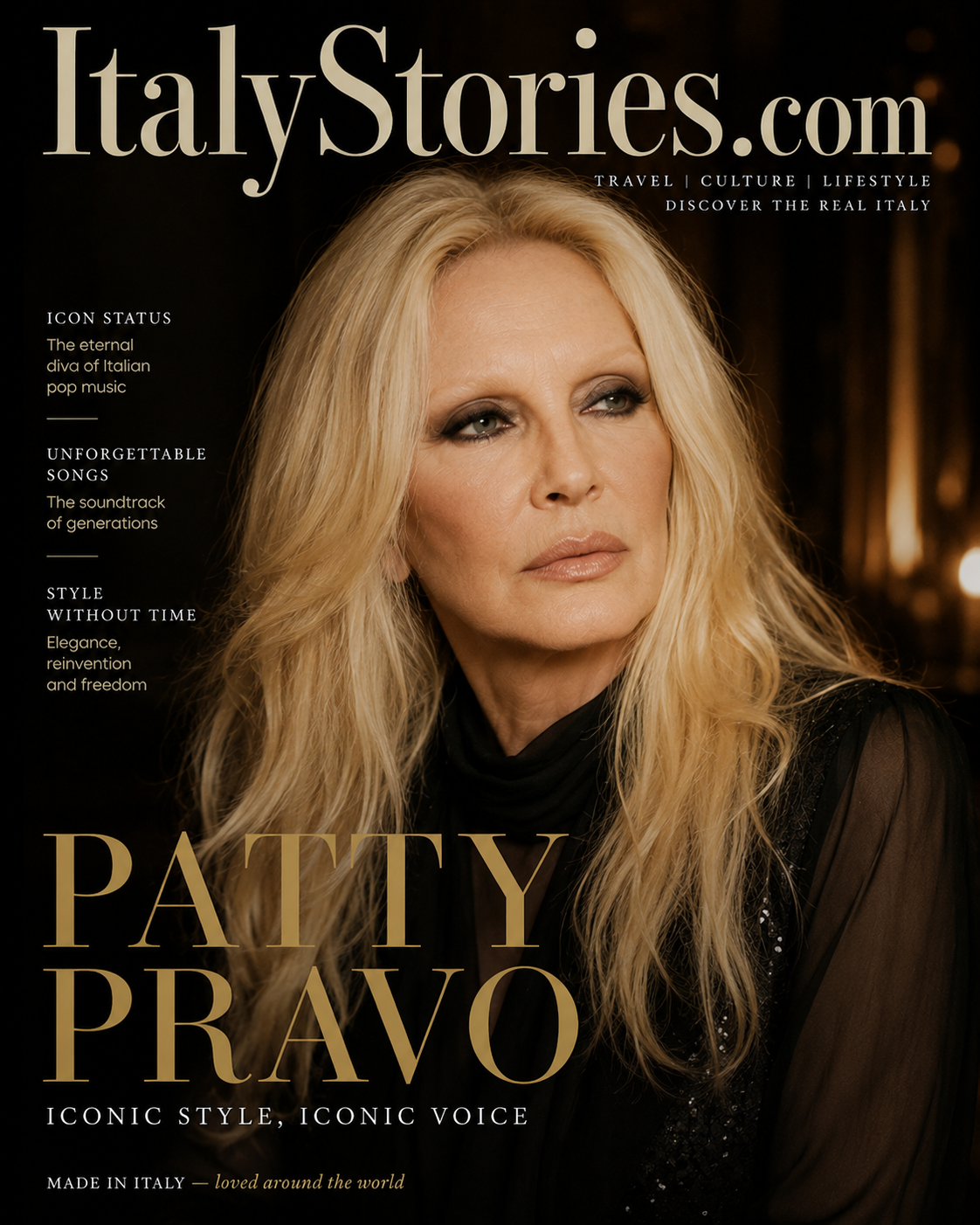
An Icon Beyond Fashion
Some singers are remembered for a song, others for a period, and a very small number for a presence so powerful that it survives every season of taste. Patty Pravo belongs to that last and rare category. She is not simply a successful singer in Italian music history, nor only a glamorous figure from the age of the Piper Club, nor merely the interpreter of unforgettable songs such as “La bambola” or “Pensiero stupendo.” She is, more profoundly, one of the great symbols of personal freedom, reinvention and female charisma in postwar Italian popular culture.
Across decades of change, Patty Pravo has remained astonishingly difficult to confine. She has been called a diva, an icon, a rebel, an interpreter, a muse, a scandal, a legend. Each of these labels contains a piece of truth, yet none fully captures her. What made her extraordinary was never just the voice, though the voice has always been distinctive. It was also the aura around it: the self-possession, the refusal of obedience, the talent for turning every appearance into a statement, and the instinctive understanding that performance is not only sound but attitude, silhouette, mystery and distance.
For generations of Italians, Patty Pravo represented something modern before much of Italy had learned how to speak modernity. She arrived not like a dutiful singer stepping into a tradition, but like a new kind of woman walking across the stage of a country that was changing rapidly and often nervously. She brought with her sophistication, irony, sensuality, elegance and unpredictability. She seemed at once Italian and international, intimate and untouchable.
To write about Patty Pravo, then, is not merely to reconstruct a career. It is to tell the story of a cultural figure whose life crossed music, fashion, television, nightlife, social change and the evolution of female public identity in Italy. Her songs matter enormously, but so does what she came to embody: a free artistic self, always in motion, always slightly ahead of expectation.
Venice, Nicoletta Strambelli and the Formation of a Future Star
Patty Pravo was born Nicoletta Strambelli in Venice on April 9, 1948. To be born in Venice is already to begin life in a city made of image, atmosphere and theatricality. Venice teaches one early that beauty can be a form of language. It is a city of reflections, masks, quiet drama and spectacle, all elements that, in different ways, would eventually echo in Patty Pravo’s public persona.
She did not come into the world as a ready-made pop symbol. Like many artists who later appear inevitable, she passed first through long, patient formation. Her family encouraged culture, and from childhood she studied music and dance. She attended the conservatory in Venice and received a rigorous training in piano, an early clue that beneath the later myth of the glamorous diva there was discipline, technique and serious musical education.
This detail is essential. Patty Pravo’s career is sometimes remembered through its visual and social impact alone, but the artistic foundation mattered deeply. Her ear was formed early. She understood structure, timing and expression. Even when she later moved through the worlds of beat music, chanson, pop and more experimental repertoire, one could sense that she was never merely posing as a musician. She had absorbed music from within.
Her adolescence also unfolded in a period of immense transformation. Italy in the late 1950s and early 1960s was changing economically, socially and culturally. Traditional certainties remained powerful, but younger generations were beginning to imagine other ways of dressing, speaking, dancing and living. In such a moment, a figure like Nicoletta Strambelli could not remain still for long. The horizon beyond Venice was already calling.
From Venice to Rome: The Discovery of a New Life
As a teenager, Nicoletta moved toward Rome, and this shift proved decisive. If Venice had offered atmosphere and formation, Rome offered velocity. The capital in the 1960s was alive with cinema, nightlife, political tension, cultural experimentation and youth energy. It was a city where identities could be remade.
In Rome she entered an environment that combined artistic possibility with social risk. She moved in circles where musicians, actors, intellectuals and adventurers crossed paths late into the night. This was not the polished, official Italy of ceremony and family respectability. It was a more electric world, one linked to international influences, to the excitement of clubs, to changing codes of behavior and style.
For a young woman with beauty, intelligence and artistic instinct, Rome could be both opportunity and test. Nicoletta did not simply adapt to that world; she absorbed it and transformed herself within it. The future Patty Pravo emerged here—not as an artificial invention but as a persona shaped by encounter, by urban rhythm, by music and by a refusal to remain ordinary.
The famous nickname that would become her stage name contained this sense of chosen identity. “Patty” had an international sound, while “Pravo,” inspired by Dante, added an intriguing literary twist. The result was a name that felt modern, elegant and slightly enigmatic. A star was being named into existence.
The Piper Club and the Birth of “La ragazza del Piper”
If one wanted to identify the mythic birthplace of Patty Pravo’s public legend, one would inevitably arrive at the Piper Club in Rome. Opened in the mid-1960s, the Piper was far more than a nightclub. It was one of the central laboratories of youth culture in Italy, a place where beat music, fashion, dance and social change met under colored lights. Many careers crossed its stage, but few became as deeply identified with its spirit as Patty Pravo.
It was there that she became “la ragazza del Piper,” the Piper girl, an expression that quickly entered Italian cultural vocabulary. The phrase was not just a journalistic tag. It suggested that Patty Pravo embodied a whole atmosphere: the youthful, bold, cosmopolitan and provocative energy of a new Italy stepping away from postwar restraint.
Her image immediately struck audiences. She did not carry herself like a traditional singer asking to be liked. She seemed self-aware, detached, magnetic. Her blond beauty, unusual style and almost sculptural poise made her impossible to ignore. Yet it would be a mistake to think she succeeded only through image. The image worked because it was joined to vocal personality and stage intelligence. She knew how to occupy space.
In many ways, the Piper era established the pattern that would define her whole career. Patty Pravo was never simply a vocalist standing in front of a microphone. She was always a figure, a presence, a total performance. The club gave her the perfect stage on which this truth could first be recognized by the public.
The First Hits and the Shock of Recognition
Patty Pravo’s early discography quickly made clear that her public fascination could be translated into records. The first phase of her success included songs that captured the atmosphere of the age while also shaping it. Covers, reinterpretations and original material all contributed to the creation of a recognizable artistic profile.
Among these early songs, “Ragazzo triste,” the Italian version of Sonny Bono’s “But You’re Mine,” is often remembered as a pioneering moment. It is frequently cited as one of the first Italian pop songs presented with a clearly youthful, modern beat-club sensibility. Whether one emphasizes its symbolic or strictly musical value, the song mattered because it announced a new kind of interpreter—urban, cool and contemporary.
Then came a sequence of recordings that strengthened her visibility and broadened her audience. She was no longer only a club sensation or a fashionable name in magazine pages. She was becoming a recording star. The Italian public, which often treated novelty with suspicion, found itself fascinated. She felt new, yet she also knew how to connect emotionally.
This combination became a key to her success. Patty Pravo offered modern style without abandoning feeling. Even when the arrangements sounded of the moment, there remained in her interpretations a human grain, a dramatic intelligence. She was not cold. She was controlled. And that distinction made all the difference.
“La Bambola” and the Making of a National Legend
In 1968, Patty Pravo recorded “La bambola,” and with that song her legend entered another dimension. There are songs that launch careers, and there are songs that permanently alter the scale of a career. “La bambola” did the latter.
At first glance, the song is a perfect pop construction: memorable melody, precise rhythm, emotional clarity, immediate impact. But its power lay in more than its catchiness. “La bambola” gave voice to a woman refusing manipulation, refusing to be treated as an object. “You can’t do what you want with me,” its message essentially declares. In the cultural context of the late 1960s, sung by someone like Patty Pravo, this had explosive symbolic resonance.
The track became an enormous hit, not only in Italy but also abroad. It sold in extraordinary numbers and gave Patty Pravo international visibility. More importantly, it fixed an image in the collective imagination. She was no longer merely a fashionable phenomenon of Rome nightlife. She had become one of the central stars of Italian popular music.
Yet “La bambola” also revealed a theme that would recur across her life and career: autonomy. Even when singing material written by others, Patty Pravo had a rare ability to seem as though she were inhabiting a personal stance. The song became her because she carried its defiance convincingly. It fit not only her voice, but her myth.
A Voice Unlike Any Other
Patty Pravo’s voice has never been easy to classify, and that very quality is one reason it remains so memorable. She is not a singer celebrated chiefly for technical virtuosity in the classical sense. Her gift lies elsewhere: in color, phrasing, atmosphere and identity. A few notes are often enough to recognize her.
The tone has long carried a smoky, slightly distant quality, capable of tenderness, irony and sensuality without overstating any of them. There is a kind of elegant laziness in her phrasing—never careless, but relaxed in a way that suggests total self-possession. She often seems less to chase the song than to let it come toward her.
This way of singing suited her extraordinary well. She was especially gifted as an interpreter. Even when using lyrics not written by herself, she could transform them into psychological scenes. A Patty Pravo performance almost always implied a character, a relationship, an emotional tension beneath the line.
Her voice also changed over time, as all great voices do. Different decades brought different textures, deepened timbres and new emotional nuances. But the essential recognizability never disappeared. She has one of those voices that, even when softened by time, remains inseparable from a cultural memory.
Elegance, Scandal and Female Freedom
To speak honestly about Patty Pravo means acknowledging that she mattered not only as a musician but as a social figure. In Italy, especially in the decades of her rise, female public life was still heavily conditioned by expectations of decorum, submission and legibility. Women in show business were often adored but also carefully classified. Patty Pravo resisted classification.
She dressed with striking freedom, moved through relationships without apology, cultivated an image of independence and refused the easy moral narratives others tried to impose on her. This generated admiration, fascination and scandal in roughly equal measure. Yet scandal, in her case, was never only gossip. It often represented society’s discomfort with a woman who would not ask permission.
She could be glamorous without being compliant, sensual without being reduced to sensuality, famous without becoming simple. The very fact that she changed styles so often—visually, musically, emotionally—helped preserve her autonomy. She would not stay fixed in the identity others preferred.
This aspect of her legacy is central. Long before the language of female empowerment became widespread in public discourse, Patty Pravo was living a version of it, imperfectly, sometimes controversially, always visibly. Many women admired her because she seemed to inhabit freedom as though it were a natural state. Many men were fascinated because she seemed impossible to possess completely. Culture remembers such figures.
The 1970s: Reinvention and “Pensiero Stupendo”
The 1970s were a decade of artistic expansion and reinvention for Patty Pravo. She could easily have remained identified only with her beat-era beginnings and with “La bambola.” Instead, she kept moving, proving she was far more than an icon of one moment. Her repertoire widened, her interpretations deepened, and her style matured.
One of the defining songs of this period was “Pensiero stupendo,” released in 1978. Written by Oscar Prudente and Ivano Fossati, it became one of the most distinctive and enduring songs in Italian pop history. The song’s lyrical ambiguity, sensual charge and unusual emotional atmosphere made it a perfect vehicle for Patty Pravo. Once again, she was singing material that did not simply please the ear—it suggested a more complex world of desire, imagination and transgression.
“Pensiero stupendo” showed how effectively she could inhabit sophisticated songwriting. The performance is poised and fluid, almost dreamlike, yet never vague. It remains one of those songs inseparable from its interpreter. One struggles to imagine anyone else owning it quite the same way.
Throughout the decade, Patty Pravo demonstrated that reinvention was not a strategy added from outside. It was intrinsic to her artistic nature. She was not interested in repeating herself merely because the public had rewarded one particular image. She preferred risk to stagnation, and this helped her remain culturally alive even as popular music changed around her.
Travels, Experimentation and the Search for New Sounds
Patty Pravo’s career was also marked by a restless curiosity that took her beyond the conventional routes of Italian pop stardom. She traveled, absorbed international influences, and often showed a desire to escape the predictable machinery of celebrity. This restlessness was both a strength and a challenge.
Artists who remain in constant motion gain freshness, but they also expose themselves to detours, uneven phases and commercial uncertainty. Patty Pravo accepted that risk. Rather than protecting a single formula, she experimented with repertoire, collaborators and atmospheres. At different moments she moved closer to chanson, rock-inflected textures, sophisticated pop and more introspective material.
Part of her allure came precisely from this unpredictability. Audiences could never be entirely sure what version of Patty Pravo would appear next. Yet beneath these surface changes, certain constants remained: individuality, elegance, a slight distance from the obvious, and an instinct for songs that carried emotional or symbolic tension.
Her career therefore resists simplification. It was not a straight line of uninterrupted chart domination. It was more interesting than that. It included peaks, transformations, disappearances and returns. The pattern resembles the life of a true artist more than that of a manufactured celebrity.
The 1980s and 1990s: Crisis, Return and Endurance
Like many long-lived artists, Patty Pravo experienced phases in which the center of the spotlight shifted. The 1980s, with their changing aesthetics and new commercial logic, were not always easy years. Public attention evolved, and every major artist of the previous era had to confront a difficult question: how to remain oneself without becoming an artifact.
Patty Pravo answered not through obedience to trends, but through endurance and selective transformation. Some periods were less commercially triumphant than others, yet she never vanished from the deeper cultural memory. Her name retained force even when chart performance fluctuated. That in itself is a sign of real stature.
In the 1990s she experienced an important revival, returning to strong public attention and reminding audiences of the strength of her repertoire and personality. Comebacks can sometimes feel desperate; hers did not. They felt organic, as though culture had rediscovered someone it had never truly forgotten.
This capacity for return is one of the marks of icon status. A mere celebrity depends on constant visibility. An icon can disappear partially and still remain present in imagination. Patty Pravo belonged unmistakably to the second category.
Sanremo, Television and the National Stage
Throughout her career, Patty Pravo maintained an important relationship with the great public stages of Italian song, including the Sanremo Festival and television. These spaces mattered because they brought her before audiences far wider than those of clubs, albums or fashionable circles.
Sanremo, in particular, has long functioned as a kind of national mirror. To appear there successfully means entering the emotional routine of the country. Patty Pravo’s presence in that world helped confirm that she was not only a cult figure or metropolitan icon, but a major artist capable of speaking to Italy at large.
Her television appearances were equally significant. Patty Pravo understood the camera. She knew how to communicate through stillness, angle, costume and gesture. She was never just “on television”; she used television as a medium of image-making. This mattered enormously in a country where televised music helped create collective memory.
When later generations encountered her through broadcasts, clips and festival performances, they did not see merely an old star. They saw someone who still controlled the frame. That kind of command is rare. It cannot be taught late. It is part of artistic nature.
Songs That Became Part of Italy
A major singer can often be measured by the number of songs that survive independent of their first commercial moment. Patty Pravo’s songbook is rich with pieces that entered the emotional and cultural life of Italy. “La bambola” is the obvious monument, but it is only the beginning.
There is “Ragazzo triste,” emblem of youthful modernity; “Pazza idea,” another key title associated with emotional risk and melodic memorability; “Pensiero stupendo,” perhaps her most seductive and conceptually complex classic; “E dimmi che non vuoi morire,” which in a later phase showed her dramatic strength with startling clarity; and “Cieli immensi,” proof that even in mature years she could return to the festival stage with dignity and force.
What unites these songs is not a single style but a single artistic intelligence. Patty Pravo has always been drawn to songs that contain more than surface charm. Even her most accessible hits usually carry tension: between desire and control, vulnerability and detachment, elegance and danger.
That is one reason her repertoire ages so well. It is not built on novelty alone. It is built on atmosphere, character and memorable melodic architecture. Her best songs continue to sound alive because they never depended only on the fashion of their year.
Image, Style and the Art of Reinvention
Few Italian singers have cultivated image as intelligently as Patty Pravo. To say this is not to diminish the music. On the contrary, it is to recognize that popular music operates through total expression. Clothes, hair, silhouette, movement, attitude—all become part of meaning.
Patty Pravo mastered this total expression. Across decades, she reinvented herself visually again and again: beat-club muse, elegant blonde icon, sophisticated interpreter, dramatic mature diva. Yet each transformation remained recognizably hers. This is the crucial point. Reinvention becomes trivial if identity is lost. In her case, identity deepened through change.
Her style could be theatrical, but it never felt empty. It always seemed connected to a concept of self: freedom, mystery, cultivated allure, refusal of the obvious. She made style into autobiography. Audiences did not simply observe what she wore or how she appeared; they read those choices as signs of character.
This is why Patty Pravo occupies an important place not only in music history but also in the history of Italian style and public femininity. She helped redefine what an Italian female star could look like—less ornamental, more authored.
A Life Lived Publicly but Never Completely Explained
Part of Patty Pravo’s enduring fascination comes from the fact that she has always remained somewhat opaque. The public knows many facts: the Venetian childhood, the Roman beginnings, the loves, the controversies, the triumphs, the phases of difficulty, the rebirths. Yet there has always remained a part of her that resists complete explanation.
This is not a flaw. It is one of the conditions of lasting charisma. Some artists become overexplained. Their image dissolves under excessive exposure. Patty Pravo, by contrast, preserved mystery. Even when she spoke candidly about life, relationships or experience, she did not hand over her entire inner world.
That reserve protected the artistic figure. She remained available to interpretation, and therefore alive in imagination. Listeners and viewers could project, wonder, revisit. She remained, in the fullest sense, a star.
In an age increasingly hungry for total transparency, Patty Pravo’s mystery feels almost aristocratic. She reminds us that art sometimes needs distance, that persona can be a form of protection as well as expression.
The Later Years: Legacy, Recognition and New Chapters
In later years, Patty Pravo increasingly came to be seen not merely as a singer from the past, but as one of the living monuments of Italian popular music. The term “living monument,” however, can sound static, and she has never truly been static. Even in mature phases of her career, she has continued to record, appear, tour and surprise.
Her later work has often benefited from a new kind of listening. Audiences and critics, no longer distracted only by scandal or glamour, can hear more clearly the intelligence of her interpretive choices and the coherence of her artistic journey. Songs from different periods begin to speak to one another. The whole life acquires shape.
This later recognition has included renewed respect from younger artists and from cultural institutions. Patty Pravo is now understood not only as a star of her own time but as a bridge across times. She links the beat generation, the great pop decades, the age of television festivals and the contemporary appetite for iconic authenticity.
Recent public activity has confirmed that her story is still open. Her return to Sanremo in 2026 with “Opera” and the release of the album Opera as part of the celebrations of her sixty-year career showed precisely this: Patty Pravo remains a historical figure, but also an active one. She is not simply remembered. She continues to participate.
Why Patty Pravo Still Matters
Why does Patty Pravo continue to matter so much? The answer is not only nostalgia, though nostalgia certainly accompanies any artist who has lived so long in public life. She matters because she represents a form of artistic identity that remains rare.
She reminds us that a singer can be both popular and singular, both accessible and mysterious. She shows that style need not be superficial, that glamour can coexist with intelligence, that interpretation can be as significant as composition, and that freedom—especially female freedom—can become an artistic language in itself.
She also matters because her repertoire still speaks. Songs like “La bambola,” “Pazza idea,” “Pensiero stupendo” and “E dimmi che non vuoi morire” do not survive out of habit alone. They survive because they still contain force, nuance and memorability.
Finally, Patty Pravo matters because she enlarges the story of Italy. Through her, one can see the transformation of the country from the 1960s to the present: youth culture, modern femininity, the evolution of media, the dialogue between national identity and international style. Her life is not outside history. It is one of the ways history can be felt.
Conclusion: The Free Voice of Italian Pop
Patty Pravo’s career cannot be reduced to a chronology of hits, though the hits are many and important. Nor can it be reduced to fashion images, biographical anecdotes or public legend, though all of those elements form part of her story. What gives her lasting greatness is the unity she created between voice, image, independence and interpretation.
From Nicoletta Strambelli in Venice to the dazzling “ragazza del Piper,” from the triumph of “La bambola” to the haunting sophistication of “Pensiero stupendo,” from phases of crisis to moments of triumphant return, she has remained unmistakably herself while never staying the same. That paradox is the essence of icon status.
In the long history of Italian popular music, Patty Pravo occupies a place few can claim. She is one of the artists through whom Italy imagined itself as modern, glamorous, emotionally complex and free. She showed that a woman on stage could be more than a voice, more than an image, more than a role assigned by others. She could be an authored presence.
That is why Patty Pravo still stands tall today: not only as a beloved singer, but as a symbol of artistic autonomy, timeless style and the stubborn beauty of a life lived on one’s own terms.
A Final Thank You from ItalyStories.com
Thank you for reading this ItalyStories.com portrait of Patty Pravo. Her journey is one of music, style, courage and reinvention, and it tells not only the story of a singer but of a freer idea of Italy itself. If this article stayed with you, we hope it leads you toward more voices, memories and cultural stories from ItalyStories.com.
[…] became an immediate cultural phenomenon. Fiorella Mannoia, Noemi, Annalisa, Arisa, Malika Ayane, Patty Pravo, Elio e le Storie Tese, Ermal Meta, Fabrizio Moro and many others contributed to casts that felt […]