

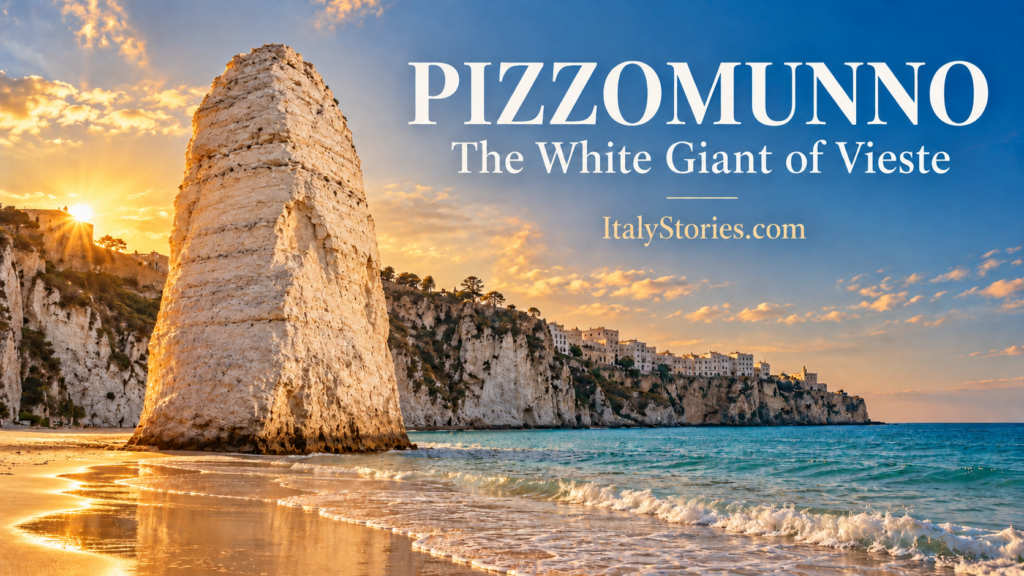
Pizzomunno Vieste is one of those places where nature seems to have deliberately created a monument and then left human imagination to explain it. Rising from the pale sand at the southern edge of the town, the enormous white monolith looks less like an ordinary rock than a silent guardian placed beside the Adriatic Sea. It is approximately 25 metres tall, broad at its base and solitary against the blue water. Geology explains how it came into existence, but the people of Vieste have given it something geology cannot provide: a name, a soul and a love story destined never to end.
The rock stands on Spiaggia del Castello, the long beach that stretches south of Vieste beneath the white cliffs of the Gargano. From a distance, Pizzomunno appears almost smooth, particularly when the morning sun reflects from its limestone surface. Seen close up, however, it reveals horizontal layers, fractures, small cavities and the irregular marks left by wind, salt and water. It is solid and imposing, yet its entire history is one of slow transformation.
For visitors arriving in Vieste, the monolith is more than a natural attraction. It has become the town’s most recognisable symbol, reproduced on postcards, signs, paintings and photographs. The people who live here do not see it simply as a geological formation. They see the petrified figure of a young fisherman condemned to wait for the woman he loved.
The Real Story of Pizzomunno Vieste
Long before the first fishermen gave the rock its present name, the Gargano was being shaped by forces far more powerful than any human settlement. This promontory projecting into the Adriatic is largely formed from limestone deposited in an ancient marine environment. Over immense periods of time, movements of the earth lifted these layers, while rain, waves and salt began to carve the coastline.
The white cliffs around Vieste are one result of that process. Their caves, arches and isolated rocks were created as the sea attacked weaker points in the stone. Water entered fractures, widened them and gradually separated sections of the cliff from the mainland. Pizzomunno is one of the most spectacular survivors of this continuing erosion.
It is generally described as a sea stack, although it now stands on the sandy beach rather than permanently surrounded by water. Its roughly elliptical mass was once connected to the nearby cliff. Marine erosion, acting along natural fractures in the rock, progressively isolated it. Wind, rain and salt spray continue to model its surface today, working at a pace too slow to observe from one summer to the next but relentless when measured across centuries.
This natural explanation does not make Pizzomunno less extraordinary. On the contrary, it reveals that the white giant is not frozen in time. It is the temporary result of an ancient and continuing struggle between stone and sea. One day, however distant, erosion will alter it beyond recognition. Its apparent immortality is only an illusion.
Perhaps this is why the people of Vieste created a legend about a man turned to stone. They saw something that looked eternal while knowing, at some deeper level, that nothing beside the sea truly lasts forever.
Pizzomunno and Cristalda
According to the best-known version of the legend, Pizzomunno was once a handsome young fisherman who lived in Vieste when the town was still a small coastal settlement. He was strong, loyal and accustomed to spending his days at sea. His heart belonged to Cristalda, a beautiful young woman whose love for him was equally profound.
Every day Pizzomunno sailed into the Adriatic to fish. As his boat moved across the water, mysterious creatures watched him from beneath the surface. They were sirens, enchanted by his beauty and determined to possess him. Night after night, they rose from the sea and offered him everything a mortal man might desire. Some versions of the story say they promised wealth; others say power, eternal youth or immortality.
Pizzomunno rejected every offer. He had already chosen Cristalda, and neither riches nor eternal life could persuade him to betray her.
The sirens were not accustomed to rejection. Their desire became jealousy, and their jealousy turned into revenge. They understood that Pizzomunno’s strength came from his love for Cristalda, so they decided to destroy the bond they could not break.
One evening, while the two lovers were together on the shore, the sirens emerged from the water. They seized Cristalda and dragged her into the depths of the Adriatic. Pizzomunno tried to save her, but the sea closed over the young woman and she disappeared.
At dawn, the people of the village found the fisherman on the beach. He was no longer made of flesh and blood. Grief had transformed him into the immense white stone that still rises from the sand.
It is a cruel ending, but legends rarely accept that true love can simply vanish. A final promise was therefore added to the story. Once every hundred years, Cristalda is allowed to return from the sea, while Pizzomunno becomes human again. For a single night, the two lovers can meet, embrace and recover the life stolen from them. At sunrise, she must return beneath the waves and he must once again become stone.
The exact details change depending on who tells the story. In some versions, Cristalda is the fisherman’s fiancée; in others, she is his wife. Occasionally she is given another name, such as Vesta or Vieste, connecting her fate directly to that of the town. The period between their meetings also varies. This is normal in oral tradition: a legend is not a document preserved unchanged in an archive. It is a living narrative reshaped by the voices that pass it from one generation to another.
Its central meaning, however, remains constant. Pizzomunno refuses immortality because a life without Cristalda would be worthless. Ironically, he is then condemned to a form of immortality in which he must spend almost all eternity without her.
Why the Legend Belongs to Vieste
The story reflects the ancient relationship between the people of Vieste and the sea. For coastal communities, the Adriatic provided food and work, but it also carried danger. Fishermen left home knowing that weather could change suddenly and that not every boat was certain to return. Families waited on the shore, reading the wind and watching the horizon.
In this context, the disappearance of Cristalda is more than a supernatural event. It echoes the real experience of communities that repeatedly lost people to the sea. The sirens give a face to an unpredictable force of nature: beautiful from a distance, generous when calm, merciless when angered.
Pizzomunno represents the person left behind. He is grief made visible, fixed forever at the point where land meets water. His white stone body faces the sea that took away the woman he loved, and his silence contains all the words he was unable to say.
Yet the legend is not entirely tragic. The promise of one night together every century transforms endless separation into endless hope. Time becomes almost irrelevant. However long the wait, the lovers have not been completely defeated.
That mixture of sadness and hope helps explain why the story has remained so powerful. It is local in its setting but universal in its emotions. No special knowledge of Vieste is required to understand the pain of losing someone, the refusal to forget or the desire to believe that separation is not final.
The White Giant and the Town Above It
Pizzomunno cannot be separated from Vieste itself. The old town occupies a rocky promontory above the sea, with white houses, narrow streets, stairways and terraces opening unexpectedly toward the Adriatic. The historic centre appears to grow directly from the limestone cliffs on which it was built.
For centuries, Vieste occupied a strategic but vulnerable position. The sea connected it with distant ports and cultures, but it also exposed the town to raids and invasions. Watchtowers, fortified buildings and the castle reflect a history in which the horizon could bring opportunity or danger.
The coastline surrounding the town is one of the most dramatic in Puglia. Tall cliffs alternate with beaches, small bays, natural arches and marine caves. To the north lies the green interior of the Gargano, including the ancient woodland of the Foresta Umbra; offshore, the Adriatic opens toward the Tremiti Islands.
Within this landscape, Pizzomunno acts as a natural entrance to Vieste. Those approaching along the coast see the white monolith before reaching the oldest streets. It seems to stand guard at the foot of the town, simultaneously welcoming visitors and protecting the memory of the people who lived from the sea.
From an Ancient Story to a Modern Song
The legend of Pizzomunno and Cristalda was known in the Gargano long before it reached a national audience, but music gave it a new life. In 2018, Italian singer-songwriter Max Gazzè presented “La leggenda di Cristalda e Pizzomunno” at the Sanremo Music Festival.
The song introduced millions of Italians to the story of the fisherman, the sirens and the young woman taken by the sea. Its orchestral arrangement and poetic language transformed a regional legend into a modern popular tale. For Vieste, it was an extraordinary moment: a story rooted in local oral tradition suddenly became part of a national cultural event.
The success of the song did not replace the older legend. It demonstrated how stories survive by changing form. What had once been passed between fishermen and families could now travel through television, radio and digital platforms, reaching listeners who had never visited the Gargano.
Many of them later came to see the white giant for themselves.
Standing Beneath Pizzomunno
Photographs struggle to communicate the true scale of the monolith. From a distance it may appear elegant and almost slender, but standing at its base gives a different impression. The rock fills the view, its weight and height immediately apparent. Human figures nearby seem extremely small.
Early morning is one of the most evocative moments to see it. The beach is quieter, the light is softer and the limestone takes on warm shades of ivory and gold. Later in the day, the contrast becomes sharper: white rock, blue sky, turquoise water and the long sweep of the beach.
Nothing visibly supernatural happens. There are no sirens among the waves and no sign of Cristalda returning from the sea. Yet the legend changes the way the place is perceived. Once the story is known, the stone no longer appears empty. Its solitude becomes meaningful.
Visitors are not looking only at a geological formation. They are looking at a man waiting.
Where Stone, Sea and Memory Meet
Pizzomunno is a perfect example of the way Italy transforms landscape into narrative. A cliff is never only a cliff, an island is rarely just an island and an ancient stone may become the body of a king, a saint or a heartbroken fisherman. Geography provides the shape; generations of people provide the meaning.
Science and legend do not need to compete here. Geology explains how Pizzomunno was separated from the cliff and shaped by erosion. The legend explains why people have continued to look at it with affection rather than simple curiosity. One describes the origin of the rock; the other describes its place in the emotional life of Vieste.
The white giant continues to stand between the town and the Adriatic, exposed to every storm and illuminated by every sunrise. Somewhere beneath the waves, at least in the imagination of those who still tell the story, Cristalda is waiting too.
Perhaps one night, when an entire century has passed and the beach is empty, the stone will become a man again. Until then, Pizzomunno will remain where he has always been: beside the sea, guarding Vieste and refusing to forget the woman he loved.
Follow ItalyStories.com to discover more remarkable places, ancient legends and forgotten stories from Italy.