

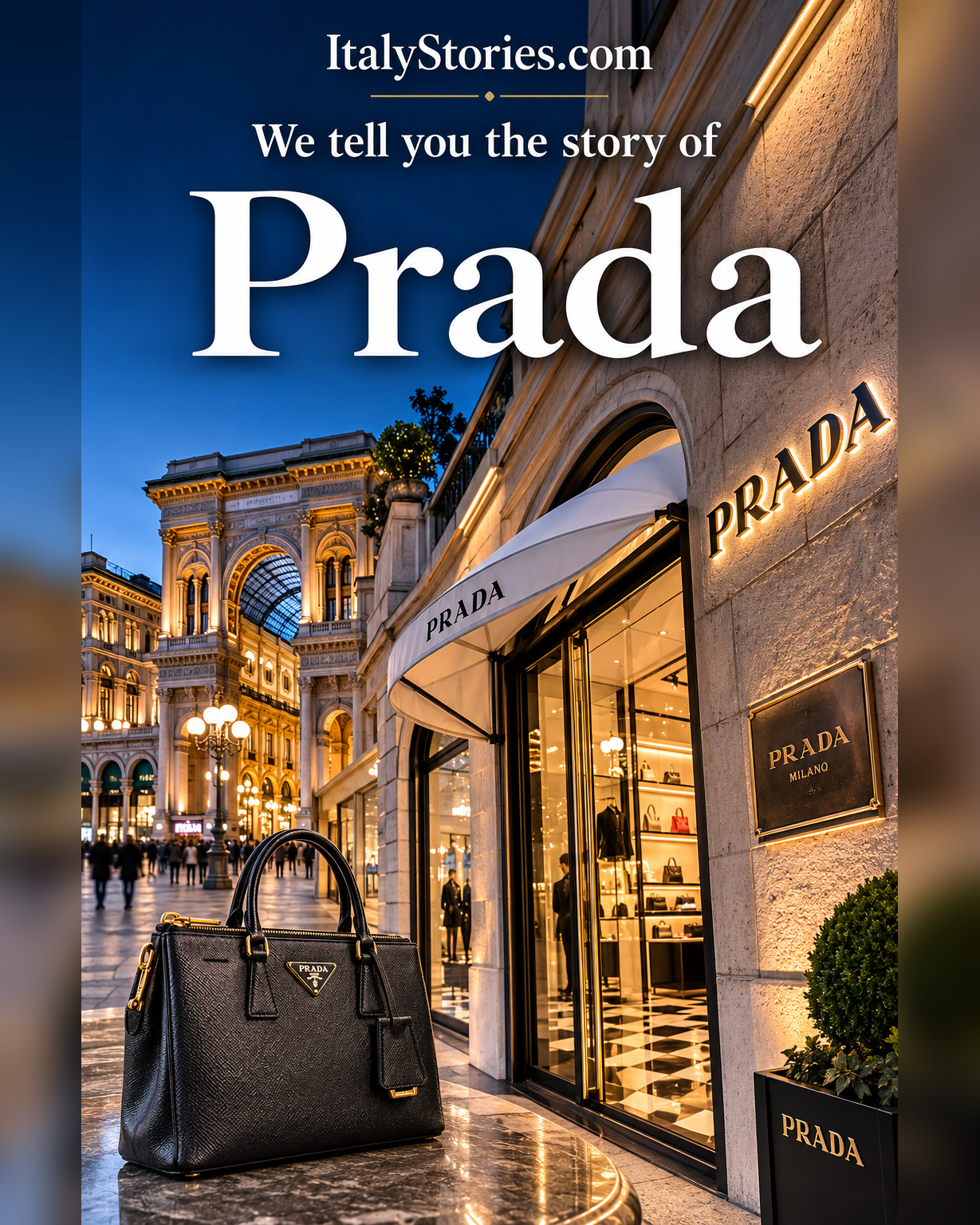
Prada: The House That Made Contradiction Beautiful
From Mario Prada’s travel goods in Milan’s Galleria to Miuccia Prada’s radical nylon and a global house that never stopped questioning luxury.
ITALYSTORIES.COM
In Milan, there are places where commerce has always behaved like theatre. The Galleria Vittorio Emanuele II is one of them: glass above, marble below, cafes and shop windows beneath a monumental arcade built for a city that wanted to look modern. In 1913, Mario Prada opened his first store there. It was not yet a fashion house in the modern sense. It was a cabinet of refined travel, filled with trunks, bags, vanity cases and unusual materials gathered from a wider world. Yet almost everything Prada would later become was already present: curiosity, precision, Milanese discipline and a fascination with the tension between usefulness and luxury.
Mario Prada was a traveler as much as a merchant. He searched for precious leathers, unusual objects and skilled craftspeople, then brought those discoveries back to Milan and gave them a distinct identity. English silver, Austrian bags, Bohemian crystal, Asian silks and fine hides could all enter the world of Fratelli Prada. The shop became known among aristocratic and wealthy European clients because it selected rather than shouted. In 1919, only six years after opening, Prada was appointed Official Supplier to the Italian Royal Household. The House of Savoy coat of arms and its knotted rope entered the trademark, a trace of monarchy that survived long after the monarchy itself disappeared.
For decades, Prada remained a respected family business rather than a global empire. Around it came war, Fascism, reconstruction, the Italian economic miracle, mass tourism and the rise of ready-to-wear. The company survived by protecting its craft and its name. Then, in the 1970s, Mario Prada’s granddaughter Miuccia entered the family business. She was an unlikely heir to a luxury house, which is precisely why the story becomes so interesting. Intellectually restless and suspicious of convention, she was fascinated by the contradictions of bourgeois life. Luxury attracted her and irritated her at the same time. That tension would become the engine of Prada’s modern identity.
The decisive encounter was with Patrizio Bertelli, a Tuscan entrepreneur who had built his own leather-goods production company. Their collaboration began in the mid-1970s and, by 1977, had become the foundation of a new business model. Miuccia brought a creative intelligence that treated fashion as an argument; Bertelli brought a rigorous understanding of manufacturing, distribution and control. Rather than simply licensing the Prada name, the company increasingly sought direct command over how products were made and sold. It was a marriage of imagination and structure, and eventually a personal marriage as well. Prada’s expansion accelerated because design and production were treated as parts of the same idea.
The transformation became visible in 1983, when Prada opened a second Milan store in Via della Spiga. Its pale green interior became so closely associated with the house that the color itself would be known as ‘Prada green.’ Yet the most important object of the decade was not made from rare leather. It was made from nylon. Miuccia Prada became fascinated by Pocono, a tough, lightweight material connected to practical and industrial use. In the 1984-85 season, Prada produced the backpack later known as the Vela. By 1987 its essential form had become a worldwide best seller. The idea was provocative: take a material considered ordinary and insist that, through design and workmanship, it could belong to luxury.
That backpack explained Miuccia Prada better than any manifesto. It was practical but expensive, severe but desirable, anti-glamorous and somehow glamorous because it refused to behave like traditional glamour. Prada had discovered a language of contradiction. In 1988, the first women’s ready-to-wear collection carried that language into clothing. Restrained colors, intellectual silhouettes and deliberately awkward details could look plain until the eye adjusted. Critics later used expressions such as ‘ugly chic,’ but the phrase was too simple. Prada was asking a more difficult question: why do we call one thing beautiful and another ordinary, and who has the authority to decide?
The 1990s turned that question into an international business. In 1993, Prada launched menswear and created Miu Miu, named after Miuccia’s family nickname and conceived as a freer counterpart to the main house. The same year, Miuccia Prada and Patrizio Bertelli established the cultural institution that would evolve into Fondazione Prada. Fashion, art, architecture and contemporary thought were no longer separate interests; they became parts of one ecosystem. Prada did not want merely to sell objects. It wanted to build environments around them. That ambition would become increasingly visible in the decades that followed.
Bertelli’s passion for sailing opened another unexpected chapter. In 1997, Prada created the challenge that led to Luna Rossa and its campaign for the America’s Cup. The same year brought Linea Rossa, a sportswear project identified by a thin red stripe. Again Prada moved between worlds that fashion once kept apart: technical performance and luxury, competition and image, laboratory fabrics and elegant retail. The group also expanded through acquisition, taking control of the English shoemaker Church’s in 1999 and later adding the Italian driving-shoe specialist Car Shoe. Prada was becoming a group, but it continued to behave like a laboratory.
Its stores became part of the experiment. In 2001, Prada opened the first Epicenter in New York, designed by Rem Koolhaas and OMA. Tokyo followed in 2003 with Herzog & de Meuron, and Los Angeles in 2004 with Koolhaas. These were not conventional boutiques. They treated retail as architecture, performance space and cultural statement. At the same time, Prada moved into eyewear and fragrance through licensing partnerships, extending the name without abandoning the logic that had defined the company since Mario Prada: an object mattered because of the world built around it.
Growth brought financial scale and new pressures. In 2011, Prada S.p.A. was listed on the Hong Kong Stock Exchange, becoming the first Italian company to choose that market for its listing. The move showed how far the business had traveled from the mahogany shelves of the Galleria. Asia was no longer a distant source of rare materials, as it had been for Mario Prada, but one of the central stages of global luxury. In 2014, the group acquired Marchesi 1824, the historic Milanese pastry house, a purchase that made sense once Prada’s interest in preserving and reinterpreting forms of Italian excellence was understood.
The relationship with culture became even more visible in 2015, when Fondazione Prada opened its Milan venue in a former distillery transformed by OMA. Prada’s idea of modernity would not be limited to seasonal fashion; it would include art, cinema, architecture and public debate. Meanwhile, the famous nylon was reconsidered for a new era. Re-Nylon introduced regenerated ECONYL yarn made from recycled waste, transforming one of the house’s most recognizable materials without abandoning its identity. The symbolism was perfect: the fabric that had once challenged the definition of luxury was now being challenged again by environmental responsibility.
In 2020, Belgian designer Raf Simons joined Miuccia Prada as co-creative director of the Prada brand, with equal creative responsibility. The partnership was remarkable because fashion houses often prefer the myth of a single author. Prada instead made dialogue part of the creative method. Miuccia’s instinct for contradiction met Simons’s precision, while Patrizio Bertelli and a new generation of management continued to develop the group. The company that had spent decades questioning the old rules of fashion was now questioning the cult of the solitary designer as well.
Prada’s story has also become larger than Prada itself. Miu Miu grew into one of contemporary fashion’s most influential brands, while Church’s, Car Shoe, Marchesi 1824 and Luna Rossa extended the group’s identity into footwear, food, sport and culture. In December 2025, the group completed the acquisition of Versace, bringing another great Milanese name into its orbit. It was a striking reversal of scale: the once-small family shop in the Galleria had become a company capable of absorbing one of the houses that helped turn Milan into a global fashion capital.
And yet the most revealing image is still the first one. More than a century after Mario Prada opened his shop, the Galleria Vittorio Emanuele II remains the symbolic heart of the company. In 2026, Prada announced an expanded Prada Galleria project around its original address, bringing together stores, cultural spaces, hospitality and private-client areas. The circle closes without really closing. Prada has never survived by repeating its past. It survives by returning to the past, examining it, disturbing it and making it contemporary again. That may be the true secret of the house: not knowing exactly what luxury is, but never becoming tired of asking the question.
◆
Continue your journey through the companies, objects and people that shaped Italy by discovering more stories on ItalyStories.com.