

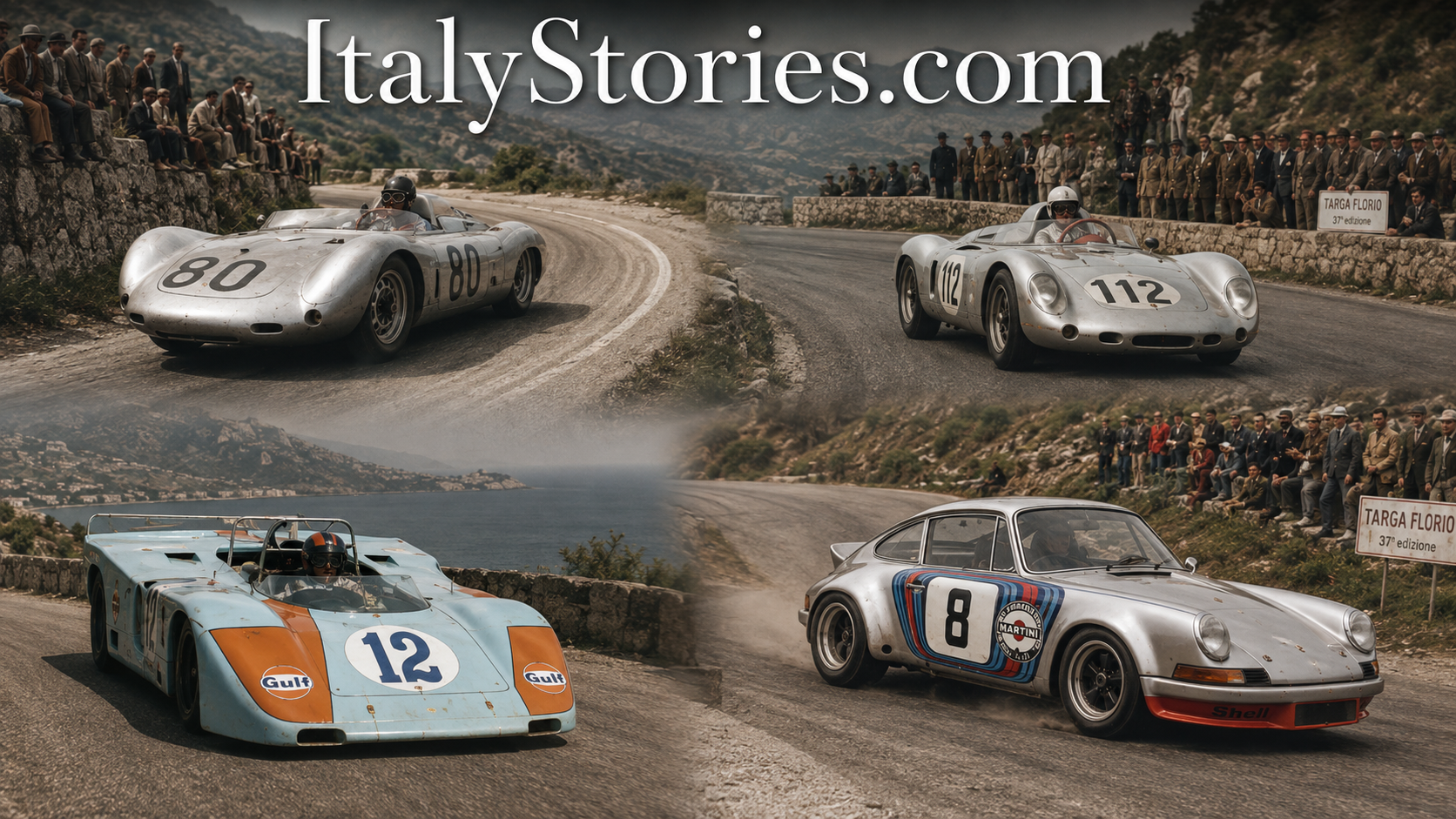
11 Victories, 900 Corners, and a Story That Became Legend
From Umberto Maglioli’s tiny 550 A Spyder to Müller and van Lennep’s brutal 911 Carrera RSR: almost twenty years in which Porsche turned the mountains of Sicily into its most extreme laboratory. A story of men, engines, courage, mistakes, records, and cars created to win where power alone was never enough.
There are circuits where the most powerful car wins.
And then there was the Targa Florio.
Seventy-two kilometers of Sicilian roads, villages crossed at unimaginable speeds, stone walls, precipices, potholes, dust, animals, spectators standing only centimeters away from the cars, and an apparently endless sequence of corners.
Seven hundred? Eight hundred? Nine hundred per lap? Even period sources do not completely agree on the exact number.
But it hardly matters.
After several hundred corners, the driver was no longer counting them.
He simply had to remember them.
The Piccolo Circuito delle Madonie, used for the most famous post-war editions of the race, measured approximately 72 kilometers. It included an elevation difference of around 600 meters and even a very fast stretch of roughly six kilometers running toward the sea.
By 1970, the race had grown to eleven laps, almost 800 kilometers, all driven on roads that, during the rest of the year, were simply ordinary public streets.
It was exactly the kind of place where Porsche could truly be Porsche.
Not always the most powerful.
Almost always the smartest.
Before Porsche Even Existed
The connection between the Porsche name and the Targa Florio actually begins before the Porsche automobile company even existed.
In 1922, Ferdinand Porsche was working for Austro-Daimler.
Together with Count Alexander “Sascha” Kolowrat, he developed a small racing car called the ADS R, soon nicknamed simply Sascha.
It had a four-cylinder engine of just 1,100 cc, approximately 50 horsepower, weighed only 598 kilograms, and could reach around 144 km/h.
On April 2, 1922, four examples entered the Targa Florio.
At that time, the course was even more terrifying than it would later become: four laps of 108 kilometers each, for a total of 432 kilometers, approximately 6,000 corners according to Porsche’s historical records, with gradients of up to 12.5 percent.
The little Austro-Daimler won its class.
Ferdinand Porsche immediately used the result in advertising, presenting his car almost as the “moral winner” of the Targa Florio.
The philosophy was already there.
Low weight, efficiency, agility, and the ability to beat cars with much larger engines.
Almost prophetic.
Why the Targa Florio Seemed Made for Porsche
At Le Mans, aerodynamics and top speed mattered.
At Daytona, a car had to survive twenty-four hours.
At the Nürburgring, it needed a little of everything.
At the Targa Florio, something different was required.
A car had to brake, change direction, accelerate, absorb the rough surface, and then do it all over again.
Thousands of times.
That is why small mid-engined Porsches could regularly challenge Ferraris, Maseratis, Fords, and other competitors equipped with much larger engines.
Porsche itself would later describe cars such as the 550 and 718 as “Giant Killers.”
The Targa also rewarded one characteristic that would become almost an obsession in Zuffenhausen:
lightness.
Less mass meant less inertia through corners.
Less stress on brakes.
Less stress on tires.
Less strain on suspension components.
And the possibility of using comparatively small engines without losing competitiveness.
Most importantly, it meant agility.
Exactly what was required in the Madonie Mountains.
Porsche’s 11 Overall Victories
Porsche still holds the all-time record among manufacturers with 11 overall victories at the Targa Florio, achieved between 1956 and 1973.
| Year | Drivers | Porsche | Distance / Time |
|---|---|---|---|
| 1956 | Umberto Maglioli | 550 A Spyder | 720 km – 7h 54'52" |
| 1959 | Edgar Barth / Wolfgang Seidel | 718 RSK | 1,008 km – 11h 02'21"8 |
| 1960 | Joakim Bonnier / Hans Herrmann | 718 RS 60 | 720 km – 7h 33'08"2 |
| 1963 | Joakim Bonnier / Carlo Maria Abate | 718 GTR | 720 km – 6h 55'45"1 |
| 1964 | Antonio Pucci / Colin Davis | 904 Carrera GTS | 720 km – 7h 10'53"3 |
| 1966 | Willy Mairesse / Herbert Müller | 906 Carrera 6 | 720 km – 7h 16'32"3 |
| 1967 | Paul Hawkins / Rolf Stommelen | 910/8 | 720 km – 6h 37'01" |
| 1968 | Vic Elford / Umberto Maglioli | 907/8 | 720 km – 6h 28'47"9 |
| 1969 | Gerhard Mitter / Udo Schütz | 908/02 | 720 km – 6h 07'45"3 |
| 1970 | Jo Siffert / Brian Redman | 908/03 | 792 km – 6h 35'30" |
| 1973 | Herbert Müller / Gijs van Lennep | 911 Carrera RSR | 792 km – 6h 54'19"9 |
But the table tells only half the story.
Because some of those victories almost sound like movie scripts.
1956: Umberto Maglioli and the Day the Little Car Beat the Giants
On June 10, 1956, Porsche arrived in Sicily with the 550 A Spyder.
It was tiny compared with the large Ferraris and Maseratis.
Its engine was the legendary Type 547 four-cylinder boxer designed by Ernst Fuhrmann: four overhead camshafts, twin ignition, and an extraordinary level of mechanical sophistication for the era.
In the version raced in 1956, it could produce approximately 135 horsepower.
The car weighed in the region of just 550 kilograms.
Behind the wheel was Umberto Maglioli.
The Porsche 550 A had made its racing debut only eleven days earlier at the Nürburgring 1000 Kilometers.
Maglioli drove the entire Targa alone.
Seven hundred and twenty kilometers.
Almost eight hours.
He won in 7 hours, 54 minutes and 52 seconds, leaving the OSCA of Cabianca and Villoresi roughly thirteen minutes behind and Piero Taruffi’s Maserati 300S even farther back.
It is worth clarifying one historical detail that is sometimes confused in modern accounts.
The 1956 Targa Florio did not count toward the World Sportscar Championship, because the CSI had not granted the event World Championship status that year.
That does nothing to diminish the importance of the victory.
It was the young Porsche company’s first major international overall triumph against manufacturers equipped with far more powerful machinery.
That day, the Porsche legend in the Madonie truly began.
1959: Porsche Takes the Entire Podium
Three years later came the second victory.
Edgar Barth and Wolfgang Seidel brought the 718 RSK home first after an extraordinarily long Targa:
14 laps, 1,008 kilometers, and more than eleven hours of racing.
But what happened behind them was perhaps even more impressive.
Second: Porsche 550 RS.
Third: Porsche 356 A Carrera.
An entirely Porsche podium.
The 718 represented the natural evolution of the 550.
Mid-engine layout.
Four-cylinder boxer engine.
Around 148 horsepower in its early specification.
Approximately 530 kilograms.
And, in its more developed forms, a top speed capable of reaching around 260 km/h.
Once again, it was not about having the biggest engine.
It was about having the right car.
1960: Bonnier, Herrmann, and the 718 RS 60
In 1960, Porsche returned to the top with Joakim Bonnier and Hans Herrmann.
The 718 had evolved into the RS 60, and its four-cylinder boxer engine now displaced roughly 1.6 liters and developed around 160 horsepower.
The result was a tiny, extremely light, remarkably effective racing machine.
Bonnier and Herrmann completed the 720 kilometers in 7h33'08"2, beating the Ferrari Dino 246 S of Wolfgang von Trips and Phil Hill.
Another 718 RS 60 finished third.
Porsche was no longer surprising anyone.
It was beginning to dominate.
1963: Eleven Seconds After Almost Seven Hours
The 1963 victory was one of the most incredible.
Porsche entered the 718 GTR Coupé, driven by Joakim Bonnier and Carlo Maria Abate.
The engine had become a 1,981 cc flat-eight, producing approximately 210 horsepower at 8,400 rpm.
It had a six-speed gearbox.
An aluminum body.
And a weight of roughly 670 kilograms.
After ten laps and almost seven hours of racing, Porsche and Ferrari were still virtually together.
Bonnier and Abate won in 6h55'45"1.
The Ferrari Dino 196 SP finished in 6h55'57".
The gap: 11.9 seconds.
Eleven seconds after 720 kilometers through the Madonie Mountains.
It is difficult to find a better demonstration of what the Targa Florio truly meant.
1964: One of the Most Beautiful Porsches Ever Built Is Born
The 904 Carrera GTS was completely different from the Porsches that had come before it.
Designed by Ferdinand Alexander Porsche, it used a steel box-section chassis bonded to a body made from fiberglass-reinforced plastic.
It represented a major turning point.
The winning car used the two-liter Fuhrmann four-cylinder boxer engine, which in the 904 had evolved to approximately 180 horsepower.
At the 1964 Targa Florio, it was driven by Antonio Pucci and Colin Davis.
Pucci was no ordinary driver.
He was Sicilian.
A baron.
He knew those roads.
And he understood the Targa Florio with the instinctive familiarity of someone who had grown up in that landscape.
After 720 kilometers, they won in 7h10'53"3.
Another 904, driven by Gianni Balzarini and Herbert Linge, finished second.
Colin Davis also set the fastest lap of the race in approximately 41'10"4.
The 904 had demonstrated something extremely important.
The Porsche philosophy could work even in a closed car that was beautiful, sophisticated, and relatively close to something that could still be driven on ordinary roads.
1966: Rain, Mud, and the Carrera 6
In 1966 came the 906 Carrera 6.
Its air-cooled 1,991 cc six-cylinder boxer engine produced approximately 210 horsepower.
The body was fiberglass.
The chassis was tubular.
The gearbox had five speeds.
Depending on gearing, top speed could approach 280 km/h.
Porsche quoted a dry weight of roughly 675 kilograms for the 906 in representative specification.
That year, it rained in the Madonie.
Then the sun came out.
Then came hail.
The road alternated between wet, muddy, and treacherously slippery.
Dieter Glemser drove an extraordinary lap in a 906 in the rain, but later hit a wall and damaged the rear suspension.
The car that survived was the 906 entered by Scuderia Filipinetti with Porsche support, driven by Belgian Willy Mairesse and Swiss driver Herbert Müller.
They won in 7h16'32"3.
Another 906, driven by Vincenzo Arena and Antonio Pucci, finished third.
The Targa rewarded speed.
But above all, it rewarded those who reached the finish.
1967: Porsche Brings an Army
By 1967, Ferdinand Piëch and the Porsche racing department wanted to leave nothing to chance.
Porsche brought what was effectively an army of 910s to Sicily.
The most extreme version was the 910/8, powered by the Type 771 flat-eight engine.
Displacement: 2,195 cc.
Power: approximately 270 horsepower.
Fuel injection.
Dry weight: around 600 kilograms.
The winners were Paul Hawkins and Rolf Stommelen.
But immediately behind them came two more Porsche 910s.
Second: Leo Cella and Giampiero Biscaldi.
Third: Vic Elford and Jochen Neerpasch.
A Porsche 1-2-3.
And the gap between first and second was just 47 seconds after more than six and a half hours of racing.
Porsche was no longer simply winning the Targa Florio.
It had learned how to occupy it.
1968: Vic Elford, a Lost Wheel, and One of the Wildest Comebacks in Racing History
If one Targa Florio deserved to become a movie, it would probably be the 1968 edition.
Vic Elford started in the Porsche 907 KH, the short-tail version better suited to the Madonie, sharing the car with Umberto Maglioli.
The 907 used a roughly 2,196 cc flat-eight, producing approximately 270 horsepower, with Bosch mechanical fuel injection and highly sophisticated prototype construction.
Then the impossible happened.
Early in the race, a wheel came loose.
Elford stopped.
Sicilian spectators climbed down from the wall where they had been watching the race and literally lifted the Porsche so that he could work on the car.
He restarted.
Soon afterwards, he had another wheel problem and suffered a puncture.
He returned to the pits with an enormous deficit: around eighteen minutes.
At that point, victory seemed absurd.
Elford effectively decided to drive every lap like a rally special stage.
He recovered time.
Then more time.
Maglioli completed his stint.
Elford returned to the wheel.
And continued attacking.
In the end, Porsche number 224 crossed the finish line first in 6h28'47"9.
Ahead of the Alfa Romeo 33/2 of Giunti and Galli.
Elford also set the fastest lap: 36 minutes, 2.3 seconds.
Average speed: almost 120 km/h.
It is still remembered as one of the greatest comebacks in road-racing history.
1969: Four Porsches in the First Four Positions
With the 908/02, Porsche moved to another level.
The flat-eight had grown to three liters.
2,997 cc.
Approximately 350 horsepower.
Bosch fuel injection.
And only around 600 kilograms.
The power-to-weight ratio was extraordinary for 1969.
The final result of the Targa was almost embarrassing for Porsche’s rivals.
First: Gerhard Mitter / Udo Schütz.
Second: Vic Elford / Umberto Maglioli.
Third: Rolf Stommelen / Hans Herrmann.
Fourth: Willi Kauhsen / Karl von Wendt.
Four Porsche 908/02s in the first four positions.
Mitter and Schütz completed the 720 kilometers in 6h07'45"3.
Average speed: approximately 117.5 km/h.
It was Porsche’s ninth victory.
But the ultimate Targa Florio machine had not yet arrived.
1970: The Porsche Almost Built Specifically for the Madonie
The 908/03 may be the purest expression of Porsche’s philosophy at the Targa Florio.
It was not designed to be universal.
Porsche developed it specifically for two circuits: the Targa Florio and the Nürburgring Nordschleife.
It was short.
Very wide.
Extremely low.
The driver was positioned farther forward to improve weight distribution.
The engine was a 2,997 cc flat-eight.
Power: 370 horsepower at 8,400 rpm.
Torque: 318.5 Nm.
Bosch fuel injection.
Aluminum tubular chassis.
Weight: only 545 kilograms.
Top speed: approximately 275 km/h.
That gave the 908/03 almost 680 horsepower per metric ton.
In 1970, the Gulf cars of John Wyer Automotive Engineering were also facing the gigantic Ferrari 512 S, equipped with a five-liter V12 producing roughly 550 horsepower.
But on the Targa Florio, horsepower alone was not enough.
Jo Siffert and Brian Redman won.
Pedro Rodríguez and Leo Kinnunen finished second in another 908/03.
The Ferrari of Vaccarella and Giunti finished third.
Then something historic happened.
On the final lap, Leo Kinnunen covered the 72 kilometers in 33 minutes and 36 seconds.
Average speed: 128.571 km/h.
On an ordinary mountain road.
That lap remains the race lap record for the Piccolo Circuito delle Madonie.
It should not be confused with the other two major Targa Florio records.
The fastest practice lap was set in 1973 by Arturo Merzario in a Ferrari 312 PB: 33'38"5.
The highest average speed over the entire race distance came in 1972, when the Ferrari of Merzario and Sandro Munari averaged 122.537 km/h.
But Kinnunen’s race lap record remains Porsche’s.
And it remains astonishing.
1973: A 911 Closes the Circle
Between Porsche’s 1970 victory and 1973, the domination stopped.
Alfa Romeo won in 1971.
Ferrari won in 1972.
Meanwhile, motorsport itself was changing.
Speeds had become enormous.
Prototypes were becoming increasingly sophisticated.
And the safety standards of the Targa Florio were beginning to look dangerously outdated.
In 1973, Porsche returned with something symbolically different.
Not a pure prototype.
A 911 Carrera RSR.
The car originated from the Carrera RS 2.7 and was radically developed for competition.
Wider bodywork.
Extreme weight reduction.
Roll cage.
Racing fuel tank.
Flat-six engine.
The RSRs of that period evolved from 2.8 to 3.0 liters.
Historical sources are not completely consistent regarding the exact specification of the winning number 8 car: some archives describe it as an RSR 2.8, others as a 3.0-liter evolution.
Porsche documents the three-liter RSR developments at approximately 2,992 cc, around 310 horsepower, and a top speed of roughly 270 km/h.
The early RSRs weighed in the region of 900 kilograms.
The Martini Racing crew consisted of Herbert Müller and Gijs van Lennep.
In qualifying, they were only fifth.
Ahead of them were Ferrari 312 PBs and Alfa Romeo 33s, pure prototypes that were significantly faster over a single lap.
The Ferrari of Arturo Merzario and Nino Vaccarella lapped in 33'38"5.
The Porsche needed 36'52"1.
But the Targa Florio was not won over one lap.
It was won by finishing.
The Ferraris and Alfa Romeos encountered problems.
The 911 kept going.
After eleven laps, Müller and van Lennep crossed the finish line in 6h54'19"9.
Ahead of the Lancia Stratos of Sandro Munari and Jean-Claude Andruet.
Another Porsche Carrera RSR, driven by Leo Kinnunen and Claude Haldi, finished third.
It was Porsche’s eleventh victory.
And it was also the final Targa Florio to count toward the World Championship for Makes.
There could hardly have been a more perfect ending.
Porsche had conquered Sicily with a tiny Spyder in 1956.
It said goodbye with a 911 in 1973.
The Men Behind the Cars
The eleven victories did not belong only to Porsche automobiles.
They also belonged to a generation of drivers who today seem to have come from another world.
Umberto Maglioli won for Porsche in 1956 and again in 1968.
Across his career, he won the Targa Florio three times.
Joakim Bonnier scored two Porsche victories: 1960 and 1963.
Herbert Müller won in 1966 and returned to win seven years later, in 1973.
Then came Hans Herrmann, Edgar Barth, Wolfgang Seidel, Carlo Maria Abate, Colin Davis, Antonio Pucci, Willy Mairesse, Paul Hawkins, Rolf Stommelen, Vic Elford, Gerhard Mitter, Udo Schütz, Jo Siffert, Brian Redman, and Gijs van Lennep.
But behind the drivers were also the men who built and organized everything.
Ernst Fuhrmann, creator of the four-cam four-cylinder boxer engine.
Huschke von Hanstein, who for years led Porsche’s sporting activities and helped transform a small manufacturer into a motorsport powerhouse.
Ferdinand Piëch, who during the 1960s pushed Porsche engineering toward ever more ambitious, experimental, and aggressive solutions.
Peter Falk, one of the key figures behind Porsche’s competition development.
And then there were the mechanics.
Technicians.
Timekeepers.
Pit crews.
The people who had to make these extremely sophisticated machines work thousands of kilometers away from Stuttgart, during a race that could never be completely controlled.
And then there were the Sicilians.
The people who knew every corner.
The people who made special racing shoes for drivers, such as Francesco “Ciccio” Liberto in Cefalù.
The spectators who lifted Vic Elford’s Porsche when he lost a wheel in 1968.
The people standing on balconies.
On walls.
Sometimes virtually on the road itself.
All while prototypes capable of more than 250 km/h passed directly in front of their homes.
Decades later, Gijs van Lennep still remembered the crowds beside the road and the roughly 900 corners per lap they had to face for almost seven hours.
Without those people, the Targa Florio would never have been the Targa Florio.
From 135 to 370 Horsepower: Porsche’s Evolution in Less Than Fifteen Years
Looking at the Porsche winners is almost like watching the evolution of the racing car happen in real time.
The 550 A of 1956 had approximately 135 horsepower.
The 718 evolved through four-cylinder engines producing around 150–160 horsepower.
The 718 GTR introduced the flat-eight.
The 904 introduced composite bodywork.
The 906 brought the six-cylinder boxer and far more sophisticated aerodynamics.
The 910/8 reached 270 horsepower.
The 907 further developed the 2.2-liter flat-eight.
The 908/02 reached approximately 350 horsepower.
The 908/03 put 370 horsepower into a 545-kilogram car.
And finally, the 911 Carrera RSR demonstrated that a car derived from a road-going production model could still defeat prototypes designed exclusively for racing.
The guiding principle remained remarkably consistent:
Do not add power if you can remove weight.
The Targa Florio Even Became the Name of a Porsche
The relationship between Porsche and this race runs so deep that in 1965, when the company needed a name for a new open version of the 911 with a fixed roll bar, someone thought immediately of Sicily.
For a time, Porsche even considered the name: “911 Flori.”
Then Harald Wagner, Porsche’s head of sales, reportedly suggested something much simpler:
Targa.
The 911 Targa was presented at the Frankfurt Motor Show in September 1965.
The Italian word targa can also mean a plate or plaque.
But the model name was chosen as a tribute to the Targa Florio and Porsche’s victories in Sicily.
From that moment, Targa would no longer be only the name of a race.
It became an automotive body style recognized throughout the world.
Porsche’s Real Record Is Not Just Eleven
It is easy to stop at the number.
11 overall victories.
More than any other manufacturer.
But Porsche’s real record at the Targa Florio may be something else entirely.
For almost twenty years, the German company used one of the most difficult races ever conceived as an enormous development laboratory.
Boxer engines.
Tubular chassis.
Fiberglass.
Fuel injection.
Brakes.
Weight distribution.
Aerodynamics.
Tires.
Ultra-light materials.
Solutions developed in those mountains would influence what Porsche eventually became.
The Targa Florio proved something that remains part of the company’s identity even today:
a sports car is not merely a powerful engine.
It is balance.
The ability to brake one meter later.
To enter a corner with less inertia.
To exit with better traction.
To survive.
And above all, to keep working when everyone else stops.
Porsche and Sicily: Much More Than a Race
Today, when you drive through the Madonie Mountains, you no longer hear the sound of a 908/03 approaching from far away.
The grandstands at Floriopoli no longer watch Jo Siffert preparing to start.
Nobody drives through Cerda at prototype racing speeds.
And perhaps that is for the best.
But something remains.
The walls remain.
The houses remain.
The mountains remain.
The villages remain.
The stories remain.
And there are names that still carry a special sound for Porsche enthusiasts:
Maglioli.
Herrmann.
Bonnier.
Pucci.
Müller.
Stommelen.
Elford.
Mitter.
Siffert.
Redman.
Van Lennep.
Because before Porsche became a company capable of building some of the most famous sports cars in the world, it had to prove that it knew how to win.
And one of the places where it proved that was on a dusty road through the mountains of Sicily.
A road with hundreds and hundreds of corners.
A race where a small engine could defeat a huge one.
A race so important that Porsche eventually put its name on its own cars.
That race was the Targa Florio.
And if there is one place outside Germany that can be considered part of Porsche’s deepest history, that place is surely here.
In Sicily.
A Very Special Thank You
A special and heartfelt thank you goes to all Porsche and Targa Florio enthusiasts who continue to preserve this extraordinary story, to those who protect photographs, documents, cars, memories, archives, and family stories, to the clubs, historians, collectors, museums, mechanics, researchers, and motorsport enthusiasts who prevent this chapter of automobile history from disappearing.
And above all, our thanks go to the generations of Sicilians who watched those cars race past their homes and transformed an automobile competition into something much greater than a race.
And finally, thank you to every one of you who has reached the end of this long journey with us.
Automotive history survives only when someone continues to tell it.
But above all, it survives because somewhere, on the other side, there is still someone willing to listen.
If you own a Porsche, if you have driven the roads of the Targa Florio, if you have old photographs, family memories, stories passed down from parents or grandparents, or simply one Porsche model that has always remained in your heart, tell us about it.
Because perhaps this story is not over.
Perhaps it has simply completed another lap of the Madonie.
[…] There are motor races, and then there was the Targa Florio. […]